
In This Article
EcoFlow vs Jackery for home backup is a head-to-head between the two best-known portable power station brands for keeping a UK home running through a power cut. Both build quiet, fume-free LiFePO4 battery units that run fridges, routers and lamps indoors. They differ mainly on expansion, recharge speed, home-wiring integration and portability.

Here’s the thing about British power cuts: they’re rare, until they aren’t. Official government guidance describes a resilient UK electricity system where most outages are short and local, but it also admits that wider, longer ones can happen. When Storm Goretti hit in 2026, thousands of homes lost supply. A fridge-freezer full of food, a router, a phone charger and two lamps don’t need much power. They need it right now.
That’s where a power station for winter blackouts earns its keep. It sits in a corner doing nothing for months, then quietly saves your weekend. This guide compares seven real models from both brands, including a 2000W power station for home backup and several with expandable battery packs. It also flags the ones I’d steer certain households away from.
A note on method: this is analysis built from manufacturer specifications, UK retail listings and published reviews. I haven’t personally used any of these units, and I’ll say so wherever the evidence is thin.
Quick Comparison: EcoFlow vs Jackery for Home Backup at a Glance
Rather than ranking seven products in a vacuum, I’ve paired each EcoFlow model with its closest Jackery rival. That’s how most people actually shop. Specs are drawn from manufacturer and UK retailer listings, so always confirm the current spec sheet before buying.
| Priority | EcoFlow pick | Jackery pick | Best For |
|---|---|---|---|
| Entry level (about 1kWh) | EcoFlow DELTA 3 Plus (1024Wh, 1800W) | Jackery Explorer 1000 v2 (1070Wh, 1500W) | Flats, short evening cuts |
| 2000W-class | EcoFlow DELTA 3 Max Plus (2048Wh, 3000W) | Jackery Explorer 2000 v2 (2042Wh, 2200W) | Family essentials, one-room backup |
| Expandable 2kWh | EcoFlow DELTA 3 Max Plus (up to 10kWh) | Jackery Explorer 2000 Plus (up to 12kWh) | Rural homes, multi-day cuts |
| Large capacity | EcoFlow DELTA Pro 3 (4096Wh, 4000W) | Jackery Explorer 3000 v2 (3072Wh, 3600W) | Whole-circuit backup vs plug-in simplicity |
Looking at the pairings, Jackery Explorer 1000 v2 and EcoFlow DELTA 3 Plus are close on capacity, but only the EcoFlow grows. For a 2000W power station for home backup, Jackery Explorer 2000 v2 is the compact, no-fuss choice, while EcoFlow DELTA 3 Max Plus gives more output and an upgrade path. The big units split along philosophy: EcoFlow DELTA Pro 3 is a system, and Jackery Explorer 3000 v2 is an appliance.
💬 Just one click — help others make better buying decisions too!😊
Top 7 Power Stations for Home Backup: Expert Analysis
I’ve ordered these from entry level to premium. Each entry interprets the specs rather than repeating them, and review sentiment is summarised from published sources only. Where I couldn’t verify a robust pool of UK owner reviews, I say so.
1. Jackery Explorer 1000 v2 — lightest route to blackout peace of mind
At around 11kg, this is the one most people can lift without a grumble, and that portability is the headline.
The 1070Wh LiFePO4 battery and 1500W inverter (3000W surge) will happily run a fridge-freezer, router, lamps and a laptop together. They won’t run a 3kW kettle or a fan heater. Jackery quotes around 4,000 cycles to 70% capacity, which for occasional blackout duty means decades rather than years. An app-activated emergency mode refills it in roughly an hour.
Based on the spec comparison, this is a sensible first power station for flats and small houses, where outages usually mean hours rather than days. The catch is that it isn’t expandable, and it’s a plug-in unit rather than a whole-home system. Reviewers on the evening-and-weekend end of the market tend to value exactly that simplicity.
TechRadar’s review gave it 4.5 stars and a Highly Recommended badge, praising its robustness and value for a 1kWh unit. I couldn’t verify a large, current pool of UK owner reviews, so check recent verified-purchase feedback on the listing.
Pros:
- ✅ Light enough for one person to carry
- ✅ Fast app-triggered emergency recharge
- ✅ Strong independent review pedigree
Cons:
- ❌ No expansion route for later growth
- ❌ 1500W ceiling rules out kettles and heaters
Indicative range at the time of research: roughly £400-£600 depending on promotions (check current price). Value verdict: excellent for short outages, limited for anything longer.
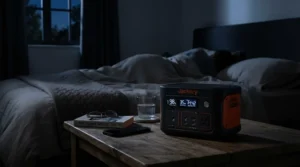
2. EcoFlow DELTA 3 Plus — 1kWh that can grow to 5kWh
This is EcoFlow’s “start small, expand later” proposition, and it’s smarter than it sounds.
Four 1800W AC outlets (3,600W surge) mean a microwave-plus-fridge combination isn’t a problem, and X-Boost lifts resistive heavy loads to around 2,400W. UK listings quote a sub-10ms UPS switchover, which keeps routers and NAS drives alive through the cut. They also quote a full mains recharge in about an hour and fan noise under 30dB at modest loads, quiet enough for a bedroom.
On paper, this is the most flexible small unit here, because expandable battery packs from EcoFlow’s DELTA range plug straight into it, up to 5kWh in total. Households that want a “grow with the budget” path will like it. If you know you’ll never expand, you’re paying for headroom you won’t use. EcoFlow’s app also supports scheduled charging, which could pair with a UK time-of-use tariff, though savings depend entirely on your tariff.
A UK newspaper reviewer of the DELTA 3 Max Plus mentions long-term use of this model on a canal boat and calls it a workhorse, while noting that extra batteries aren’t cheap. I couldn’t verify rating counts for this specific model.
Pros:
- ✅ Expands from 1kWh to 5kWh
- ✅ Very fast UPS switchover
- ✅ Five-year warranty on UK listings
Cons:
- ❌ Extra batteries add serious cost
- ❌ Capacity alone won’t cover multi-day cuts
Indicative range: roughly £600-£1,000 depending on retailer and promotions (check current price). Value verdict: best small unit for people who suspect they’ll want more later.
3. Jackery Explorer 2000 v2 — compact 2kWh with 2200W output
If I were shortlisting a 2000W power station for home backup for a flat or terrace, this would be first on the list. It packs 2042Wh and 2200W into a 17.9kg box.
The 2200W continuous output (4400W peak) comfortably runs a fridge-freezer, TV and lighting together, though not a 3kW kettle. Add a UPS switchover of 20ms or less and a quoted two-hour wall recharge, and you get a solid outage tool. Jackery says it works down to -20°C when paired with its Extreme Guard bag (sold separately), which matters for an unheated garage or outbuilding.
What most buyers overlook is that this model isn’t expandable. What you buy is what you get, and my arithmetic (see the runtime table later) suggests around 11 hours of essentials. For one-night cuts that’s plenty. For storm-season rural living, it’s a ceiling you’ll feel.
Comparison roundups commonly credit Jackery with portability and simplicity, while some argue EcoFlow offers more watt-hours per pound. I couldn’t verify UK owner review counts for this model.
Pros:
- ✅ Compact for 2kWh class
- ✅ Quoted two-hour mains recharge
- ✅ Cold-weather bag option
Cons:
- ❌ Not expandable
- ❌ 2200W won’t run kettles or heaters
Indicative range: roughly £800-£1,400 depending on promotions (check current price). Value verdict: strong for simplicity, weaker on future-proofing.
4. EcoFlow DELTA 3 Max Plus — 3000W output, expandable to 10kWh
This is the most interesting mid-range model here: 2048Wh, 3000W continuous and room to grow.
The 3000W rating (up to 3,900W with X-Boost on UK listings) spread across four 13A ports means a short kettle burst is possible alongside the fridge. Generator charging up to 2,400W and 1,000W alternator input mean a petrol generator or your car can top it up. That extends runtime in a multi-day outage, which is where plain batteries struggle.
Add extra batteries and it starts to behave like a mini home battery. That’s the real analysis point: the base unit is superb value as a standalone, but each expansion pack carries a hefty premium. Plan your total capacity before you buy so you’re not drip-feeding £600 purchases.
A UK newspaper reviewer judged it a meaningful upgrade over its predecessor, with excellent output for its size and very quick recharging, but flagged the cost of add-on batteries. That’s one reviewer’s verdict, not an aggregate rating.
Pros:
- ✅ 3000W covers heavy household loads
- ✅ Takes generator and alternator charging
- ✅ Expandable battery packs reach 10kWh
Cons:
- ❌ Add-on batteries are expensive
- ❌ Heavier than 1kWh-class units
Indicative range: roughly £1,200-£1,500 for the base unit (check current price). Value verdict: the best all-rounder here for most UK homes.
5. Jackery Explorer 2000 Plus — 3000W with 12kWh headroom
Jackery’s answer to EcoFlow’s expansion strategy, this is the only Jackery here with a proper growth path.
The base unit delivers 2042Wh and 3000W (6000W surge) across three 13A ports on the UK version. Up to five expansion packs take capacity to 12kWh. Jackery also describes pairing two units in parallel for 24kWh and 6000W at 240V, using a connector sold separately. It supports pass-through charging and EPS-style backup operation, and quotes over 4,000 cycles to at least 70% capacity.
On a three-day storm outage, 12kWh at a modest essentials load is the difference between “managing” and “camping indoors”. Note that retailer guidance says packs recharge through the main unit when using mains, so plan your charging time accordingly. The UK warranty is generally quoted as three years plus two on registration.
I could verify spec sheets and retailer content, but not a robust set of independent UK reviews, so weigh it on specifications and check recent owner feedback.
Pros:
- ✅ Expandable battery packs up to 12kWh
- ✅ 3000W output on 13A UK ports
- ✅ Parallel option for 6000W
Cons:
- ❌ Packs and connector cost extra
- ❌ Shorter headline warranty than EcoFlow
Indicative range: roughly £1,200-£2,000 for the base unit (check current price). Value verdict: the best Jackery for long outages.
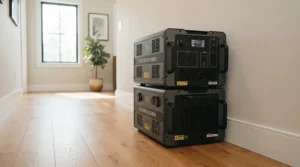
6. Jackery Explorer 3000 v2 — 3kWh in a 27kg box
Jackery’s first 3kWh UK unit trades expandability for sheer in-the-box capacity.
With 3072Wh and 3600W (7200W surge), it can run a fridge-freezer, lighting, broadband and a TV for roughly 17 hours by my estimate. A UPS switchover of 20ms or less covers routers and desktop PCs. Jackery quotes about two hours for a mains recharge, though check the UK spec. Remember that individual UK sockets cap at 13A, so find out how this unit splits its 3600W across outlets before planning a heavy appliance.
TechRadar’s reviewer suggested the combination of high output and large capacity suits emergency use or off-peak charging. I couldn’t verify an official expansion route, so treat it as a fixed-capacity unit. It’s a sensible stationary backup for anyone who doesn’t want to think about modules.
Pros:
- ✅ Large capacity without extra modules
- ✅ 3600W output headroom
- ✅ Quick quoted recharge for its size
Cons:
- ❌ At 27kg, awkward to carry upstairs
- ❌ No verified expansion path
Indicative range: roughly £1,000-£1,800 depending on promotions (check current price). Value verdict: good for simplicity, costly if you later need more capacity.
7. EcoFlow DELTA Pro 3 — home-circuit ready, scalable to 48kWh
This is the premium pick, and it’s closer to a home battery with wheels than a camping gadget.
The 4096Wh base capacity, 4000W continuous output (8000W surge, X-Boost to 6000W) and up to 12kWh per unit via two extra batteries make it the ceiling of this guide. The wider system can be scaled much further, up to 48kWh. Listings quote 80% recharge in about an hour, noise of 30dB under 2kW load, an IP65-rated battery pack and 4,000+ cycles to 80%. EcoFlow lists compatibility with its Smart Home Panel for circuit-level integration, which must be installed by a qualified electrician.
Honest analysis: this is overkill for a flat and brilliant for a rural home with a well pump, freezer chest and frequent storm cuts. Listings show a packaged weight of about 56kg, so plan for wheels, stairs and storage. Roundups repeatedly name it the top pick for whole-home capability, though that’s a recurring theme rather than a UK rating.
Pros:
- ✅ 4000W output covers heavy loads
- ✅ Expansion up to 12kWh per unit
- ✅ Rugged IP65 battery pack
Cons:
- ❌ Premium price, heavy to move
- ❌ Overkill for small flats
Indicative range: low-to-high £2,000s depending on retailer (check current price). Value verdict: worth it if you’ll use the expansion; wasteful if not.
| Product | Capacity | Continuous AC | Expansion | Indicative price range | Best For |
|---|---|---|---|---|---|
| Jackery Explorer 1000 v2 | 1070Wh | 1500W | No | £400-£600 | Flats, short cuts |
| EcoFlow DELTA 3 Plus | 1024Wh | 1800W | Up to 5kWh | £600-£1,000 | Starter with a growth path |
| Jackery Explorer 2000 v2 | 2042Wh | 2200W | No | £800-£1,400 | Simple 2000W-class backup |
| EcoFlow DELTA 3 Max Plus | 2048Wh | 3000W | Up to 10kWh | £1,200-£1,500 | Best all-rounder |
| Jackery Explorer 2000 Plus | 2042Wh | 3000W | Up to 12kWh | £1,200-£2,000 | Long outages, rural homes |
| Jackery Explorer 3000 v2 | 3072Wh | 3600W | Not verified | £1,000-£1,800 | Fixed-capacity stationary backup |
| EcoFlow DELTA Pro 3 | 4096Wh | 4000W | Up to 12kWh/unit | £2,000-£2,800+ | Whole-circuit systems |
Price ranges are indicative from UK listings at the time of research and move often. The table makes the structure obvious: EcoFlow DELTA 3 Plus, EcoFlow DELTA 3 Max Plus, EcoFlow DELTA Pro 3 and Jackery Explorer 2000 Plus are the four with documented expandable battery packs. If your outage risk is “an evening”, the two sub-£1,000-ish picks win on value. If it’s “a stormy weekend”, only the expandable options keep pace.
Setting Up a Power Station Before the Winter Blackout Arrives
The best power station for winter blackouts is the one that’s charged, tested and in the right room before the storm warning. A 30-minute weekend job beats a panicked evening, so work through this checklist.
- Charge fully and register the warranty. Jackery’s extended warranty typically activates on registration, so do it on day one.
- Write your essentials list in watts. Fridge-freezer, router, lamps, phone chargers. Skip heaters.
- Choose the spot. Keep it indoors, off the floor in a dry, ventilated place, within cable reach of the fridge.
- Connect the app. Both brands offer Wi-Fi and Bluetooth monitoring. Set up emergency charging or battery-saving modes now, not during the cut.
- Test with a real load. Plug in the fridge-freezer for an hour and watch the percentage drop.
- Set a monthly reminder. Check charge and keep the unit away from freezing garages where possible.
The most common first-30-days mistake is leaving it in an unheated outbuilding. Check the maker’s stated charging temperature range before you do. LiFePO4 cells generally dislike charging below freezing, so winter placement matters more than most owners expect.

Real-World Scenarios: Three UK Households, Three Setups
Numbers only help when you map them to a life. Here are three profiles with a budget, an environment and a frequency of use.
The city flat. A couple in a leasehold flat, a few short cuts a year, working from home on laptops. They need broadband, lights and a fridge for four to six hours. Either Jackery Explorer 1000 v2 or EcoFlow DELTA 3 Plus fits. I’d choose the EcoFlow if they might eventually add capacity, and the Jackery if lightness matters more.
The rural storm-belt bungalow. Frequent winter outages, a chest freezer and a well pump. They need days, not hours. EcoFlow DELTA 3 Max Plus with extra batteries, or Jackery Explorer 2000 Plus with expansion packs, is the logical route. Adding a smart generator for auto-recharging deserves a look too.
The medically reliant household. Someone uses a CPAP or similar low-power equipment and is on the Priority Services Register. A Jackery Explorer 2000 v2 or EcoFlow DELTA Pro 3 can run low-wattage equipment for a long time. But I’d never treat any consumer power station as the sole safeguard for life-critical equipment. Speak to your equipment provider and network operator.
How to Choose EcoFlow vs Jackery for Home Backup
Choosing between these brands is less about loyalty than arithmetic. Work through these steps in order.
- Count your essentials in watts. A fridge-freezer cycles on and off, so average draw is far below its label. Add router, lamps and chargers.
- Convert watts into hours. Multiply rated capacity by about 0.85 for realistic usable energy, then divide by your load.
- Check the 13A socket limit. A UK socket tops out near 3kW, so a 3000W-class output is the practical ceiling per outlet.
- Decide whether you’ll expand. If yes, choose among EcoFlow DELTA 3 Plus, EcoFlow DELTA 3 Max Plus, EcoFlow DELTA Pro 3 or Jackery Explorer 2000 Plus.
- Read the cycle claims carefully. These units use lithium iron phosphate cells, known for longevity and thermal stability. But EcoFlow quotes cycles to 80% capacity while Jackery quotes cycles to 70%, so the numbers aren’t directly comparable.
- Look at recharge routes. Fast mains charging, car, solar and generator inputs all shorten recovery time. In UK winter, don’t rely on solar.
- Check warranty and certification. UK listings quote five years for EcoFlow; Jackery typically offers three plus two on registration. Look for CE or UKCA marking on the listing.
EcoFlow vs Jackery for Home Backup: Where Each Brand Wins
After comparing the listings, the pattern is clear.
Recharge speed and charging flexibility
EcoFlow’s DELTA line leans hard on fast charging and multiple inputs, including generator and alternator options. Jackery counters with quick emergency modes and strong solar-panel ecosystems. Neither is slow, so the gap matters mainly if you face repeated cuts.
Expansion and home integration
This is EcoFlow’s clearest lead. Comparison roundups report deeper home-panel integration and a broader ecosystem, including smart generators. Jackery’s Jackery Explorer 2000 Plus is the exception, with a real expansion route, but Jackery Explorer 2000 v2 and Jackery Explorer 1000 v2 are essentially closed systems.
Portability and simplicity
Jackery wins when you want to carry it, plug it in and forget it. Jackery Explorer 1000 v2 is the clearest example.
Warranty and cycle claims
EcoFlow’s five-year UK warranty looks more generous on paper. Jackery’s three-plus-two structure only matches it if you register. Both brands now quote roughly 4,000 cycles, so older advice about Jackery’s shorter cycle life applies to previous generations, not these models.
2000W Power Station for Home Backup: What the Number Really Means
A 2000W power station for home backup is the sweet spot for most British households, but only if you understand what “2000W” does and doesn’t cover.
Your fridge-freezer, TV, router and lighting together typically draw well under 500W. A 2000W power station for home backup handles all of that with room to spare, plus a laptop and a small microwave. What it won’t run is a standard 3kW kettle, an electric shower or a fan heater, because those exceed the rating.
Two models land squarely in this class. Jackery Explorer 2000 v2 offers 2200W in a compact, non-expandable box. EcoFlow DELTA 3 Plus offers 1800W (2400W with X-Boost) and grows to 5kWh. If you want a 2000W power station for home backup that also expands, EcoFlow DELTA 3 Max Plus and Jackery Explorer 2000 Plus step up to 3000W, which covers a kettle burst. Check the UK-specific output rating on any listing, because 13A sockets cap what a single port can carry.
Power Station for Winter Blackouts: Runtime, Cold and Honest Expectations
Britain’s national supply picture is reassuring. The National Energy System Operator’s early view of winter 2026/27 forecasts enough electricity, though NESO cautions that tight days can occur during cold snaps. In practice, most household outages come from storms and local network faults rather than national shortages. That’s exactly why a power station for winter blackouts makes sense.
The table below is my own arithmetic, not a manufacturer claim. It assumes about 85% usable energy and a 150W essentials load (fridge-freezer, router, lights and chargers).
| Product | Usable energy (est.) | Essentials runtime at 150W | Runtime at max expansion | Best For |
|---|---|---|---|---|
| Jackery Explorer 1000 v2 | ~910Wh | ~6 hours | Not expandable | Short evening cuts |
| EcoFlow DELTA 3 Plus | ~870Wh | ~6 hours | ~28 hours (5kWh) | Starter with growth |
| Jackery Explorer 2000 v2 | ~1,740Wh | ~11 hours | Not expandable | Overnight cuts |
| EcoFlow DELTA 3 Max Plus | ~1,740Wh | ~11 hours | ~56 hours (10kWh) | Multi-day storms |
| Jackery Explorer 2000 Plus | ~1,740Wh | ~11 hours | ~68 hours (12kWh) | Rural homes |
| Jackery Explorer 3000 v2 | ~2,610Wh | ~17 hours | Not verified | Fixed backup |
| EcoFlow DELTA Pro 3 | ~3,480Wh | ~23 hours | ~68 hours (12kWh) | Whole-circuit systems |
Treat these as ballpark figures, since real loads vary. The table shows why expandable battery packs matter: only the expandable models stretch past a day. It also shows that a 2kWh unit is an overnight solution, not a weekend one.
Two cautions for winter. First, a 2kW fan heater drains a 2kWh unit in about an hour, so don’t plan to heat a room with it. Second, December solar yields are weak, so plan to recharge from a car, a generator or the mains when it returns.
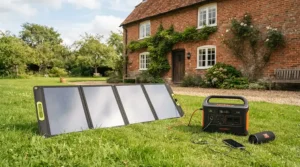
Expandable Battery Packs Explained: EcoFlow vs Jackery Expansion Paths
Expandable battery packs are the feature most buyers underestimate and later wish they’d planned for. The two brands approach it differently.
EcoFlow’s approach is a shared ecosystem. UK listings say EcoFlow DELTA 3 Plus accepts extra batteries from the DELTA 2 and DELTA 3 ranges, up to 5kWh. EcoFlow DELTA 3 Max Plus reaches 10kWh with extra batteries, and EcoFlow DELTA Pro 3 reaches 12kWh per unit, with a wider system scaling to 48kWh. That cross-compatibility means an older battery can sometimes serve a newer unit, which is attractive if you already own EcoFlow gear.
Jackery’s approach is narrower. Jackery Explorer 2000 Plus supports up to five packs for 12kWh, and two units can be paralleled for 24kWh and 6000W at 240V. The other Jackery models here are fixed capacity.
The commercial reality is that expandable battery packs are expensive. A UK reviewer specifically noted that the add-ons aren’t cheap, so decide on a total target capacity up front. If you just need one night of backup, an expandable system is paying for flexibility you won’t use.
Safety, Wiring Rules and Long-Term Cost
A power station is only safe if it’s connected correctly. The golden rule: never feed a power station into a household socket using a double-ended lead. That can energise your wiring with live pins and endanger you and anyone working on the network. Whole-home connection needs a properly installed interlocked changeover or the manufacturer’s home panel, fitted by a qualified electrician under BS 7671, the UK wiring regulations.
Food safety matters too. The Food Standards Agency’s advice on keeping food safe in a power cut is worth a read, and a power station keeps the fridge running so you’re less likely to need it. Look for CE or UKCA marking on the listing.
On long-term cost, think in terms of insurance. Spread the price of a £1,000-range unit over ten years and it works out at roughly £100 a year for peace of mind. If you cycle it daily, the maths improves further, because 2042Wh across 4,000 cycles is theoretically over 8,000kWh of throughput. Time-of-use tariffs could offset some cost, but that depends on your tariff, so I wouldn’t count on it.
Common Mistakes When Buying a Power Station
Most regrets come from the same handful of errors.
- Buying on watt-hours alone. A 3kWh unit with a weak output rating is useless for a kettle.
- Ignoring the 13A limit. UK sockets cap near 3kW, so a headline output may not reach one outlet.
- Expecting to heat the house. Resistive heaters are battery-killers.
- Mixing incompatible expansions. Check that extra batteries match your exact base unit.
- Planning on winter solar. Short days and low sun mean recharge from elsewhere.
- Storing it at zero percent or in a freezing shed. Charge it and keep it indoors.
- Treating the EcoFlow vs Jackery for home backup decision as brand loyalty. It’s a spec-to-household decision, so run the arithmetic first.
Power Station vs Petrol Generator: Which Is Right for a UK Home?
Petrol generators are cheap per watt but come with serious baggage. They produce carbon monoxide, so they must never run indoors, and they’re loud, need fuel and need maintenance. Power stations are the opposite: quiet, fume-free and ready at the flick of a switch.
| Factor | Power station | Petrol generator | Best For |
|---|---|---|---|
| Indoor use | Safe in a ventilated room | Never indoors (carbon monoxide risk) | Power stations for homes |
| Noise | Quiet fans | Loud | Power stations for flats |
| Runtime | Limited by battery, extendable | Limited by fuel | Generators for long runs |
| Maintenance | Minimal | Fuel, oil, servicing | Power stations for low effort |
| Best for | Jackery Explorer 2000 v2 or EcoFlow DELTA 3 Max Plus | Heavy loads over many days | Mixed households use both |
The table shows that neither wins outright. For most British homes, short-to-medium cuts favour a power station like Jackery Explorer 2000 v2 or EcoFlow DELTA 3 Max Plus. For longer outages, pairing a power station with a smart generator, which EcoFlow’s ecosystem supports, gives the best of both worlds without running fumes indoors.
FAQ
❓ Can an EcoFlow or Jackery power station run a fridge-freezer during a power cut?
❓ Is a 2000W power station for home backup enough for a UK family?
❓ Can I add expandable battery packs to a Jackery Explorer 2000 v2?
❓ Is a power station for winter blackouts safe to use in freezing weather?
❓ Can I connect a power station to my house wiring?
Conclusion
So, which wins the EcoFlow vs Jackery for home backup contest? It depends on your household. Choose EcoFlow if you want expansion options, faster ecosystem integration and a longer warranty on paper. Choose Jackery if you prize carry-and-plug simplicity and a compact build.
My shortlist, in short: Jackery Explorer 1000 v2 for flats and short cuts, EcoFlow DELTA 3 Plus for a small start with room to grow, and Jackery Explorer 2000 v2 as the tidy 2000W power station for home backup. EcoFlow DELTA 3 Max Plus is the best all-rounder, Jackery Explorer 2000 Plus is the best Jackery for long cuts, Jackery Explorer 3000 v2 suits fixed-capacity backup, and EcoFlow DELTA Pro 3 is the premium system.
Before you buy, run your own essentials arithmetic, decide whether you’ll need expandable battery packs, and check that the unit you choose is right for a power station for winter blackouts in your own home. Do that, and the next storm becomes an inconvenience rather than a crisis.
✨ Don’t Wait for the Next Storm!
🔍 Compare the models above, click any highlighted product name to check current pricing and availability, and give your home a quiet, reliable safety net before winter arrives.
Recommended for You
- Portable Power Station For Power Cuts: 7 Reliable UK Picks (2026)
- Power Station For Long Power Outages: 7 Best UK Picks (2026)
- Whole House Power Station System: 7 Proven UK Picks (2026)
Disclaimer: This article contains affiliate links. As an Amazon Associate, I earn from qualifying purchases. If you purchase products through these links, we may earn a small commission at no additional cost to you.
✨ Found this helpful? Share it with your friends! 💬🤗
