
In This Article
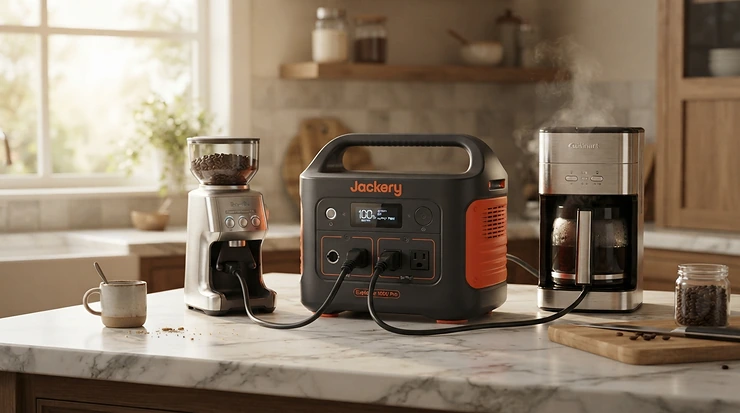
Here’s the awkward truth about portable batteries. The unit that happily runs your router and fridge today will feel cramped once a heat pump, a home office or a rooftop panel array turns up. A power station for growing power needs flips that script. Rather than guessing your future load and overpaying on day one, you buy a sensible core unit now and bolt on capacity when life demands it.

That’s incremental battery investment in a nutshell, and in 2026 it has gone properly mainstream. Most major brands now sell extra battery modules, stackable designs and parallel-ready inverters. An expandable solar generator can start life as a desk-side backup in the £200-£250 range and grow into a multi-kilowatt-hour household reserve.
There’s a catch, though. “Expandable” doesn’t mean the same thing everywhere. One ecosystem stops at 858Wh, another stretches past 48kWh, and a few popular, well-reviewed models can’t expand at all. So this guide does the unglamorous homework. It compares seven real units sold in the UK on expansion ceilings, output, cycle life and indicative cost, then translates the specs into kitchens, power cuts and budgets.
Think of it as future-proofing home power without a crystal ball. Everything here rests on published specifications, UK retailer listings and independent reviews. I haven’t hands-on tested any of these units, and I’ll flag every place where the evidence is thin.
What Is a Power Station for Growing Power Needs?
A power station for growing power needs is a portable lithium battery unit with an inverter and several outlets that can scale up by adding extra battery modules or linking with another unit. You start with the capacity you need today and expand later, instead of replacing the whole system when demand rises.
Most current examples use lithium iron phosphate (LFP) cells. Wikipedia’s overview of lithium iron phosphate batteries explains the trade-off. LFP stores less energy per kilogram than other lithium-ion chemistries, but it is prized for stability and long cycle life. That suits a battery you intend to keep for a decade.
An expandable solar generator is the same idea with panels attached. Three scaling styles are worth knowing:
- Stackable batteries connect through a dedicated port.
- Modular systems split the inverter and battery into separate boxes.
- Parallel setups link two inverters for more output.
Capacity (watt-hours) tells you how long you can run. Output (watts) tells you what you can run at once. A good power station for growing power needs lets you grow both.
Quick Comparison: Power Station for Growing Power Needs at a Glance
Before the deep dives, here’s the whole field on one screen. Capacity is the base unit, and the “max” column shows what each manufacturer says its ecosystem can reach with its own add-ons. Output is continuous AC power, not the flattering surge figure. Prices are indicative ranges at the time of research, so check current price before you commit.
| Product | Base capacity | Max expandable | Continuous output | Best For |
|---|---|---|---|---|
| EcoFlow RIVER 3 Plus | 286Wh | 858Wh | 600W | Router, laptop and gadget backup |
| EcoFlow DELTA 3 Plus | 1,024Wh | 5kWh | 1,800W | A flexible first “real” station |
| Anker SOLIX F2000 | 2,048Wh | 4,096Wh | 2,300W | Warranty-minded buyers who need one step up |
| Bluetti AC200L | 2,048Wh | 8,192Wh | 2,400W | Most expansion per pound |
| Jackery Explorer 2000 Plus | 2,042Wh | 12kWh | 3,000W | Heavy loads, big single-brand ceiling |
| Bluetti Apex 300 | 2,764.8Wh | About 19.4kWh per unit (58kWh paralleled) | 3,840W | Home-backup-minded long hauls |
| EcoFlow DELTA Pro 3 | 4,096Wh | 12kWh single unit | 4,000W | Whole-home ambitions |
Looking at the table, the Bluetti AC200L offers the most expansion headroom per pound in the 2kWh class, while the EcoFlow DELTA 3 Plus is the gentlest on-ramp if you’re unsure how big you’ll go. The Anker SOLIX F2000 stops at 4,096Wh, so it suits buyers who value a five-year warranty over unlimited growth. The EcoFlow DELTA Pro 3 only makes sense if your loads genuinely reach the 4kW class.
💬 Just one click — help others make better buying decisions too!😊
Top 7 Power Station for Growing Power Needs Picks: Expert Analysis
Each pick below gets the same treatment: what the specs mean in practice, who it suits, and what reviewers say where I could verify it.
1. EcoFlow RIVER 3 Plus — tiny starter that stacks wirelessly
The standout party trick is the pogo-pin connection. Slot an extra battery underneath and the pair behaves as one unit, with no cables or screws.
The RIVER 3 Plus packs 286Wh of LFP storage, 600W continuous output (1,200W with X-Boost) and a sub-10ms UPS switchover into a 4.7kg body. In practice that’s router, laptop and lighting territory, not kettle territory. EcoFlow says it can keep a 3W Wi-Fi router alive for around 35 hours. That’s a manufacturer figure, but it looks plausible once inverter overhead is counted. Add the 286Wh or 572Wh extra battery and the ceiling rises to 858Wh.
As a power station for growing power needs, this is the cheapest way to test the stackable idea before committing four figures. Renters and first-timers get a real UPS for their broadband and a taste of how an expandable solar generator behaves. The flip side is a low ceiling. 858Wh won’t carry a fridge-freezer and a boiler pump through a long outage.
I couldn’t find a deep pool of independent UK reviews for this exact model. Treat its durability claims (3,000 cycles to 80%) as manufacturer claims, not verified results.
Pros:
- ✅ Wire-free stacking in seconds
- ✅ Light at roughly 4.7kg
- ✅ Claimed one-hour mains recharge
Cons:
- ❌ 858Wh ceiling limits long-term growth
- ❌ 600W output rules out kettles and heaters
Around £200-£250 (check current price) makes it a low-risk entry point, provided you accept the ceiling.
2. EcoFlow DELTA 3 Plus — easiest on-ramp to 5kWh
Its strongest card is flexibility. It accepts extra batteries from the DELTA 2, DELTA 2 Max, DELTA 3 and DELTA Pro 3 families, taking the system from 1,024Wh to 5kWh.
The DELTA 3 Plus delivers 1,800W continuous through four AC outlets, stretching to 2,400W with X-Boost. That lets it handle many kettle-class loads that would trip a plain 1,800W inverter. A 1,500W AC input recharges it in about 56 minutes, and dual 500W solar inputs take roughly 70 minutes in good light. UK retailers list 4,000+ cycles to 80% and a five-year warranty. At 12.5kg it’s one of the lighter 1kWh units around.
Here’s the analytical take. This is the sweet spot for most households starting a power station for growing power needs. 1kWh keeps a fridge-freezer running for the best part of a day (Ofgem’s rule of thumb is about 1kWh per 26 hours), before conversion losses. One extra battery doubles it. Peak and off-peak charging management also helps incremental battery investment earn its keep.
TechRadar awarded the DELTA 3 Plus five stars and an Editor’s Choice badge, praising its balance of power, portability and versatility.
Pros:
- ✅ Grows from 1,024Wh to 5kWh
- ✅ Roughly one-hour mains recharge
- ✅ Light at 12.5kg and quiet at modest loads
Cons:
- ❌ Extra batteries add cost and weight
- ❌ Heavy 3kW-class loads remain out of reach
Expect roughly £550-£700 (check current price). It’s the strongest all-round value here.
3. Anker SOLIX F2000 — five-year warranty, UK-spec sockets
What sets it apart is polish and paperwork: UK three-pin sockets, a five-year full-device warranty and a notably sturdy shell.
The Anker SOLIX F2000 (formerly PowerHouse 767) stores 2,048Wh and delivers 2,300W in UK form. Trusted Reviews judged that enough for a washing machine, dishwasher, tumble dryer or kettle. Anker claims a 0-80% recharge in about 1.4 hours and a 20ms switchover during a power cut, which is fine for most electronics.
Expansion is where it differs. One BP2000 battery doubles it to 4,096Wh, and only compatible F-series units can use it. The Anker SOLIX F2000 is therefore a power station for growing power needs with one planned step, not a ladder. If you know you’ll want 4kWh and no more, that’s perfectly sensible. If you suspect you’ll want 8kWh, look elsewhere.
Trusted Reviews also noted that it isn’t splashproof and could overheat in direct sun, so it wants a shaded, indoor home. I found too little independent long-term reliability data to say more.
Pros:
- ✅ Five-year full-device warranty
- ✅ UK three-pin sockets and sturdy casing
- ✅ Claimed 0-80% recharge in about 1.4 hours
Cons:
- ❌ One expansion step only (4,096Wh)
- ❌ Not splashproof, dislikes direct sun
The base unit sits around £1,500-£1,800, with the BP2000 listed near £1,300 (check current price). It’s a premium price for a capped ecosystem.
4. Bluetti AC200L — most expansion per pound
Headroom is the headline. With B210, B230 or B300-series batteries, 2,048Wh can reach 8,192Wh, and Bluetti’s UK shop lists 4,096Wh with a single B230.
The Bluetti AC200L offers 2,400W output (3,600W “power lifting” for purely resistive loads) and four 230V sockets. It also has Wi-Fi and Bluetooth app control and up to 1,200W of solar input, which is very high for this class. UK-facing coverage cites 0-80% in about 45 minutes on 2,400W AC input. Notebookcheck flagged its weight, and at 28.3kg this is a parked unit, not a casual carry.
For an expandable solar generator you want to grow in 2kWh steps, the AC200L is the value pick. It’s the only 2kWh unit here that reaches 8kWh without a change of inverter. Its weak spot is age. It’s rated to 3,000+ cycles to 80%, versus 6,000+ on Bluetti’s newer cells.
The Yorkshire Post’s reviewer liked the design and solar input, and noted that launch pricing was steep before discounts arrived.
Pros:
- ✅ Reaches 8,192Wh with expansion batteries
- ✅ 1,200W solar input
- ✅ Wi-Fi and Bluetooth app control
Cons:
- ❌ Heavy at 28.3kg
- ❌ Cycle rating trails Bluetti’s newer cells
Roughly £1,100-£1,300 (check current price) is strong value if you’ll actually use the expansion.
5. Jackery Explorer 2000 Plus — five-pack, 12kWh ceiling
Its calling card is a plug-in battery-pack system. Connect up to five packs and capacity climbs from 2,042Wh to roughly 12kWh.
The Jackery Explorer 2000 Plus delivers 3,000W (6,000W surge) across three 230V sockets, weighs 27.9kg and recharges from the wall in about 1.7 hours per its spec sheet. Each Battery Pack 2000 Plus adds 2,043Wh at roughly 19kg. Packs can be charged independently from solar or a car socket, though they can’t power anything without the station.
One trap deserves flagging. Jackery rates 4,000 cycles to at least 70% capacity, while EcoFlow and Bluetti quote to 80%. The figures aren’t like-for-like, and Jackery’s is the looser claim. 9to5Toys also described this model as a legacy product, so check current UK stock of both the base unit and packs before building a plan around it.
I couldn’t verify a substantial body of independent UK reviews for this model, so weigh the spec sheet accordingly.
Pros:
- ✅ Biggest single-brand ceiling here (12kWh)
- ✅ 3,000W continuous output
- ✅ Packs can charge independently
Cons:
- ❌ Cycle rating counted to 70%, not 80%
- ❌ Older generation, so availability needs checking
Historic listings suggest roughly £1,000-£1,500 for the base unit (indicative only, as I couldn’t confirm a stable UK price). Check current price.
6. Bluetti Apex 300 — home-battery thinking in a portable shell
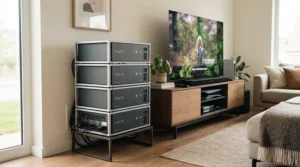
Scale is the headline. One unit takes up to six B300K batteries (about 19.4kWh), and Notebookcheck describes paralleled units with up to 18 packs reaching 58kWh.
The Bluetti Apex 300 offers 2,764.8Wh, 3,840W from six AC outlets, a sub-20ms UPS and LFP cells rated to 6,000+ cycles to 80%. At 38kg it isn’t a casual carry. The Yorkshire Post’s reviewer praised its low standby drain of around 20W. Here’s the arithmetic they don’t spell out: 20W left on for 24 hours burns about 0.5kWh, so switch the inverter off when idle.
Notebookcheck argues it’s closer to a home energy-storage system than a classic portable unit, aimed at owners with larger solar arrays. That’s also why there are no USB or 12V ports as standard. Adding the Hub D1 for 12V devices costs around £200 extra, according to the Yorkshire Post.
For a power station for growing power needs over many years, the Apex 300‘s cell longevity is its big argument. 6,000 cycles at one a day is over 16 years.
Pros:
- ✅ 6,000-cycle LFP cells
- ✅ 3,840W output
- ✅ Scales to 58kWh paralleled
Cons:
- ❌ No USB or 12V ports without the Hub D1
- ❌ 38kg isn’t casually portable
Expect around £1,650-£2,300 (check current price), with one-battery bundles nearer £2,500. It’s a long-haul investment.
7. EcoFlow DELTA Pro 3 — whole-home ambitions
Output is its trump card: 4,000W continuous (6,000W with X-Boost, 8,000W surge) from a single unit.
The DELTA Pro 3 stores 4,096Wh in LFP cells and weighs 51.5kg, with wheels and a telescoping handle to make that bearable. It offers a sub-10ms UPS, roughly 30dB at modest loads, 4,000+ cycles to 80% and about an hour to 80% on fast AC. A single unit expands to 12kWh with two extra batteries. EcoFlow quotes up to 48kWh across multi-inverter systems, which need additional hardware.
TechRadar called the DELTA Pro 3 outstanding, praising capacity, output, rapid charging and smart-home integration. My analytical caveat is that most households’ essential loads sit well under 3kW. This is a power station for growing power needs only if yours truly will grow that far. Connecting any such unit to home circuits is a job for a qualified electrician, not a plug-in adaptor.
Pros:
- ✅ 4,000W continuous output
- ✅ 12kWh from one inverter
- ✅ Rapid charging and sub-10ms UPS
Cons:
- ❌ 51.5kg demands wheels and planning
- ❌ Overkill unless loads are genuinely heavy
A UK warehouse-club listing sat around £2,200, so think £2,000-£2,500 (check current price). It’s strong value only if you’ll use the output.
Here’s the field side by side, with review picture limited to what I could verify:
| Product | Cycle rating | Weight | Indicative price range | Review picture | Best For |
|---|---|---|---|---|---|
| EcoFlow RIVER 3 Plus | 3,000 to 80% | 4.7kg | £200-£250 | Little independent UK coverage found | Renters, gadget backup |
| EcoFlow DELTA 3 Plus | 4,000+ to 80% | 12.5kg | £550-£700 | Five-star TechRadar review | First-time expanders |
| Anker SOLIX F2000 | 10-year lifespan claimed | Not confirmed | £1,500-£1,800 | Sturdy, but not splashproof | One-step upgraders |
| Bluetti AC200L | 3,000+ to 80% | 28.3kg | £1,100-£1,300 | Good solar, heavy | Expansion on a budget |
| Jackery Explorer 2000 Plus | 4,000 to 70% | 27.9kg | £1,000-£1,500 (indicative) | Limited independent evidence | Big single-brand ceiling |
| Bluetti Apex 300 | 6,000+ to 80% | 38kg | £1,650-£2,300 | Praised standby drain, pricey | Long-haul home backup |
| EcoFlow DELTA Pro 3 | 4,000+ to 80% | 51.5kg | £2,000-£2,500 | Strongly positive TechRadar review | Heavy loads |
The Bluetti Apex 300‘s 6,000-cycle cells give it the best durability claim on paper, but its weight and missing ports narrow who it suits. The EcoFlow DELTA 3 Plus is the only mid-priced unit with a verified independent endorsement and an easy path to 5kWh. Note that the Jackery Explorer 2000 Plus cycle figure is counted to 70%, so it isn’t directly comparable.
✨ Don’t Miss These Top Picks!
🔍 Take your home resilience to the next level with these carefully selected units. Click on any highlighted product to check current pricing and availability. These systems will help you build reliable backup power your household will love!
How to Build an Expandable Solar Generator in Stages
Starting small only works if the growth path is planned before the first purchase. This is how to build an expandable solar generator without regrets:
- Audit first. A cheap plug-in watt meter shows each appliance’s running watts. Note daily hours too, because watt-hours decide capacity.
- Buy the inverter you’ll need in three years. Batteries are easy to add, but inverter limits are not. If a 2,000W kettle matters to you, a 600W unit is a dead end.
- Leave the expansion port free. Buy the first extra battery only after a month of real usage data.
- Add solar last. UK winter yields are modest, so pair panels with off-peak mains charging to fill the gaps.
- Run an outage drill. Move your router and fridge onto the station for an evening and watch the app.
For maintenance, Bluetti advises topping a stored unit up to roughly 80% every three to six months. Check firmware quarterly, keep vents clear and avoid hot windowsills.
The classic mistakes in the first 30 days are running a kettle and microwave together on an 1,800W unit, forgetting that inverter losses shave real capacity, and buying panels before measuring loads. Done patiently, incremental battery investment spreads cost across years without ever leaving you underpowered.
Real-World Scenarios: Which Power Station Fits Which Household?
Specs only matter when matched to a life. Here are three profiles, with budget, environment and frequency of use.
The flat-dwelling remote worker (budget around £250, occasional short cuts). The EcoFlow RIVER 3 Plus with one extra battery gives about 572Wh. That’s enough for router, laptop and lighting through an evening. It won’t run a fridge-freezer for a full day, but it needn’t.
The rural family (budget around £1,500, a few multi-hour cuts a year). A Bluetti AC200L plus one B230 reaches 4,096Wh. By my rough estimate of about 2kWh a day for essentials (fridge-freezer, router, lights, chargers, boiler controls), that’s around two days of coverage. Solar panels can follow later.
The electrified household (budget £2,000 and up, daily cycling). Ofgem treats 4,100kWh a year as “high” electricity use. Households like this, with a heat pump, an EV or rooftop solar, should look at the Bluetti Apex 300 with B300K batteries or the EcoFlow DELTA Pro 3. Check any heat pump’s start-up draw with your installer first. Home integration needs a qualified electrician.
Notice the pattern. Every profile starts with measured loads, not marketing numbers. That’s the discipline that makes a power station for growing power needs a smart purchase rather than an expensive guess.
How to Choose a Power Station for Growing Power Needs
Pick the unit whose inverter covers today’s biggest load and whose expansion ceiling is at least two or three times its starting capacity. Then check the ecosystem will still sell batteries in five years. In more detail:
- List your essentials and their wattages. The total running watts sets your minimum inverter.
- Convert to daily watt-hours. This sets starting capacity, with roughly 10-15% shaved for inverter losses as a rule of thumb.
- Check the ceiling. If you might need 4kWh later, avoid a platform that stops at 858Wh.
- Confirm the ecosystem. Extra batteries are brand-specific, so ask who makes them and for how long.
- Match charging to your life. Compare mains speed, solar input and off-peak scheduling.
- Compare cycle ratings like-for-like. Cycles to 80% and cycles to 70% are different promises.
- Weigh the stackable power station vs fixed capacity power station question honestly. Section below.
Energy Demand Forecasting: Sizing Your Power Station for Growing Power Needs
Good energy demand forecasting needs a baseline, and Ofgem’s guidance on average gas and electricity use provides one. A medium household uses around 2,700kWh of electricity a year, and a high one around 4,100kWh. That’s roughly 7.4kWh and 11.2kWh a day respectively, so a 2kWh unit covers about a quarter of a medium home’s whole-day demand. Ofgem’s own appliance guide suggests a fridge-freezer uses about 1kWh every 26 hours.
You rarely need whole-home coverage, though. A practical forecast runs in three steps:
- Today: list essentials and total their daily watt-hours (typically 1.5-2.5kWh).
- Two years out: add what’s coming, such as a home office, a chest freezer or a second fridge.
- Five years out: add structural changes like a heat pump’s controls or an induction hob.
Ofgem’s high-use figure is a useful reality check. If your five-year column approaches it, favour platforms that expand past 8kWh. If it stays modest, you may never need more than one extra battery, and a capped ecosystem like the Anker SOLIX F2000 is fine.
Stackable Power Station vs Fixed Capacity Power Station: The Honest Comparison
The stackable power station vs fixed capacity power station debate isn’t one-sided. Here are the key differences:
| Factor | Stackable | Fixed capacity |
|---|---|---|
| Day-one cost | Higher; inverter built for growth | Lower per kWh at launch |
| Growth path | Add modules or parallel units | Buy a second, separate unit |
| Brand lock-in | High; only same-ecosystem batteries fit | None |
| Weight | Grows with each module | Fixed and easier to move |
| Best For | EcoFlow DELTA 3 Plus, Bluetti AC200L | Anker SOLIX C1000 Gen 2, Bluetti Elite 200 V2 |
Fixed capacity can win on price. The Anker SOLIX C1000 Gen 2 (1,024Wh, 4,000 cycles) has been seen around £549 and has no expansion option. By contrast, an extra 2,048Wh battery can cost nearly as much as a fixed unit. A reseller listed Anker’s BP2000 near £1,299, so you pay for the option to grow.
There’s a cautionary tale too. The Bluetti Elite 200 V2 offers 2,073.6Wh and 6,000+ cycles to 80%. Bluetti staff confirmed in their community forum that it doesn’t connect to expansion batteries. It’s excellent if 2kWh is your final answer, and a dead end if it isn’t.
So the stackable power station vs fixed capacity power station choice comes down to certainty. If your needs are stable, fixed wins on cost. If they’re likely to grow, stackable’s premium is cheap insurance.
Future-Proofing Home Power: What to Check Before You Buy
Future-proofing home power starts with the direction of travel. The National Energy System Operator’s Future Energy Scenarios 2025 report projects Britain’s electricity demand rising nearly threefold by 2050. It also suggests efficiency could trim up to a fifth, and demand flexibility could roughly halve peak demand. National scenarios aren’t your household’s forecast, but the electrification trend is plain.
A practical future-proofing home power checklist:
- Inverter headroom. Choose output above today’s biggest load.
- Open expansion ports. Don’t fill them on day one.
- Cross-generation compatibility. The EcoFlow DELTA 3 Plus accepts several EcoFlow battery generations, which lowers obsolescence risk.
- Solar input. More input watts keep options open, and the Bluetti AC200L‘s 1,200W is generous.
- Warranty and cycle life. Longer is better, but compare cycles on the same basis.
- Platform longevity. The Jackery Explorer 2000 Plus shows how a model can drift towards legacy status.
No portable unit is fully future-proof. But a power station for growing power needs with open ports, strong cells and a long warranty gets closest.
Incremental Battery Investment: Long-Term Cost & Maintenance
Incremental battery investment spreads spend across years, and the starting points differ widely:
| Starting point | Indicative outlay | Growth route | Value verdict |
|---|---|---|---|
| EcoFlow RIVER 3 Plus | £200-£250 | Up to 858Wh | Cheapest experiment |
| EcoFlow DELTA 3 Plus | £550-£700 | Up to 5kWh | Best balance |
| Anker SOLIX F2000 | £1,500-£1,800 | One pack (4,096Wh) | Premium and capped |
| Bluetti AC200L | £1,100-£1,300 | Up to 8,192Wh | Value ladder |
| Jackery Explorer 2000 Plus | £1,000-£1,500 (indicative) | Up to 12kWh | Check availability |
| Bluetti Apex 300 | £1,650-£2,300 | Up to about 19.4kWh | Long-haul |
| EcoFlow DELTA Pro 3 | £2,000-£2,500 | Up to 12kWh single unit | Heavy-load |
The Bluetti AC200L and EcoFlow DELTA 3 Plus give the clearest staircases from modest spend. The Anker SOLIX F2000‘s cost is justified mainly by its warranty rather than its growth path, and the EcoFlow DELTA Pro 3 only repays its outlay if you use its output.
Here’s an illustrative lifetime calculation. A £600 unit with 1.024kWh and 4,000 cycles stores about 4,096kWh over its life. That’s roughly 15p per kWh stored, before conversion losses and capacity fade, which push real cost higher. With Ofgem’s cap at around 24.7p per kWh in spring 2026, daily cycling saves money only if you shift power across a wide price gap. For most buyers, the value is resilience, not arbitrage.
Maintenance is light: partial-charge storage, firmware updates, clear vents. At one cycle a day, 4,000 cycles is nearly eleven years, and 6,000 is over sixteen.
Features That Actually Matter (And Those That Don’t)
What matters:
- Expansion ceiling and ecosystem longevity. This decides whether the unit grows with you.
- Continuous output, not surge. A headline 6,000W surge won’t boil a kettle that needs sustained watts.
- UPS switchover time. Sub-10ms is friendlier to computers than 20ms.
- Solar input wattage. It determines how fast you can refill in thin British sunshine.
- Like-for-like cycle ratings and warranty length.
What doesn’t:
- Surge figures. They’re marketing, not capability.
- USB port counts. Most households need two or three.
- Display gimmicks. The app tells you more.
- Headline cycle counts without the capacity threshold. A big number to 70% is not a big number to 80%.
Filter every spec sheet through one question: does this help a power station for growing power needs grow? If not, it’s decoration.
Safety, Regulations and Compliance Guide
Large lithium batteries deserve respect. West Yorkshire Fire and Rescue’s lithium-ion battery safety advice says to avoid leaving batteries charging unattended, keep them off escape routes, avoid temperature extremes and buy quality equipment. It also recommends working smoke alarms nearby. Treat your station the same way: charge in a ventilated, shaded spot away from hallways, especially in flats.
On compliance, look for CE or UKCA marking, UK-compliant three-pin sockets and transport certification (UN38.3). LFP cells are generally more thermally stable than older lithium-ion chemistries, but quality protection circuitry still matters, so avoid uncertified bargains.
Never feed a station into a house circuit with a homemade adaptor lead. Back-feeding can endanger you and anyone working on the network. Proper integration, whether through a transfer switch or an inlet, belongs to a qualified electrician working to current wiring regulations.
Finally, a power station for growing power needs gets heavier as it grows. Plan floor space, lifting and ventilation for the final setup, not just the starter unit.
Frequently Asked Questions
❓ How long will a power station for growing power needs run a fridge-freezer?
❓ Can I mix brands on an expandable solar generator?
❓ Is a portable unit better than a fixed home battery for future-proofing home power?
❓ What is the cheapest way to start incremental battery investment?
❓ Does energy demand forecasting require a smart meter?
Conclusion
Buying a power station for growing power needs is really a bet on your own future, and the smartest bets are small, measured and reversible. Start by auditing loads, forecast two and five years ahead, and choose an ecosystem whose ceiling comfortably exceeds your forecast.
For most households the EcoFlow DELTA 3 Plus is the safest starting point, with its light weight, fast charging and path to 5kWh. If you want maximum expansion for the money, the Bluetti AC200L earns its place. If durability over a decade matters, the Bluetti Apex 300‘s cells are hard to beat, and the EcoFlow DELTA Pro 3 suits genuinely heavy loads. The Anker SOLIX F2000 is for those who want one upgrade and a long warranty, the Jackery Explorer 2000 Plus needs its availability checked, and the EcoFlow RIVER 3 Plus is the cheapest way to test the idea.
Remember the stackable power station vs fixed capacity power station trade-off. Pay for expandability only if growth is likely. Whatever you choose, treat safety and installation seriously, and use the cost ranges here as a guide only. Check current price and availability, because both change often.
✨ Ready to Start Small and Grow Smart?
🔍 Choose the starter unit that fits today’s loads and leaves room for tomorrow’s. Click any highlighted product above to check current pricing and availability, and build your resilience one battery at a time!
Recommended for You
- Stackable Power Station: 7 Best Buys, Honestly Ranked (2026)
- Power Station For Whole House Off-Grid: 7 Best Picks (2026)
- Expandable Power Station: 7 Best Picks For UK Homes (2026)
Disclaimer: This article contains affiliate links. As an Amazon Associate, I earn from qualifying purchases. If you purchase products through these links, we may earn a small commission at no additional cost to you.
✨ Found this helpful? Share it with your friends! 💬🤗
