

In This Article
A stackable power station is a portable battery-and-inverter unit built to grow. You add compatible battery packs, usually by cable or by stacking them on top, to multiply capacity without replacing the core. Think of it as Lego for electricity. Start with 1kWh or 2kWh, then bolt on more watt-hours as your needs and your bank balance allow.
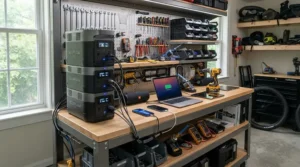
Why does that matter? Because the classic mistake in this category is buying the wrong size twice. Go too small and you’re shopping for a bigger unit within a year. Go too big and you’ve funded a lump of battery that sits in the cupboard, quietly depreciating. A stackable power station sidesteps the dilemma: pay for what you need now, top up later.
Here’s how this guide was built. I haven’t hauled these units up a hill or run a freezer off them for a fortnight, and I won’t pretend otherwise. What I’ve done is dig through manufacturer specifications, UK retailer listings and published tests, then translate them into what they mean for your kitchen, camper or garden office. Where something couldn’t be verified, I’ll say so.
Most units below use lithium iron phosphate cells, a chemistry valued for its thermal stability and long cycle life. That’s why five-year warranties and 3,000-plus cycle ratings are now common. Ahead: seven picks, the compatibility traps, the maths of phased buying and UK safety notes. Quick disclosure: this article contains affiliate links, so I may earn a small commission at no extra cost to you.
Quick Comparison: Stackable Power Station Options at a Glance
Here’s the lay of the land before we go deep. Capacities come from manufacturer and retailer listings.
| Product | Base capacity | Max with packs | Best For |
|---|---|---|---|
| Anker SOLIX C1000X | 1,056Wh | 2,112Wh | Flats and weekend vans on a budget |
| EcoFlow DELTA 2 | 1,024Wh | 2,048Wh (one extra battery) | First-timers testing the idea |
| EcoFlow DELTA 2 Max | 2,048Wh | 6,144Wh | Growing households |
| Anker SOLIX F2000 | 2,048Wh | 4,096Wh | Simple, clean doubling |
| Jackery Explorer 2000 Plus | 2,042.8Wh | 12kWh (24kWh when paralleled) | Maximum headroom |
| Sherpa BASE 2.5 | 2,048Wh | Pack pairing to confirm | UK specialist-retailer support |
| Bluetti Apex 300 | 2,764.8Wh | 19,353.6Wh (six B300K) | Serious home backup |
Read down the “Max” column and the pecking order is obvious. The Bluetti Apex 300 and Jackery Explorer 2000 Plus play in a different league for ceiling, while the Anker SOLIX C1000X and EcoFlow DELTA 2 are about cheap, low-commitment entry. But ceiling isn’t everything. A 12kWh maximum means nothing if you only ever buy one pack, so match the headroom to the life you actually lead.
💬 Just one click — help others make better buying decisions too!😊
Top 7 Stackable Power Station Picks: Expert Analysis
Prices below are ranges drawn from UK retailer listings at the time of research, not Amazon-specific figures, and they move constantly. Always check current price before you buy.
1. Anker SOLIX C1000X — cheapest way to start stacking
The Anker SOLIX C1000X is the gentle on-ramp to a stackable power station: a 1,056Wh core that doubles to 2,112Wh once an expansion battery joins it. Anker’s SurgePad technology lifts output to 2,400W and claims to cover 99% of appliances. Treat that as marketing. Many UK kettles draw around 3kW, so check wattage labels before assuming anything. Anker rates the EV-grade cells at 3,000 cycles and a ten-year lifespan; charge it weekly and the chemistry will outlast your interest in camping.
Based on the spec comparison, it suits flat-dwellers wanting router-and-laptop resilience, plus weekend campervanners. The catch is headroom. One expansion step and you’ve hit the ceiling, so think stepping stone, not forever system.
On reviews, I couldn’t verify enough genuine owner feedback for this exact bundle to summarise honestly. A US tester did praise the related Anker SOLIX C1000 Gen 2 for solar-generator use, but that’s a different model, so don’t read it as a verdict here.
Pros:
- ✅ Doubles to 2,112Wh with one expansion
- ✅ 2,400W surge-assisted output
- ✅ 3,000-cycle cells, ten-year lifespan claim
Cons:
- ❌ Only one expansion step available
- ❌ Bundle stock looked patchy at one UK retailer
Around £1,000-£1,100 for the unit-plus-expansion bundle at one UK retailer, which showed as sold out at the time of research, so check current price. Fair value if you want both halves in one box.
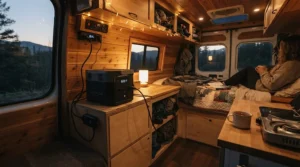
2. EcoFlow DELTA 2 — the 1kWh crowd-pleaser with room to grow
The EcoFlow DELTA 2 is the model UK buyers keep getting pointed towards, and it’s easy to see why. The 1,024Wh core charges from 0-80% in roughly 70 minutes on mains, according to a UK retailer listing. Plug it in after breakfast and it’s ready by lunch. That’s enough for a router, laptop and lights through a long evening, or a fridge-freezer for a few hours.
The expandable battery power station angle comes with a hard limit. A DELTA 2 accepts only one extra battery, and the EcoFlow DELTA 2 Extra Battery can’t run on its own. It recharges only through the host unit or an EcoFlow smart generator. On paper that doubles you to 2,048Wh, and no further.
Reviewers largely agree it punches above its weight. Outdoor Life’s 2026 testing named it best overall, citing value for output and a modest 10W idle draw on the AC inverter. Icon Polls calls it the default UK recommendation.
Pros:
- ✅ Fast mains charging, 0-80% in about 70 minutes
- ✅ LFP chemistry with a five-year guarantee
- ✅ App monitors the station and extra battery together
Cons:
- ❌ Capped at a single extra battery
- ❌ Extra battery can’t work without its host
Station prices swing with promotions, so check current price. The extra battery alone runs around £700 at one UK DIY retailer, roughly 68p per Wh. That’s the sting. Great start, pricey growth.
3. EcoFlow DELTA 2 Max — 2kWh core, 6kWh ceiling
The EcoFlow DELTA 2 Max is where “stackable” starts to feel literal. Each DELTA 2 Max Smart Extra Battery adds 2,048Wh, and the host takes up to two, for 6,144Wh in total. EcoFlow says the packs are designed to stack securely on the station and on each other. A tidy tower beats a floor full of cables.
Each pack uses LFP chemistry rated for 3,000 cycles to 80% capacity. That’s roughly ten years of daily use, if the claim holds. EcoFlow’s own example has 6kWh running a 120W fridge for about 42 hours. My back-of-envelope sum lands a few hours under that, which is why you plan with the conservative figure.
On the review side, Bob Vila’s testers rated it their upgrade pick but flagged it as the heaviest unit they tested. Each pack alone weighs 19kg, so think about where this tower lives permanently.
Pros:
- ✅ Two packs reach 6,144Wh
- ✅ Packs designed to stack on each other
- ✅ LFP cells rated for 3,000 cycles
Cons:
- ❌ Heavy, with 19kg per extra pack
- ❌ Packs cost well over 60p per Wh
Extra packs sit in the £1,300-£1,350 range at UK retailers; check current price for the station itself. It buys flexibility, not a bargain.
4. Anker SOLIX F2000 — the simplest clean doubling to 4kWh
The Anker SOLIX F2000, also sold as the PowerHouse 767, wins fans for how little fuss its expansion involves. Connect the Anker 760 expansion battery (2,048Wh) with the battery-to-host cable, line up the logo, push in, and your 2,048Wh station becomes 4,096Wh. Retailer listings promote a ten-year lifespan and a five-year warranty on the pack.
What that means in practice: a fridge, router and a few lights can ride through a long outage with hours of margin. It’s a battery pack compatibility story with a tight rule, though. Retailers state that only the F2000 works with the 760 pack, so you’re locked into Anker for the upgrade.
Honest note on reviews. The one UK listing I found carried a single five-star review, far too thin to generalise from. Treat owner sentiment here as unproven rather than negative.
Pros:
- ✅ Doubles to 4,096Wh in one step
- ✅ Simple plug-in cable connection
- ✅ Five-year warranty on the expansion pack
Cons:
- ❌ Locked to Anker’s own pack
- ❌ Thin verified owner-review pool
UK pricing varies between retailers, so check current price. Good value if you want a clean 4kWh system and no cable spaghetti.
5. Jackery Explorer 2000 Plus — widest ceiling, cheapest packs per Wh
If you want a power station with add-on battery packs and lots of room, the Jackery Explorer 2000 Plus is the benchmark. One station takes up to five Jackery Battery Pack 2000 Plus units (2,042.8Wh each) for 12kWh. Two stations paralleled reach 24kWh at 240V and 6,000W. The main unit outputs 3,000W and weighs 27.9kg, and the cells are rated for 4,000 cycles to 70% capacity.
Here’s the interesting bit. At around £600 for a pack at one UK retailer, expansion costs under 30p per Wh, about half the EcoFlow packs. Jackery quotes a 3+2 year warranty.
Reviewers are lukewarm on the main unit rather than the system. OutdoorGearLab calls it a quality product but says Jackery’s newer 2000 v2 largely supersedes it on price and weight for most people. If expansion is your priority, that’s the 2000 Plus’s remaining edge. Check that before you assume the cheaper sibling works for you.
Pros:
- ✅ Up to five packs for 12kWh
- ✅ 3,000W output handles heavy loads
- ✅ Packs cost under 30p per Wh
Cons:
- ❌ 27.9kg main unit is a proper lift
- ❌ Newer 2000 v2 undercuts it for non-expanders
Packs around £600 at one retailer; check current price for the station. Best value-per-Wh growth path here.

6. Sherpa BASE 2.5 — expandable pick with UK specialist support
The Sherpa BASE 2.5 offers 2,500W and 2,048Wh, with automatic battery switch-over in 8-20ms during power cuts, quick enough that most desktop PCs and routers won’t notice. An LCD shows input, output and battery state, and the unit carries over-voltage, overheat, overload and short-circuit protection. The sibling Sherpa BASE 2.0-EB extra battery is a 2,048Wh LiFePO4 pack that the maker says can be linked up to 15 times for 32,768Wh.
Now the compatibility catch. The BASE 2.5 listing doesn’t spell out which extra battery pairs with it. Confirm with the seller that the BASE 2.0-EB is supported before buying. One retailer also says it can’t currently ship portable power to Northern Ireland due to courier insurance.
I couldn’t find independent reviews for this model, so I won’t invent a consensus. Judge it on specifications and retailer support until more owner feedback appears.
Pros:
- ✅ 2,500W output covers most home loads
- ✅ 8-20ms switchover suits office kit
- ✅ LiFePO4 pack with large linking ceiling
Cons:
- ❌ Pack pairing not clearly documented
- ❌ Few independent reviews found
Check current price, as listings vary. Reasonable value only once pairing is confirmed in writing.
7. Bluetti Apex 300 — serious home-backup headroom
The Bluetti Apex 300 is the stackable power station for people who think in kilowatt-hours. The base is 2,764.8Wh with 3,840W output. It takes up to six Bluetti B300K or B500K packs, topping out at 19,353.6Wh with six B300K. Maximum charging input rises from 3,840W to 6,240W with packs attached, so bigger systems refill faster. UPS changeover is listed at 20ms or less, and the B300K stacks beneath the station using a short 270mm cable.
Testers aren’t shy about downsides. Outdoor Life’s reviewer called it too heavy, noted it lacks DC charging including USB and car ports, and measured roughly 2,290Wh delivered from 2,765Wh claimed, about 83%. Another review roundup repeats the missing-USB grumble. Note too that US listings mention NEMA outlets, so confirm the UK socket layout before ordering.
Pros:
- ✅ Six packs reach 19,353.6Wh
- ✅ 3,840W output for heavy appliances
- ✅ 20ms-or-less UPS switching
Cons:
- ❌ Heavy to move and position
- ❌ No USB or DC ports on the unit
Expect a premium over 2kWh fixed units; check current price. Worth it if backup is the mission, overkill for camping.
Now the economics side by side.
| Product | Expansion pack | Pack price range | Roughly per Wh | Best For |
|---|---|---|---|---|
| Anker SOLIX C1000X | Matching expansion battery (bundle) | Bundle around £1,000-£1,100 | Bundle only | First-time stackers |
| EcoFlow DELTA 2 | DELTA 2 Extra Battery (1,024Wh) | Around £700 | Roughly 68p | Phased budgets |
| EcoFlow DELTA 2 Max | DELTA 2 Max Smart Extra Battery (2,048Wh) | £1,300-£1,350 range | Roughly 63-66p | Growing homes |
| Anker SOLIX F2000 | Anker 760 expansion battery (2,048Wh) | Check current price | Unverified | Simple doubling |
| Jackery Explorer 2000 Plus | Jackery Battery Pack 2000 Plus (2,042.8Wh) | Around £600 at one retailer | Under 30p | Big headroom |
| Sherpa BASE 2.5 | Sherpa BASE 2.0-EB (confirm pairing) | Check current price | Unverified | UK specialist support |
| Bluetti Apex 300 | Bluetti B300K | Check current price | Unverified | Serious backup |
The standout number is the Jackery Battery Pack 2000 Plus. At under 30p per Wh, it costs less than half the EcoFlow packs, if that one retailer’s price holds. That doesn’t make it an automatic winner, because price per Wh ignores weight, port layout and whether you’ll ever fill the ceiling. I also couldn’t confirm several pack prices, so check current price before budgeting.
Real-World Scenarios: Matching a Stackable Power Station to Your Life
Specifications are abstractions. Here are three hypothetical profiles, with budgets, environments and usage frequency spelled out.
The renter with a modest flat. Budget: under £1,000. Environment: a second-floor flat, no garden. Use: a few outages a year. The EcoFlow DELTA 2 fits, because 1,024Wh covers a router, laptop and lights for ages, and a fridge for a few hours. If cuts become regular, add the extra battery later. The risk is paying roughly 68p per Wh for that growth.
The weekend campervan couple. Budget: around £1,000-£1,100. Environment: a van with limited stowage. Use: perhaps 25 weekends a year. The Anker SOLIX C1000X bundle gives 2,112Wh in one purchase, enough for lights, a fridge and device charging. Add roof solar before more batteries.
The rural family with long outages. Budget: several thousand pounds, spent in stages. Environment: a house where storms can interrupt supply for days. Use: occasional but critical. The Bluetti Apex 300 with B300K packs, or the Jackery Explorer 2000 Plus with packs, suits better. Both scale high, and the Apex’s 20ms-or-less switchover keeps broadband kit alive. Mind the weight: 27.9kg for the Jackery base and 19kg per pack aren’t a one-person lift on stairs.

Setting Up Your Stackable Power Station: A First-30-Days Guide
Nobody reads manuals until something blinks angrily. Do this instead.
Week one: place and connect.
- Choose a flat, ventilated spot away from heat and not in an escape route.
- Stack packs with the maker’s own cables. The Bluetti Apex 300‘s short 270mm cable exists precisely for stacking over a B300K.
- Update firmware when the app offers it. Bluetti says paired Apex and B300K units update together in about ten minutes.
Week two: calibrate.
- Charge to full, then run a known load, such as a 120W fridge, for several hours and compare runtime against your expectations.
- Log idle drain. Reviews show inverters draw around 10-15W when on, which adds up to 240-360Wh a day.
Weeks three and four: rehearse the outage.
- Switch off the mains deliberately and see whether your router, PC and fridge ride through.
- Set app notifications, and note where cables and the manual live.
Ongoing: Recharge on a calendar reminder and check the manual’s storage guidance, since many makers recommend topping up periodically. Common mistake in month one: leaving everything plugged into a unit you’ve never actually tested.
How to Choose a Stackable Power Station
Choosing well is mostly arithmetic and honesty. Work through these steps.
- Start with the load, not the brand. Add up the watts of what you must run. Watt-hours divided by watts gives hours, before losses.
- Check the output ceiling. Packs add endurance, not muscle. A 2,400W inverter stays a 2,400W inverter, however many packs you stack.
- Verify the expansion limit. Some stations take one pack, others six. Match it to your five-year plan.
- Confirm pack compatibility in writing. More on that below.
- Price the packs per Wh. The sticker on the base unit tells you little about where the money goes.
- Weigh the weight. A 19kg pack is fine on a shelf and miserable up stairs.
- Check warranty and marking. Look for UKCA or CE marking, plus clear guarantee terms of around four to five years.
Battery Pack Compatibility: The Detail That Decides Everything
Battery pack compatibility is where stackable ambitions quietly die. Packs are proprietary and generation-specific, so a pack that fits one station often won’t fit its sibling.
Real examples from listings: the DELTA 2 takes one extra battery while the DELTA 2 Max takes two. The Anker 760 expansion battery works only with the Anker SOLIX F2000. The Jackery Battery Pack 2000 Plus needs the Jackery Explorer 2000 Plus. And the Bluetti Elite 200 V2 and Elite 300 don’t expand directly at all. Bluetti says its B80 can connect to the Elite 300 only in power-bank mode, a pseudo-expansion.
Even retailers muddle it. One UK listing for the Bluetti B300K says both that it’s designed exclusively for the Bluetti Apex 300 and that it integrates with older AC-series stations. When listings contradict, get the manufacturer to confirm compatibility in writing before you pay.
Stackable Power Station vs Fixed-Capacity Unit vs Petrol Generator
Is stacking worth it versus a bigger single unit? The Bluetti Elite 200 V2 is the fair fixed-capacity counterpoint: 2,073.6Wh, 2,600W and, per Bluetti, not expandable.
| Feature | Stackable power station | Fixed-capacity (e.g. Bluetti Elite 200 V2) | Petrol generator |
|---|---|---|---|
| Capacity growth | Add packs later | None | Add fuel |
| Indoor use | Yes, with sensible ventilation | Yes | No (fumes, noise) |
| Running cost | Electricity only | Electricity only | Fuel and servicing |
| Upfront cost | Lower to start, higher in total | Often lowest per Wh | Varies widely |
| Best For | Growing or uncertain needs | Known, fixed needs | Heavy outdoor loads |
A published UK review praised the Bluetti Elite 200 V2 for its sharp pricing and 1,000W solar input, while lamenting that it isn’t expandable and has only two AC sockets on the UK version. If your needs are fixed, a single 2kWh unit is often the better buy. If they’re uncertain, a stackable power station is the safer gamble.
Upfront vs Phased Investment: Buying Your Stackable Power Station in Stages
Upfront vs phased investment is really a question of how well you know yourself. Buying everything today locks in the lowest hassle. Phasing spreads the cost and lets real usage teach you what you need.
The risks of phasing are practical. Packs can go out of stock, ranges can be discontinued, and prices can move either way. The Anker SOLIX C1000X bundle, around £1,000-£1,100, shows how a maker can sell both halves together. The packs for other systems cost roughly £600-£1,350 each.
| Strategy | Typical approach | Approx spend | Best For |
|---|---|---|---|
| Fixed 2kWh | One unit, no packs | Under £1,000 range (UK review headline for the Bluetti Elite 200 V2) | Known, stable needs |
| Phased | Base now, pack within 12 months | Base plus around £600-£1,350 | Uncertain or tight budgets |
| Full upfront | Base plus packs together | Highest day-one cost | People who hate loose ends |
Phasing wins when you’re unsure and the ecosystem looks long-lived. Go upfront if you already know you’ll want the full system within a year, or if the pack price might rise. Either way, check current price and confirm the pack will still be sold.

Scalable Capacity: How Many Watt-Hours Do You Actually Need?
Scalable capacity only pays off if you size it sensibly. Use the runtime formula Bluetti publishes: capacity × depth of discharge × inverter efficiency, divided by load plus the unit’s own draw.
A working example with assumed numbers: 2,048Wh × 0.85 gives about 1,740Wh usable. Divide by a 120W fridge plus roughly 15W of self-consumption and you get about 13 hours. Stack to 6,144Wh and that’s around 38 hours. EcoFlow’s marketing claims 42, so plan with the lower figure.
A rough rule: 1kWh covers connectivity and laptops for a day, around 2kWh adds a fridge overnight, and 4-6kWh starts to look like a proper outage plan. Your own appliance labels beat any rule of thumb.
✨ Don’t Miss These Exclusive Deals!
🔍 Take your stackable power station search to the next level with these carefully selected products. Click on any highlighted product name to check current pricing and availability. These picks will help you build backup power your household can rely on!
Modular Power Station Review: What Independent Testers Keep Saying
A modular power station review is only as honest as its sources, so here’s what published testers say, not my own bench work.
The concept is no longer niche. Outdoor Life framed the Bluetti Apex 300 as the latest entry in the stackable power station wars, noting Anker and Goal Zero already had their own versions. Its reviewer found the Apex 300 too heavy and lacking DC charging ports.
Elsewhere, Outdoor Life’s 2026 roundup named the EcoFlow DELTA 2 best overall, Bob Vila’s testers flagged the EcoFlow DELTA 2 Max as the heaviest in their test, and OutdoorGearLab suggested the Jackery Explorer 2000 Plus is largely overtaken by a cheaper, lighter sibling for non-expanders.
Three themes repeat. Weight is the most common complaint, port layout is the second, and pack cost per Wh is the quiet third. Nobody I found disputes the underlying idea. Stacking works, if you accept the trade-offs.
Common Mistakes When Buying an Expandable Battery Power Station
An expandable battery power station tempts people into confident errors. Here are the usual suspects.
- Assuming brands interchange. They don’t. Packs are locked to specific hosts.
- Expecting packs to add power. They add endurance. A small inverter stays small.
- Ignoring weight. A 19kg pack plus a 27.9kg base is a two-person job.
- Forgetting recharge time. More capacity needs more input. A big system on a slow wall socket takes a long time to refill.
- Treating “expandable” as a promise. Always confirm the current pack is sold, in stock and compatible.
- Skipping the rehearsal. An untested backup is a hope, not a plan.
Power Station With Add-On Battery Packs: Real-World Performance
What changes when you add packs to a power station with add-on battery packs? Less than the brochures imply, and more than you’d guess.
Charging takes longer in absolute terms, even if the percentage rate is similar. One listing claims 2 hours to refill a Jackery Explorer 2000 Plus system under ideal solar conditions, but that assumes a lot of panels and sunshine. In a British autumn, plan on slower.
Idle drain matters too. At 10-15W, inverters left on for 24 hours burn 240-360Wh a day, which is a noticeable bite out of 1kWh and a rounding error on 6kWh. Physically, expect a stack. Packs sit on or under the host, so floor footprint stays small while height and weight climb.
Safety, Regulations and Compliance for UK Homes
Big batteries deserve respect. LFP is regarded as safer than some other lithium-ion chemistries, but that doesn’t mean carefree.
Fire services urge common sense. Fire Scotland’s lithium-ion battery guidance advises buying from reputable retailers, using manufacturer-approved chargers, never covering batteries while charging, and avoiding storage in escape routes or communal areas. That last point matters in flats.
Look for UKCA or CE marking and clear warranty terms. For anything beyond plugging in appliances, such as hard-wiring into a consumer unit or a home integration kit, use a qualified electrician working to BS 7671. Never back-feed a household socket. And one practical note: a UK retailer said it can’t currently ship portable power to Northern Ireland, so check delivery rules early.

FAQ
❓ Can a stackable power station run a UK electric kettle?
❓ Can I charge an add-on battery pack from solar panels on its own?
❓ Will my broadband router stay on during a power cut?
❓ How heavy is a stackable power station once I add packs?
❓ Will expansion packs still be available in a few years?
Conclusion
So, which stackable power station should you buy? Based on the specs and what testers report, the EcoFlow DELTA 2 and Anker SOLIX C1000X are the low-commitment starters. The EcoFlow DELTA 2 Max and Anker SOLIX F2000 sit in the middle for households that will grow. The Jackery Explorer 2000 Plus offers the cheapest expansion per Wh at the time of research, and the Bluetti Apex 300 has the highest ceiling for serious backup. The Sherpa BASE 2.5 is worth a look once pack pairing is confirmed.
The strategic point is bigger than any model. A stackable power station rewards buyers who size honestly, confirm compatibility in writing and rehearse an outage before they need one. If your needs are fixed, a single unit like the Bluetti Elite 200 V2 may serve you better and cost less. If your needs are uncertain, phasing your spend is the smart route.
Whichever you choose, check current price, read the warranty and place the unit somewhere safe and ventilated.
Recommended for You
- Power Station For Whole House Off-Grid: 7 Best Picks (2026)
- Expandable Power Station: 7 Best Picks For UK Homes (2026)
- Power Station For Camping Cooking: 7 Best Picks For UK Trips (2026)
Disclaimer: This article contains affiliate links. As an Amazon Associate, I earn from qualifying purchases. If you purchase products through these links, we may earn a small commission at no additional cost to you.
✨ Found this helpful? Share it with your friends! 💬🤗
