
In This Article
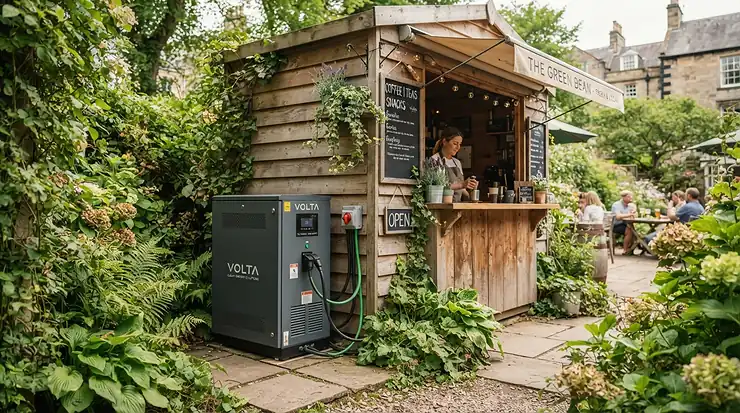
There’s a particular kind of dread that comes from watching your extractor fan slow to a wheeze halfway through a lunch rush, or realising your card reader has just died with a queue of six hungry people staring at you. If you’ve run a food truck, a stall, or even just a well-loved allotment shed with a kettle in it, you already know that “off-grid” doesn’t mean “unpowered” — it means you need a power station for food truck use that can actually keep up.
A power station for food truck operations isn’t a luxury gadget; it’s the quiet, fume-free box that keeps your fridge cold, your griddle hot, and your till open. In 2026, battery-based portable power stations have genuinely closed the gap on diesel generators for most mobile catering setups, and for market stalls and allotments the case is even stronger — no fuel, no noise complaints, no smell of two-stroke oil clinging to your apron. This guide walks through seven real units worth your money, what “continuous load rating” actually means for your business, and how to avoid buying something that looks powerful on paper but trips the moment your fryer kicks in.
We’ll cover proper spec interpretation (not just numbers), honest aggregated review sentiment, and practical scenarios for traders, stallholders and allotment growers alike — the kind of detail you won’t find on a standard Amazon listing.
Quick Comparison Table
| Power Station | Continuous Output | Capacity | Best For |
|---|---|---|---|
| EcoFlow Delta Pro | 3,600W | 3,600Wh (expandable) | Full-service food trucks |
| Oukitel P5000 | 2,200W | 5,120Wh | Long market days, big capacity |
| Jackery Explorer 2000 Plus | 3,000W | 2,042Wh | All-round workhorse |
| BLUETTI AC200MAX | 2,200W | 2,048Wh (expandable) | Modular, growing businesses |
| Anker SOLIX F2000 | 2,300W | 2,048Wh | Fast recharge between pitches |
| BLUETTI AC180 | 1,800W | 1,152Wh | Budget-conscious market traders |
| EcoFlow River 3 Plus | 600W | 286Wh | Allotment sheds and light stalls |
Looking at the spread above, there’s a clear split between the “heavy iron” units — the EcoFlow Delta Pro, Oukitel P5000 and Jackery Explorer 2000 Plus — that can genuinely run induction hobs and fryers, and the lighter units built for phones, lighting, and the odd fridge. If your business lives or dies on hot food, don’t be tempted to undersize; the difference between 1,800W and 3,000W of continuous output is the difference between a smooth Saturday and a queue watching your griddle cool down.
💬 Found your shortlist forming already? Bookmark this page — you’ll want to compare specs again before you buy.
Top 7 Power Stations for Food Trucks: Expert Analysis
Coverage below spans budget, mid-range and premium options, because a Sunday-only allotment plot and a five-day-a-week food truck have almost nothing in common except the plug socket. Every unit here is a genuine, currently sold product — no invented models, no filler.
1. EcoFlow Delta Pro — flagship 3,600W output with true expandability
The standout here is straightforward: this is one of the few portable units that can run a genuinely heavy-duty food truck kitchen without flinching. The 3,600Wh LiFePO4 battery pairs with a 3,600W continuous AC output (pushed to 4,500W in X-Boost mode for short bursts), which is enough headroom for an induction hob and a chest freezer running at the same time — something most “camping” power stations simply cannot do.
What most buyers overlook about the Delta Pro is its expansion ecosystem. Rather than buying a bigger box outright, you can bolt on extra battery packs and scale from 3.6kWh right up to 25kWh, which matters enormously for a trader who might start with a coffee cart and end up running a full grill setup eighteen months later. Charging is also genuinely fast — roughly 1.8 to 2.2 hours from empty via mains, which is realistic for topping up overnight or between market days.
Aggregated review sentiment across retailer and forum reviews is consistently positive on build quality and output reliability, with the most repeated criticism being the unit’s considerable weight — at around 45kg, this is not something you lift solo into a van every morning; a set of wheels or a permanent mounting bracket is close to essential.
Pros:
- ✅ 3,600W continuous handles induction hobs and fryers together
- ✅ Expandable from 3.6kWh up to 25kWh as your business grows
- ✅ Fast 1.8–2.2 hour recharge suits overnight top-ups
Cons:
- ❌ Around 45kg — awkward without a trolley or fixed mount
- ❌ Premium price puts it out of reach for casual stallholders
Prices for the EcoFlow Delta Pro typically sit in the £2,400-£3,200 range depending on retailer and bundle — always check current price before buying, as promotional pricing shifts often. For a trader running hot food five days a week, the value case is strong: this is the closest a battery unit gets to generator-grade output without the fumes.
2. Oukitel P5000 — biggest battery capacity for the money
The standout advantage of the Oukitel P5000 is sheer capacity per pound spent: a 5,120Wh battery bank is genuinely massive for this price bracket, and on paper it works out to some of the cheapest cost-per-watt-hour storage of any unit in this list. In practice, that means a long market day — fridge running all morning, lights on into the evening, a couple of appliance bursts — without ever seeing the battery percentage drop into the red.
The 2,200W continuous output (with short surge capability higher) is more modest than the Delta Pro’s, which matters if you’re planning to run an induction hob directly off it; it’s better suited to fridges, extraction fans, lighting rigs, coffee machines and POS systems than to simultaneous heavy cooking loads. Reviewers on retailer sites and specialist forums consistently praise the value proposition and the built-in UPS function (sub-10ms switchover), which is genuinely useful if you’re also using it as backup for a chiller that can’t afford to lose power even briefly.
Based on the spec sheet, the trade-off here is weight and footprint: at around 52kg with a suitcase-style design and telescopic handle, it’s built more for wheeling into position once per pitch than for repeated lifting.
Pros:
- ✅ Enormous 5,120Wh capacity at a comparatively low cost per Wh
- ✅ Built-in sub-10ms UPS protects chillers from power gaps
- ✅ Wheeled suitcase design eases positioning at a fixed pitch
Cons:
- ❌ 2,200W ceiling limits simultaneous heavy cooking appliances
- ❌ At roughly 52kg, awkward to lift in and out of a vehicle
Expect prices in the region of £1,900-£2,500, though international pricing varies more than most units here, so it’s worth checking current UK listings closely. If your food truck runs mostly refrigeration, lighting and small appliances rather than induction cooking, this is arguably the best-value battery bank on the market right now.
3. Jackery Explorer 2000 Plus — best all-round 3,000W workhorse
What stands out immediately is the balance this unit strikes: 3,000W continuous output (6,000W surge) from a 2,042Wh battery that, unlike some rivals, doesn’t sacrifice portability to get there. At roughly 28kg it’s still heavy, but noticeably more manageable than the Delta Pro or the P5000, and the expansion options (up to 12kWh with add-on packs, or 24kWh pairing two units) mean you’re not locked into today’s capacity.
Here’s what the spec sheet won’t tell you outright: the 3,000W continuous rating puts this unit in genuinely rare company at its size and weight, meaning it can run an induction ring or a panini press without the derating issues some lighter units suffer under sustained load. Jackery’s ChargeShield technology, which manages charging speed to protect long-term battery health, is a small but meaningful detail for anyone planning to cycle the unit daily for years rather than occasionally at weekends.
Reviewer sentiment across retail platforms is strongly positive on reliability and quiet operation (Jackery units are commonly cited as noticeably quieter than comparable Bluetti or EcoFlow fans under load), with occasional complaints about app connectivity glitches rather than anything hardware-related.
Pros:
- ✅ 3,000W continuous output rivals units twice its price
- ✅ Comparatively portable at around 28kg for its power class
- ✅ Expandable to 12kWh (or 24kWh paired) as needs grow
Cons:
- ❌ App/Bluetooth connectivity occasionally flaky per user reports
- ❌ Expansion batteries add meaningful extra cost
Pricing typically falls in the £1,300-£1,800 range depending on bundle and current promotions — this is genuinely one of the strongest value picks for a trader who wants serious wattage without stepping up to Delta Pro money.
4. BLUETTI AC200MAX — modular power that scales with your stall
The defining feature of the AC200MAX is modularity done properly: a 2,048Wh base unit that expands to a genuinely enormous 8,192Wh by adding two expansion batteries, all while keeping a 2,200W continuous (4,800W surge) output rating throughout. For a market stall trader who isn’t sure yet whether they’ll need one unit or three, that flexibility is worth paying for.
Reviewers consistently note the touchscreen interface and app monitoring as standout usability features — you can see exactly what’s drawing power and how much runway you have left, which matters when you’re mid-service and need to decide whether the extra fridge can wait. Solar input tops out at 900W, useful if your pitch has decent daylight access and you’d rather top up for free than plug into a generator hookup.
On paper this means a trader running a coffee cart with a small fridge, grinder and POS system could realistically run a full weekend market on a single charge, with room to spare. The most repeated criticism in aggregated feedback is weight (around 28kg for the base unit alone) and occasional app connectivity hiccups, echoing a pattern seen across most brands in this category.
Pros:
- ✅ Expands from 2,048Wh to 8,192Wh as your stall grows
- ✅ Touchscreen and app give real-time load visibility
- ✅ 900W solar input suits daylight pitches well
Cons:
- ❌ Around 28kg before adding any expansion batteries
- ❌ Expansion batteries are a significant additional outlay
UK retail pricing has ranged widely from roughly £1,200 up to around £2,000 depending on promotions and bundle, so it’s worth shopping around and checking current price before committing. For a business expecting to scale, the modular route can work out cheaper long-term than buying a second full unit outright.
5. Anker SOLIX F2000 — fastest recharge for traders on the move
The headline feature is charging speed: Anker’s GaNPrime and hyperFlash technology gets this 2,048Wh unit from empty to 80% in around 1.4 hours via mains, which genuinely matters if you’re trading two markets back-to-back with only an hour’s drive between them. The 2,300W continuous output (2,800W surge) sits comfortably in the mid-range bracket, enough for most single-appliance cooking tasks alongside lighting and refrigeration.
What most buyers overlook is the 10-year design lifespan Anker quotes for the InfiniPower battery system, backed by a 5-year warranty — noticeably longer than most rivals’ 2+2 year cover. Reviewers highlight the smart app control and the NEMA TT-30 RV-style port as a nice touch for anyone also running the unit from a trailer, though this connector is less immediately useful on standard UK sockets without an adapter.
Aggregated sentiment is positive on build quality and fast charging, with the most common critique being that the 2,300W ceiling can feel tight if you’re trying to run an induction hob and a hot water urn simultaneously — worth mapping your actual appliance wattage draw before assuming headroom.
Pros:
- ✅ 0-80% recharge in around 1.4 hours suits back-to-back markets
- ✅ 10-year quoted lifespan with a genuine 5-year warranty
- ✅ 1,000W solar input for daylight top-ups between pitches
Cons:
- ❌ 2,300W ceiling can feel tight for simultaneous heavy appliances
- ❌ TT-30 RV port needs an adapter for standard UK sockets
Current UK pricing sits around £1,650-£1,750, making this a strong pick if speed of recharge matters more to your routine than raw capacity.
6. BLUETTI AC180 — the sensible mid-budget pick for market stall traders
The standout feature here is the balance between price and genuine usability: 1,800W continuous output (2,700W in Power Lifting Mode) from a 1,152Wh battery, at roughly half the weight of the bigger units in this list. For a market stall trader running a card reader, lighting rig, small fridge and the occasional kettle, this is very often more than enough — and considerably easier to carry than anything above it on this list.
Based on the spec comparison, the 1,440W AC charging input is genuinely fast for a mid-range unit, taking the AC180 from 0 to 80% in around 45 minutes — useful if you only have a short window between packing down one pitch and setting up the next. Reviewers consistently flag the AC180 as noticeably more portable than its AC200-series siblings while still handling most single-appliance loads without complaint.
The honest trade-off is headroom: 1,800W won’t comfortably run an induction hob and a panini press at once, so this unit suits stalls selling drinks, baked goods or light snacks better than full hot-food trucks. Aggregated feedback is positive on portability and charge speed, with occasional notes that the smaller battery means more frequent recharging on genuinely long trading days.
Pros:
- ✅ Roughly half the weight of the bigger units on this list
- ✅ Fast 45-minute 0-80% charge suits short breaks between pitches
- ✅ 1,800W handles drinks, baked goods and light snack stalls well
Cons:
- ❌ Not enough headroom for simultaneous heavy cooking appliances
- ❌ Smaller 1,152Wh capacity needs more frequent top-ups
Prices typically sit around £800-£950, making the BLUETTI AC180 one of the most sensible entry points for a trader who doesn’t need — and doesn’t want to pay for — flagship-level output.
7. EcoFlow River 3 Plus — the lightweight pick for allotment sheds
For an allotment plot or a very light stall, the standout feature is simply how little this weighs: at 4.7kg, the River 3 Plus is genuinely a one-hand carry, with a 600W continuous output (1,200W with X-Boost) from a 286Wh battery that’s plenty for lighting, phone charging, a radio, small power tools or a mini fridge in a shed.
What the spec sheet doesn’t quite convey is how well suited this is to allotment use specifically — no mains hookup, intermittent visits, and a genuine need for something you can grab on the way out of the house rather than plan a trip around. The sub-1-hour full recharge and sub-20ms UPS switchover (handy if you’re running a sensitive propagator or incubator) are both disproportionately useful for this exact use case.
Reviewer sentiment is consistently positive on build quality and portability for its size, with the most common (and entirely fair) criticism being that 600W simply isn’t enough for anyone hoping to run serious catering equipment — this is a light-duty companion, not a food truck power station, and buyers expecting otherwise are usually disappointed.
Pros:
- ✅ Just 4.7kg — genuinely a one-hand carry to the allotment
- ✅ Under an hour for a full recharge between visits
- ✅ Sub-20ms UPS protects propagators or sensitive kit
Cons:
- ❌ 600W ceiling rules out serious catering equipment entirely
- ❌ 286Wh capacity is modest for anything beyond light use
Typical pricing runs from around £250-£320, making the EcoFlow River 3 Plus an easy recommendation for allotment holders or anyone running a very light stall selling jams, plants or crafts rather than hot food.
Full Spec Comparison and Value Analysis
| Power Station | Weight | Recharge Time (AC) | Warranty | Price Range |
|---|---|---|---|---|
| EcoFlow Delta Pro | ~45kg | 1.8-2.2 hrs | 2 years (standard) | £2,400-£3,200 |
| Oukitel P5000 | ~52kg | ~1.8 hrs | 2 years | £1,900-£2,500 |
| Jackery Explorer 2000 Plus | ~28kg | ~2 hrs | 3+2 years | £1,300-£1,800 |
| BLUETTI AC200MAX | ~28kg | ~1.5 hrs | 2+2 years | £1,200-£2,000 |
| Anker SOLIX F2000 | ~30.5kg | ~1.4 hrs | 5 years | £1,650-£1,750 |
| BLUETTI AC180 | ~16kg | ~45 mins | 5 years | £800-£950 |
| EcoFlow River 3 Plus | ~4.7kg | ~1 hour | 5 years | £250-£320 |
Warranty length is one of the most overlooked value signals in this category: the Anker SOLIX F2000, BLUETTI AC180 and EcoFlow River 3 Plus all carry 5-year cover, which meaningfully changes the total cost of ownership calculation over the units offering only 2 or 2+2 years. Cost-per-watt-hour tells a different story again — the Oukitel P5000 is hard to beat on raw storage value, but that number means little if your continuous output needs exceed what the inverter can actually deliver at once.

Understanding Continuous Load Rating: What It Actually Means for Your Business
If you take one number away from this article, make it this one: continuous load rating is the wattage a power station can output indefinitely, without overheating or shutting down — and it is a completely different figure from the “surge” or “peak” rating that manufacturers often print larger on the box.
Here’s why that distinction matters in practice. Compressor-driven appliances — chest freezers, chillers, and some fridges — draw a short burst of two to three times their running wattage the instant they switch on, then settle back down. A fridge rated at 150W running might spike to 400-450W for a second or two on startup. Most units handle that fine because surge ratings are generous. The real risk comes from stacking several appliances’ running wattage on top of each other and exceeding the unit’s continuous rating — that’s when you’ll see a shutdown mid-service, not a graceful power reduction.
A simple rule of thumb: add up the running wattage of everything you expect to have on simultaneously (fridge, extraction fan, lighting, POS, coffee machine) and keep it comfortably under 80% of the unit’s continuous rating, leaving headroom for whichever appliance has the largest startup surge. This is precisely why the government’s guidance on maintaining portable electrical equipment exists in the first place — undersized or overloaded equipment is a genuine, well-documented fire and shock risk, not just an inconvenience.
Appliance Wattage Draw: What Your Food Truck Really Pulls
Before buying, it pays to actually total up your appliance wattage draw rather than guessing. The table below covers typical mobile catering and market stall equipment; running watts are what matters for continuous load, while peak watts only matter briefly at startup.
| Appliance | Typical Running Watts | Typical Peak Watts |
|---|---|---|
| Single induction hob ring | 1,800-2,000W | 2,200W |
| Panini press / griddle | 1,500-1,800W | 1,800W |
| Hot water urn | 1,800-2,200W | 2,200W |
| Chest freezer | 100-150W | 800-1,200W |
| Espresso machine | 1,200-1,500W | 1,600W |
| Chip/pie warmer | 400-600W | 600W |
| Extraction fan | 100-300W | 350W |
| Card reader / POS | 5-15W | 20W |
| Festoon/string lighting | 40-100W | 100W |
Add these together for whatever runs at once, and you’ll quickly see why a 600W unit is fine for an allotment shed but hopeless for a hot food truck: an urn and a griddle running together already draws more than 3,000W, before you’ve even switched the freezer or lights on. This is exactly the kind of load-planning most Amazon listings never mention, and it’s the single biggest reason new traders end up disappointed with an underpowered unit.
Power Station vs Diesel Generator: The Real Generator Alternative for Trading
For years, the default generator alternative for trading was simple: a small petrol or diesel genset, loud, smelly, and occasionally temperamental to start on a cold morning. In 2026, battery power stations have become a genuinely credible replacement for most mobile catering and market use cases — though not universally, and it’s worth being honest about where the trade-offs sit.
| Factor | Diesel Generator | Battery Power Station |
|---|---|---|
| Noise | 70-100dB, often audible streets away | Near-silent, typically under 30dB |
| Running cost | Fuel + regular servicing | Electricity only, no consumables |
| Emissions | Direct exhaust fumes at point of use | Zero emissions at point of use |
| Runtime | Limited only by fuel supply | Limited by battery capacity |
| Weight/setup | Heavy, needs ventilation and fuel storage | Heavy but plug-and-play, no fuel handling |
| Regulatory risk | Increasingly restricted at events/markets | Generally welcomed, fewer permit issues |
The analysis here isn’t one-sided: a diesel generator still wins on raw, indefinite runtime for genuinely huge continuous loads, since you can simply keep refuelling it. But for the vast majority of food trucks, market stalls and allotment users, a well-sized battery unit removes the noise complaints, fuel logistics and maintenance headaches entirely — and increasingly, event organisers and councils are actively restricting generator use on noise and emissions grounds, making the battery route not just nicer but sometimes the only permitted option.
Power Stations for Market Stall Traders: What Changes
A power station for market stall trader use has different priorities to a full food truck rig, mostly because market pitches tend to be tighter, more temporary, and often shared with neighbouring stalls in ways that make cable management and noise genuinely important.
If you’re selling drinks, baked goods, jewellery or crafts rather than hot food, a mid-range unit like the BLUETTI AC180 or Anker SOLIX F2000 is very often plenty — you’re typically running lighting, a card reader, maybe a small fridge or urn, not a full kitchen. Weight matters more here too: most market traders are setting up and packing down solo or with one helper, so a 16kg unit that wheels or carries easily beats a 45kg flagship every time, even if the bigger unit technically offers more headroom.
Many UK councils also require an electrical safety certificate for any powered equipment used at a licensed market pitch, alongside RCD protection on outdoor connections — worth checking with your local authority’s street trading licence requirements before your first trading day, since this applies to battery power stations as much as generators.
Power Stations for Allotment: Sheds, Solar and Sensible Sizing
A power station for allotment use is a different animal again — usually intermittent, often unsupervised for days at a time, and rarely needing anything close to food-truck wattage. Lighting, a radio, charging a phone, running a small water pump, or keeping an incubator or propagator ticking over are the realistic use cases, which is exactly why the lightweight EcoFlow River 3 Plus earns its place on this list.
Solar charging deserves a specific mention here: an allotment plot is often the ideal environment for topping up a power station between visits, since most units in this guide accept solar input and many plot holders already have space for a small folding panel. That said, the National Allotment Society notes that allotment tenancy agreements typically restrict the site to non-commercial cultivation use — worth checking your specific plot’s rules before assuming you can run a trading stall or business equipment from allotment land, since many agreements explicitly prohibit it.
For most plot holders, a compact 500-1,000Wh unit is the sweet spot: enough for genuinely useful jobs without paying for capacity you’ll never draw down between visits.
How to Choose a Power Station for Food Truck Use
- Total your simultaneous running wattage first. Add up everything that runs at once during your busiest service moment, not your average moment — this single number should drive every other decision.
- Buy headroom, not just enough. Aim to stay under roughly 80% of continuous rating even at peak simultaneous load, leaving room for whichever appliance surges hardest on startup.
- Weigh portability against capacity honestly. A 52kg unit with huge capacity is worthless if you’re setting up solo and can’t safely lift it — factor in wheels, trolleys or a fixed mount.
- Check recharge speed against your actual schedule. A trader doing back-to-back markets needs fast AC recharge far more than one doing a single weekly Saturday pitch.
- Compare warranty length, not just price. A 5-year warranty on a slightly pricier unit often beats a cheaper unit backed by only 2 years, especially for daily commercial use.
- Confirm your local licensing requirements. Electrical safety certification requirements vary by council and by whether you’re trading on public land, private land, or an allotment site.
- Plan for growth, not just today. Modular or expandable units cost more upfront but can save a second full purchase later if your business scales.
Common Mistakes When Buying a Power Station for a Food Truck
The most expensive mistake by far is buying on capacity (Wh) alone without checking continuous output (W) — a huge battery with a modest inverter will happily store plenty of energy but still trip the moment you try to run a griddle and an urn together. Reviewers across multiple retailer sites repeatedly flag this exact confusion in negative feedback, usually phrased as “not powerful enough” when the real issue was appliance stacking, not capacity.
A second common error is ignoring weight entirely until delivery day — a 45-52kg unit is genuinely difficult for one person to manoeuvre daily, and plenty of traders end up buying a trolley or rethinking their van layout after the fact. Third, many first-time buyers skip solar entirely to save money upfront, then find themselves paying for mains recharging every single night when a modest folding panel would have covered a meaningful chunk of their daily needs for free.
Finally, don’t assume all AC outlets on a unit are created equal — some budget units limit total simultaneous outlet output below the headline continuous figure, so it’s worth checking the manufacturer’s port-level specification rather than just the headline wattage number.
What to Expect: Real-World Performance on Service Days
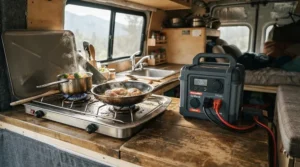
Specs on a page rarely match a genuinely busy Saturday, so here’s what that actually looks like in practice. A well-sized 2,000-3,000Wh unit running a fridge, lighting and POS system continuously, plus intermittent bursts from a coffee machine or panini press, will typically last a full 6-8 hour trading day comfortably, with battery percentage dropping steadily rather than in the sudden cliff-edge drops you get from a poorly matched setup.
What most buyers don’t anticipate is fan noise under sustained heavy load — most units are near-silent at idle but audibly whir once you’re pulling 1,500W+, which is worth factoring in if you’re trading somewhere noise-sensitive. Cold weather also genuinely reduces usable capacity in LiFePO4 batteries, typically by somewhere in the region of 10-20% below freezing, so winter market traders should build in extra margin rather than cutting it fine on a summer-tested runtime estimate.
Long-Term Cost & Maintenance: Total Cost of Ownership
Unlike a diesel generator, a battery power station has essentially no ongoing consumable cost — no oil changes, no fuel, no spark plugs — but the battery itself has a finite cycle life, typically rated between 3,000 and 6,500 cycles to 80% capacity depending on the unit. For a trader cycling the battery most days, that still works out to somewhere around 8-15+ years of realistic use before capacity meaningfully degrades, which comfortably beats most generators’ practical working lifespan when you factor in ongoing servicing.
Electricity cost per full charge is genuinely modest — a 2,000Wh unit costs only a few pounds to fully recharge from the mains at typical UK domestic rates — making the running cost advantage over diesel substantial once you account for fuel price volatility. The main long-term cost most buyers underestimate is expansion batteries or replacement units for units that eventually degrade below useful capacity, which is where the warranty length differences noted earlier genuinely matter to your total spend over five-plus years of trading.
Practical Usage Guide: Setup, Charging Routine and First 30 Days
Getting the most from a new power station starts before you ever plug in an appliance. Fully charge the unit before first use, and run through the manufacturer’s app pairing process if it has one — most units in this guide offer real-time load monitoring that’s genuinely useful once you’re relying on it daily. In the first month, deliberately undercharge and undercycle slightly rather than running the battery flat to empty every night; most LiFePO4 units handle full discharge cycles fine, but keeping typical daily use between roughly 20% and 90% extends usable lifespan meaningfully over years of daily commercial cycling.
A common first-30-days mistake is skipping a proper load test before your first live trading day — plug in your actual appliance combination at home first, watch the display for a few minutes under full simultaneous load, and confirm nothing trips before you’re relying on it in front of customers. Set a charging routine that fits your trading pattern: overnight mains charging suits most weekly traders, while daily traders often benefit from topping up via solar during quieter mid-morning periods rather than relying solely on overnight charging.
Store the unit somewhere dry and temperature-stable between uses where possible — extreme heat and cold both measurably shorten LiFePO4 battery lifespan over time, and a van that bakes in summer sun is a genuinely common culprit behind premature capacity loss reported in aggregated user reviews.
✨ Don’t Miss These Exclusive Deals!
🔍 Take your food truck power setup to the next level with these carefully selected units. Click on any highlighted product above to check current pricing and availability, and give your customers the reliable, generator-free service they’ll remember you for!
Real-World Scenarios: Three Traders, Three Power Setups
Consider a full-time food truck owner running five days a week, cooking hot food from a griddle and induction hob while keeping a chest freezer running throughout service — this is precisely the buyer who needs the EcoFlow Delta Pro or Jackery Explorer 2000 Plus, since anything under roughly 2,500W continuous will struggle the moment two heavy appliances overlap.
Now picture a weekend market stallholder selling artisan bread and coffee, trading Saturday mornings only, needing lighting, a card reader, a small fridge and an espresso machine for four hours. The BLUETTI AC180 or Anker SOLIX F2000 fits comfortably here — enough continuous output for the coffee machine without the weight or cost of the flagship units, and fast enough recharge to be ready again by next weekend without planning around it.
Finally, an allotment holder who visits three evenings a week to water, tend a small greenhouse and occasionally run power tools for maintenance work needs almost none of the above — the EcoFlow River 3 Plus, charged at home between visits, covers lighting, phone charging and light power tool use without ever needing anything close to food-truck capacity.
Problem → Solution: Fixing the 5 Most Common Power Failures on the Round
Problem: The unit shuts down mid-service when the fridge and hob run together. This is almost always a continuous load rating issue, not a fault — check your combined running wattage against the unit’s continuous rating and either reduce simultaneous appliance use or upgrade to a higher-output unit like the EcoFlow Delta Pro.
Problem: Battery percentage drops faster than expected in cold weather. LiFePO4 chemistry loses meaningful usable capacity below freezing — build in a bigger safety margin for winter trading, or keep the unit somewhere insulated between service bursts where practical.
Problem: The unit won’t fully recharge overnight before an early market start. Check your AC input wattage against the unit’s maximum charge rate; units like the Anker SOLIX F2000 or BLUETTI AC180 recharge dramatically faster than heavier flagship units and may suit an early-start routine better.
Problem: Card reader or POS intermittently drops out. This is occasionally a port-level output limitation rather than an overall capacity issue — plug sensitive electronics into a dedicated outlet where the unit offers one, and avoid daisy-chaining through a shared extension lead.
Problem: The unit is too heavy to move solo between van and pitch. Consider a lighter mid-range unit such as the BLUETTI AC180, or invest in a proper trolley rated for the unit’s weight — manually lifting 30kg+ units repeatedly is a genuine manual handling risk worth taking seriously.
Safety, Regulations and Street Trading Compliance
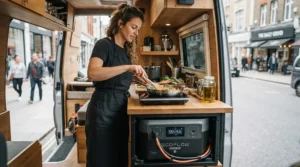
Electrical safety compliance isn’t optional for mobile catering or market trading in the UK, and it applies to battery power stations just as much as generators. Most local authorities now require an electrical safety certificate — typically a periodic inspection dated within the last three years — as part of any street trading licence application, alongside evidence that outdoor connections are protected by an RCD with a 30mA tripping current.
The HSE’s official guidance on maintaining portable electrical equipment sets out sensible, low-cost inspection routines that apply directly to power stations, extension leads and connected appliances used commercially — worth reading in full before your first trading season, since compliance failures can affect your licence as well as your safety. Practically, this means checking cables and plugs regularly for damage, avoiding daisy-chained extension leads, and keeping outdoor connections away from standing water or exposed to rain wherever possible.
FAQ
❓ What size power station do I need for a food truck?
❓ Can a power station run a food truck all day?
❓ Is a battery power station cheaper than a generator for trading?
❓ Do I need a licence to use a power station on a market stall?
❓ Can I use a power station for both my food truck and my allotment?
Conclusion
Choosing a power station for food truck use ultimately comes down to one honest calculation: what do you actually need running simultaneously during your busiest moment, and how much are you willing to carry to get it? For genuinely heavy hot-food operations, the EcoFlow Delta Pro and Jackery Explorer 2000 Plus earn their premium price tags through real, sustained continuous output rather than marketing numbers. For traders whose loads are lighter — drinks, baked goods, crafts — the BLUETTI AC180 and Anker SOLIX F2000 deliver most of the practical benefit at a noticeably friendlier price and weight.
Market stall traders and allotment holders shouldn’t feel pressured into flagship-level capacity they’ll never draw down; matching the unit to your actual appliance wattage draw, checking your local licensing requirements, and being honest about how far you’re prepared to carry a battery pack will get you to the right choice faster than chasing the biggest number on the spec sheet. Whichever unit you land on, the shift away from diesel generators genuinely does make trading quieter, cleaner and considerably less stressful — and that’s worth something no spec sheet fully captures.
Recommended for You
- Power Station 500-1000Wh: 7 Proven UK Picks (2026)
- Mid-Size Power Station vs Petrol Generator: 7 Best Picks 2026
- Portable Power Station 500-1500Wh: 7 Best UK Picks (2026)
Disclaimer: This article contains affiliate links. As an Amazon Associate, I earn from qualifying purchases. If you purchase products through these links, we may earn a small commission at no additional cost to you.
✨ Found this helpful? Share it with your friends! 💬🤗
