
In This Article
A power cut never announces itself politely. One minute the kettle’s on, the next you’re groping for a torch app while the fridge hums its last and the router blinks off mid-download. If you’ve ever sat through a three-hour outage wondering whether the freezer contents are salvageable, you already understand the appeal of a power station for whole house backup.
In plain terms: a power station for whole house backup is a large battery unit — typically lithium iron phosphate (LiFePO4) — that stores mains electricity and releases it through built-in AC outlets or a home transfer switch when the grid drops out, keeping fridges, routers, lighting and medical equipment running without fumes, noise or a trip to the petrol station.
This isn’t a niche worry, either. Depending on where you live, you might be dodging outages far more often than a Londoner does — and every one of them is a reason to have a plan. We’ll walk through seven real, currently available units spanning budget to premium, explain how transfer switches and load prioritisation actually work, and help you figure out exactly how much capacity your household needs. No vague marketing waffle — just specs, honest analysis, and the trade-offs nobody puts on the box.
Quick Comparison Table
| Power Station | Capacity | Continuous Output | Price Range | Best For |
|---|---|---|---|---|
| Jackery Explorer 300 Plus | 288Wh | 300W | Around £250-£300 | First-time buyers, essential appliances backup |
| Bluetti AC70 | 768Wh | 1,000W | £550-£650 range | Router, laptop, small circuit backup |
| Anker SOLIX C800 | 768Wh | 800W (2,400W surge) | £750-£900 range | Solar-dependent households |
| Bluetti AC200L | 2,048Wh | 2,400W | £1,350-£1,500 range | Expandable mid-range whole-house backup |
| EcoFlow DELTA 2 Max | 2,048Wh | 2,400W | £850-£950 range | Power station under £2000 for home backup |
| FOSSiBOT F2400 | 2,048Wh | 2,200W (4,800W surge) | £1,200-£1,600 range | Fridge-freezer + full essentials overnight |
| Bluetti Apex 300 | 2,765Wh | 3,000W+ | £2,000-£2,500+ range | True whole-home, long-term scalability |
Looking across this table, there’s a clean split between “essential circuit” units under 1,000Wh and genuine “whole house” contenders at 2,000Wh and beyond. The Bluetti AC200L and EcoFlow DELTA 2 Max sit in the sweet spot most UK households land in — big enough to matter, expandable enough to grow, and still comfortably a power station under £2000 for home backup. The Bluetti Apex 300 is the outlier: it costs more upfront but its expansion ceiling dwarfs everything else here.
💬 Found a pick you like already? Bookmark this page and come back once you’ve sized your circuits — it’s worth doing properly before you buy.
Top 7 Power Stations for Whole House Backup: Expert Analysis
1. Jackery Explorer 300 Plus — best entry point for essential appliances backup
The Jackery Explorer 300 Plus is where most people should start, not because it’s flashy, but because it’s honest about what it does. Its 288Wh LiFePO4 cell and 300W continuous output won’t run a fridge-freezer for long, but it will comfortably manage a router, a lamp, phone charging and a laptop through a multi-hour cut. At 3.75kg it’s light enough to move between rooms, and the 100W USB-C PD port fast-charges a laptop directly without an adapter — a small detail that saves real hassle at 2am during a blackout.
Based on the spec comparison, this is squarely a power station for essential appliances backup rather than a whole-house solution, and Jackery is upfront about that positioning rather than overselling it. It suits renters, small flats, or anyone building a backup system gradually — buy this first, add a second or bigger unit later. Reviewers consistently note the build quality and UK warranty support are stronger than most budget competitors at this price point, with the battery management system rated for 52 separate safety protections. Aggregated feedback flags the small size as a genuine limitation for anything beyond light-duty backup — don’t expect it to touch a kettle or microwave.
Pros:
- ✅ Genuinely portable at 3.75kg — easy to move between rooms
- ✅ 100W USB-C PD charges laptops without a separate adapter
- ✅ Strong UK warranty support relative to price
Cons:
- ❌ 288Wh won’t sustain a fridge for more than an hour or two
- ❌ No solar expansion ecosystem to grow into later
At around £250-£300, this is a low-risk way to dip a toe into home backup. Value verdict: excellent if your goal is essential appliances backup, poor if you’re picturing whole-house coverage.

2. Bluetti AC70 — best small circuit-level backup for router and devices
Step up to the Bluetti AC70 and you get 768Wh of LiFePO4 capacity with 1,000W continuous output — enough headroom to run a small fridge, a router, lighting and a laptop simultaneously for the better part of a working day. The 700W solar input means it can trickle-charge itself during a prolonged multi-day outage, which the Jackery above simply can’t do.
What most buyers overlook about this model is that it’s really a circuit-level backup tool rather than a whole-house one: think of it as covering a single “essentials” extension lead rather than your consumer unit. That framing matters because it changes how you should shop — you’re not comparing it to a generator, you’re comparing it to “what absolutely cannot go dark.” Reviewers consistently report solid build quality and a genuinely useful mobile app for monitoring charge state remotely, though a recurring complaint in user reviews is that the fan is audible under heavier loads, noticeable in a quiet room at night.
Pros:
- ✅ 700W solar input allows multi-day off-grid recharging
- ✅ 1,000W output covers router, lighting and small fridge together
- ✅ LiFePO4 chemistry rated for thousands of charge cycles
Cons:
- ❌ Audible fan noise under sustained heavier loads
- ❌ Not enough headroom for a kettle or hob simultaneously
Priced in the £550-£650 range, the Bluetti AC70 earns its keep as a circuit-level backup unit for anyone who wants more runway than an entry-level pick without committing to a full whole-house system yet.
3. Anker SOLIX C800 — best surge headroom for solar-reliant households
The standout feature of the Anker SOLIX C800 is its startling 2,400W surge rating on a 768Wh unit — nearly triple its 800W continuous output. In practice, that means appliances with a high startup spike (fridge compressors, certain pumps) won’t trip the unit even when the tank isn’t full, something cheaper units in this capacity class often struggle with.
On paper this means the C800 is best suited to households that lean on solar as their primary recharge method rather than mains alone — its 400W solar input and Anker’s scheduling-capable app make it a credible daily-cycling unit, not just an emergency-only box gathering dust in a cupboard. What the spec sheet won’t tell you, but reviewers note, is that Anker’s build quality and firmware polish are a genuine step up from many budget rivals, though the unit runs heavier than comparable capacity competitors at 9.1kg, which matters if you’re planning to relocate it around the house during a cut.
Pros:
- ✅ 2,400W surge rating handles high-draw appliance startup cleanly
- ✅ 400W solar input suits daily solar-dependent cycling
- ✅ Polished companion app with usage scheduling
Cons:
- ❌ 800W continuous output is modest relative to the surge figure
- ❌ Heavier than similarly sized rivals at 9.1kg
At £750-£900, this is the pick for buyers who already have or plan to add solar panels and want a unit engineered around that use case rather than mains-only charging.
4. Bluetti AC200L — best expandable mid-range whole-house pick
This is where the article’s “whole house” claim starts to earn its name properly. The Bluetti AC200L delivers 2,048Wh standalone with 2,400W continuous output, and critically, it’s expandable — bolt on additional battery packs and you can scale capacity well beyond the base unit without replacing anything.
Based on the spec comparison, 2,400W of continuous output covers almost everything in a typical UK kitchen except a full-power kettle or electric shower running simultaneously with other loads — a genuinely useful ceiling for real-world outages. What most buyers overlook is the expansion economics: buying a small unit and scaling later is often cheaper and more flexible than committing to one enormous power station upfront, especially if your budget starts as a power station under £2000 for home backup and grows over time. Reviewer sentiment aggregated across retail listings is strongly positive, with a 4.8-out-of-5 average across dozens of verified purchases, though a recurring theme is that the companion app’s update cadence lags Bluetti’s own hardware releases.
Pros:
- ✅ Expandable battery system scales capacity over time
- ✅ 2,400W continuous output covers most kitchen appliances
- ✅ Strong aggregated review average across verified buyers
Cons:
- ❌ App feature updates reportedly lag behind hardware
- ❌ Base unit alone won’t stretch to multi-day heating loads
In the £1,350-£1,500 range, the Bluetti AC200L is one of the strongest arguments in this entire list for buying mid-range and expanding rather than overspending on a premium unit from day one.
5. EcoFlow DELTA 2 Max — the sensible power station under £2000 for home backup
If you asked ten UK home-backup forums for a single recommendation, a lot of them would land on the EcoFlow DELTA 2 Max. Its 2,048Wh standalone capacity and 2,400W continuous output (with X-Boost stretching that to 3,100W for brief high-draw moments) covers essentially everything in a UK home bar a full-power kettle or electric shower.
Here’s what to weigh: the real differentiator isn’t the base unit, it’s the expansion path. Add an EcoFlow Smart Extra Battery and you’re at roughly 4kWh; add a second and you’re near 6kWh — built out gradually rather than paying for a £3,000 system on day one. It runs on the same mature EcoFlow app across the whole product range, including the EcoFlow Smart Home Panel for proper circuit-level backup wired into your consumer unit. Reviewers consistently praise the sub-hour 0-80% recharge time, though a fair complaint in aggregated feedback is that at 23kg, this isn’t something you casually carry between rooms — it’s designed to live permanently in a utility room or garage corner.
Pros:
- ✅ 2,400W (3,100W boosted) output covers nearly all home appliances
- ✅ Modular expansion batteries avoid a single huge upfront cost
- ✅ Sub-hour fast charging from 0-80%
Cons:
- ❌ 23kg means it’s effectively stationary, not portable
- ❌ Expansion batteries carry a per-Wh premium over the base unit
At around £850-£950, this genuinely is a power station under £2000 for home backup even after adding an expansion battery or two — which is precisely why it shows up on so many independent UK comparison lists.
6. FOSSiBOT F2400 — best for full essentials backup through the night
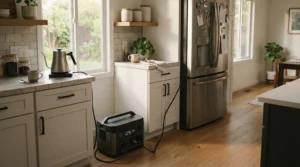
Reviewers who’ve tested this against fridge-freezer runtime specifically tend to land on the same conclusion: the FOSSiBOT F2400 is the practical choice when “essentials” means the whole essentials list, not just a couple of devices. Its 2,048Wh capacity runs an average UK fridge-freezer (150-200W draw) for roughly 8-10 hours while simultaneously keeping Wi-Fi, phone charging and lighting live — a scenario that matches almost exactly what happens during a real evening power cut.
What most buyers overlook about surge ratings is how much they matter at appliance switch-on, and the F2400’s 4,800W surge handles UK appliance startup loads — fridge compressors, pump motors — comfortably where lower-surge units occasionally trip. Its sub-30-millisecond UPS switchover time means anything plugged directly in barely notices the grid dropping out, which matters enormously if you’re backing up a router or a CPAP machine rather than just lighting. Aggregated review sentiment is favourable on raw performance, though as a newer brand to the UK market it doesn’t yet carry the multi-year track record that Jackery or EcoFlow have built up.
Pros:
- ✅ Runs a full-size fridge-freezer for 8-10 hours on one charge
- ✅ 4,800W surge comfortably handles appliance startup spikes
- ✅ Sub-30ms UPS switchover barely registers on connected devices
Cons:
- ❌ Newer brand with a shorter UK track record than established rivals
- ❌ Less mature accessory and app ecosystem than EcoFlow or Bluetti
Priced in the £1,200-£1,600 range, the FOSSiBOT F2400 is the pick when your priority is genuinely keeping the fridge cold overnight, not just the router blinking.
7. Bluetti Apex 300 — most scalable true whole-home backup system
For buyers who’ve decided resilience is a long-term project rather than a one-off purchase, the Bluetti Apex 300 is the ceiling-raiser on this list. Its 2,765Wh base capacity already covers 99% of household appliances — laptops, fridges, coffee machines, fans, and even heavier-duty loads like washing machines and well pumps — but the real story is the expansion path, which scales up to a genuinely startling 58kWh via additional battery modules.
Based on the spec comparison, no other unit here comes close to that ceiling, which is precisely why independent reviewers have specifically flagged it as a standout for whole-home backup rather than emergency-only use. What that means in practice is you’re not just buying a power station for whole house backup, you’re buying the foundation of a system that can eventually rival a small home battery installation, at a fraction of the disruption and cost of a full solar-and-battery retrofit. Reviewer sentiment praises the expandability and solid day-to-day performance, though this is unambiguously a premium purchase — the base unit alone sits above the £2,000 mark, and the real value only shows up once you factor in years of expansion runway.
Pros:
- ✅ Expandable to 58kWh — far beyond any rival on this list
- ✅ 2,765Wh base already covers 99% of household appliances
- ✅ Positions as a genuine long-term whole-home backup foundation
Cons:
- ❌ Premium pricing puts it above most household budgets upfront
- ❌ Overkill if your actual need is essential appliances backup
At roughly £2,000-£2,500+ before expansion, this is the pick for households treating power resilience as infrastructure, not an afterthought.
Practical Usage Guide: Circuit-Level Backup, Transfer Switches and Load Prioritisation
Buying the hardware is the easy part. Getting real whole-house value out of it depends on three things most listings gloss over. First, circuit-level backup: rather than running extension leads across your living room during a cut, a proper setup ties the power station directly into specific circuits on your consumer unit — fridge, lighting, boiler controls, router — so backup power flows through your existing sockets automatically. This is the difference between an emergency box you drag out twice a year and a system that just quietly works.
Second, transfer switch compatibility is the piece that makes circuit-level backup possible and safe. A transfer switch physically isolates your chosen circuits from the grid before connecting them to your power station, preventing the genuinely dangerous scenario of backfeeding electricity into grid lines during a fault. EcoFlow’s Smart Home Panel, for example, manages up to 10 circuits automatically with a roughly 20-millisecond switchover, while manual transfer switches let you select a handful of essential circuits — fridge, a couple of sockets, lighting — that stay powered without any dependency on an app. Whichever route you take, this is not a DIY electrical job: installation has to be carried out by a qualified, registered electrician working to UK wiring regulations.
Third, load prioritisation is how you stretch limited capacity across an extended outage. Every major ecosystem (EcoFlow, Bluetti, Anker) lets you rank circuits by priority in-app, so if capacity drops low the system automatically sheds non-essential loads — outdoor sockets, say — before touching the fridge or your medical equipment. Set this up once, properly, rather than during a blackout at midnight.

Real-World Scenarios: Which Power Station Suits Your Household
Picture three households. First, a young professional in a one-bed flat who mostly worries about the router and laptop staying alive through short evening cuts — the Jackery Explorer 300 Plus or Bluetti AC70 covers this without over-spending, and portability actually matters here since there’s no permanent spot to leave a 23kg unit. Second, a family of four in a three-bed semi with a full fridge-freezer, needing lighting, Wi-Fi and the freezer to survive a multi-hour evening cut without panic — this is exactly the FOSSiBOT F2400 or EcoFlow DELTA 2 Max territory, both built around that specific runtime. Third, a rural household on a network with genuinely frequent interruptions, perhaps also running a home office that can’t afford downtime, where the Bluetti Apex 300‘s expansion path or the Bluetti AC200L‘s scalability starts to look like sensible infrastructure rather than overkill. Match your household’s actual outage frequency and appliance list to these profiles before you buy, not the other way around.
Problem → Solution: Common Whole-House Backup Mistakes
A recurring problem is buyers sizing a unit around wishful thinking rather than real load — solution: add up the actual wattage of your must-run appliances (fridge, router, a few lights) rather than assuming “whole house” means literally everything. Another common issue is discovering mid-outage that the unit isn’t wired into any circuits at all — solution: sort transfer switch installation before you need it, not during a cut. A third frequent complaint is buyers choosing a power station for essential appliances backup that’s too small for a family kitchen — solution: match capacity to household size using the product comparisons above rather than the cheapest unit on the shelf. Finally, several reviewers report forgetting to test their system — solution: run a scheduled monthly discharge-and-recharge cycle so you know it actually works before an emergency proves otherwise.
How to Choose a Power Station for Whole House Backup
- Total your essential wattage. List every appliance you genuinely need — fridge, router, lighting, boiler controls — and add their running watts together as your floor requirement.
- Check the surge rating, not just continuous output. Compressor-driven appliances spike on startup; a low surge rating can trip a unit even with capacity to spare.
- Decide portable vs stationary. Anything above roughly 15kg effectively lives in one spot — factor that into where you’ll install a transfer switch.
- Confirm expansion compatibility. Buying into an ecosystem (EcoFlow, Bluetti, Anker) that supports add-on batteries protects your investment as needs grow.
- Budget for installation, not just hardware. A qualified electrician fitting a transfer switch typically adds a meaningful sum on top of the unit price — build that in from the start.
- Weigh solar input if outages run long. Multi-day resilience depends on recharging capability, not just battery size.
- Read aggregated review sentiment, not star averages alone. Look for recurring, specific complaints (fan noise, app bugs) rather than headline ratings.
Power Station for Essential Appliances Backup vs Whole-House Systems
These two categories get conflated constantly, and it costs buyers money in both directions. A power station for essential appliances backup — think the Jackery Explorer 300 Plus or Bluetti AC70 — is built around a handful of must-run devices: router, lighting, phone charging, maybe a small fridge. It’s cheaper, lighter, and genuinely sufficient for short, occasional cuts. A true whole-house system, by contrast, is sized and wired to keep multiple rooms and a full kitchen running for hours, often through a transfer switch tied into the consumer unit rather than a single extension lead. The honest advice: don’t buy whole-house capacity you’ll never use, but equally, don’t stretch an essentials-only unit across a household that genuinely needs more — check the comparison table above against your own appliance list before deciding which category you actually fall into.
Power Station vs Petrol Generator for Whole-House Backup
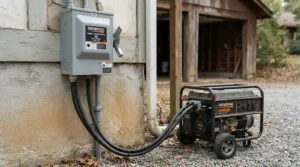
The obvious alternative to a battery power station is a petrol or diesel generator, and it’s worth being honest about the trade-offs rather than dismissing generators outright. Generators typically deliver higher sustained wattage for lower upfront cost per watt, and they can run indefinitely as long as fuel keeps arriving. But they’re loud, produce carbon monoxide that makes indoor or enclosed use genuinely dangerous, need regular maintenance, and require you to store flammable fuel safely. A power station for whole house backup, by contrast, is silent, safe to run indoors, requires effectively zero maintenance, and recharges from the mains or solar panels rather than a fuel can — at the cost of a hard capacity ceiling once the battery’s depleted. For most suburban and urban UK households, the safety and noise profile alone tips the decision toward a battery system; rural properties with space to store and run a generator safely may reasonably go either way.
Home Backup Power Station Review: What UK Owners Actually Report
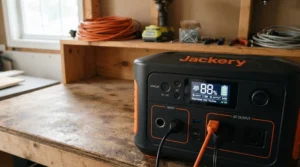
Pulling together aggregated feedback across the products in this guide rather than any single retailer’s star rating, a few patterns repeat consistently. LiFePO4 units across all seven brands here draw praise for genuinely quiet operation and low heat output compared with older lithium-ion designs. App reliability is the most common point of friction — EcoFlow’s ecosystem draws the most consistently positive comments, while newer entrants like FOSSiBOT show more variance in review sentiment simply due to a shorter track record. Build quality complaints are rare across established brands but do surface occasionally around connector durability after heavy daily cycling. If you’re reading a home backup power station review anywhere else, weigh specific, repeated complaints more heavily than a single five-star or one-star outlier — aggregate sentiment tells you far more than any individual review.
Power Station Under £2000 for Home Backup: Best Value Picks
| Model | Standalone Capacity | Price Range | Expandable To |
|---|---|---|---|
| EcoFlow DELTA 2 Max | 2,048Wh | £850-£950 | ~6kWh |
| Bluetti AC200L | 2,048Wh | £1,350-£1,500 | Multiple add-on packs |
| FOSSiBOT F2400 | 2,048Wh | £1,200-£1,600 | Manufacturer-dependent |
Interpreting this table: all three land comfortably as a power station under £2000 for home backup on their own, yet each offers a growth path beyond that base capacity, so you’re not locking yourself into today’s needs permanently. The EcoFlow DELTA 2 Max offers the lowest entry cost per Wh here, while the Bluetti AC200L and FOSSiBOT F2400 trade a higher upfront price for stronger continuous output or surge handling respectively — the right pick depends on whether your must-run appliance list is light or heavy.
Safety, Regulations & Lithium Battery Compliance in the UK
All seven units in this guide use LiFePO4 chemistry, which is meaningfully more thermally stable than older lithium-ion formats and the industry’s preferred choice for stationary home backup for that reason. That said, sensible precautions still apply: keep units ventilated, away from direct heat sources, and never attempt to wire a transfer switch yourself — UK wiring regulations require a qualified, registered electrician for any connection into your consumer unit, and getting this wrong risks both safety and warranty validity. If you’re researching wider household electricity resilience, it’s worth understanding how regional power cut frequency varies across the UK, since rural and northern areas experience meaningfully more interruptions than London and the South East, which should factor into how much capacity and redundancy you actually need.
Long-Term Cost & Maintenance
A power station for whole house backup is close to maintenance-free compared with a generator — no oil changes, no fuel stabiliser, no annual service. The main long-term cost variable is battery degradation: LiFePO4 cells in the units featured here are typically rated for 3,000-plus full charge cycles before capacity noticeably drops, which at a monthly test-and-recharge routine works out to multiple decades of realistic use. Total cost of ownership should also account for expansion batteries if you’re building capacity gradually, and for professional transfer switch installation if you want proper circuit-level backup rather than extension leads. For context on what your must-run appliances actually cost to power, typical UK household appliance wattage figures are a useful starting point when sizing a system, and pairing that with an appliance energy ratings guide helps you avoid over- or under-buying capacity. It’s also worth noting that battery-based home backup is a fast-moving category — brands like Anker have expanded aggressively into whole-home battery ecosystems in recent years, so checking for newer model releases before you commit is generally worthwhile.
FAQ
❓ How big a power station do I need for whole house backup?
❓ Can I install a power station for whole house backup myself?
❓ What's the difference between circuit-level backup and whole-house backup?
❓ Is a power station under £2000 for home backup actually enough capacity?
❓ How does load prioritisation work on a home backup power station?
Conclusion
There’s no single “best” power station for whole house backup — there’s only the right size for your household’s actual appliance list, outage frequency, and budget. If you’re just protecting a router and a lamp, the Jackery Explorer 300 Plus does the job without overspending. If you need a fridge-freezer and full essentials covered overnight, the FOSSiBOT F2400 or EcoFlow DELTA 2 Max earn their price tags. And if resilience is a long-term priority rather than a once-a-year worry, the Bluetti Apex 300‘s expansion ceiling is genuinely hard to match. Whichever tier fits, pair the hardware with a properly installed transfer switch and sensible load prioritisation, and a power cut stops being an emergency and starts being a mild inconvenience.
✨ Don’t Miss These Exclusive Deals!
🔋 Take your home backup planning to the next level with the picks above. Click through on any bolded product to check current pricing and availability before you decide!
Recommended for You
- Power Station vs Generator For Home Backup: 7 Best Picks (2026)
- Portable Power Station 1500-3000Wh: 7 Best UK Picks (2026)
- Power Station For Glamping Weekends: 7 Ultimate Picks (2026)
Disclaimer: This article contains affiliate links. As an Amazon Associate, I earn from qualifying purchases. If you purchase products through these links, we may earn a small commission at no additional cost to you.
✨ Found this helpful? Share it with your friends! 💬🤗
