
In This Article
British market trading is a battery problem hiding as a business. You’ve got the gazebo sorted, the till float counted, the stock arranged just so — and then a customer taps their card at 11am and your reader’s flashing red because nobody thought about power. A power station for outdoor markets solves exactly this: a portable, rechargeable battery unit — not a generator, no fuel, no fumes — built to keep your card reader, lights and phone charger running from set-up to pack-down. Whether you’re doing a Saturday car boot sale, a full farmers’ market pitch, or a day’s fishing where the same battery keeps your bite alarm and phone alive, the right unit turns “I hope it lasts” into “it lasts, full stop.”

This guide compares seven real, currently available units — from a budget-friendly entry-level box to a premium multi-stall powerhouse — with honest analysis of what each one is actually good at, not just what the spec sheet says. We’ll cover card reader power draw specifically (it’s lower than you’d think, but the phone running it isn’t), portable lighting that won’t drain your battery by lunchtime, and the regulatory quirks that make a power station for outdoor markets the sensible choice over a generator at most licensed events. Stick around for the seven-product breakdown, three real trading scenarios, and a plain-English answer to the one question every trader eventually asks: will this actually get me through a whole day?
What Is a Power Station for Outdoor Markets?
A power station for outdoor markets is a portable, rechargeable lithium battery unit — think a suitcase-sized power bank — with AC sockets, USB ports and a 12V output, built to run card readers, string lights, phone chargers and small electronics through a full day of outdoor trading without a mains connection. Capacity is measured in watt-hours (Wh), which tells you how much energy is stored; output is measured in watts (W), which tells you how much you can draw at once. Get either number wrong for your setup and you’ll either run out of juice by 2pm or trip the unit trying to run too much simultaneously.
Most 2026 models use LiFePO4 (lithium iron phosphate) cells rather than the older lithium-ion chemistry found in cheap power banks — LiFePO4 is more stable, tolerates thousands of charge cycles, and copes with a cold, damp market morning far better. It’s also worth knowing the legal backdrop: many UK councils that issue street trading licences explicitly restrict or ban petrol and diesel generators on pitches, which is one of the quieter reasons battery power stations have become the default choice for market traders rather than a lifestyle upgrade.
Quick Comparison Table
Before the full breakdown, here’s the shortcut version — five scenarios, five picks, at a glance.
| Product | Capacity / Output | Best For |
|---|---|---|
| BLUETTI EB3A | 268Wh / 600W | Best budget pick for phones, lights and a card reader |
| Jackery Explorer 500 v2 | 512Wh / 500W | Best for a power station for car boot sale trips |
| EcoFlow RIVER 2 Pro | 768Wh / 800W | Best for a power station for day fishing |
| EcoFlow DELTA 2 | 1,024Wh / 1,800W | Best all-rounder for a full trading day |
| EcoFlow DELTA 2 Max | 2,048Wh / 2,400W | Best premium pick for multi-stall setups |
Looking at this shortlist, the pattern is clear: capacity and output climb together as trading days get longer and busier, but the “best” pick genuinely depends on whether your bottleneck is weight, budget, or raw power. Nobody needs the top row and the bottom row’s specs at once — matching the unit to your actual trading day, not the biggest number on the page, is the whole exercise.
💬 Just one click — help other traders make better buying decisions too!😊
Top 7 Power Stations for Outdoor Markets: Expert Analysis
Here’s the full seven, spanning budget to premium, with real specs and honest commentary on each.
| Product | Capacity | Continuous Output | Price Range | Best For |
|---|---|---|---|---|
| BLUETTI EB3A | 268Wh | 600W | £190–£240 | Budget entry, solo traders |
| Jackery Explorer 500 v2 | 512Wh | 500W | £380–£450 | Car boot sales, light carrying |
| EcoFlow RIVER 2 Pro | 768Wh | 800W | £430–£500 | Full trading day, all-rounder |
| Anker SOLIX C1000 (Gen 2) | ~1,056Wh | 1,800W | £650–£800 | Back-to-back trading days |
| EcoFlow DELTA 2 | 1,024Wh | 1,800W | £470–£540 | Default workhorse pick |
| Oukitel P2001 | 2,000Wh | 2,000W | Check current price | Best capacity-per-pound |
| EcoFlow DELTA 2 Max | 2,048Wh | 2,400W | £1,050–£1,250 | Multi-stall, catering setups |
Looking at the comparison above, capacity and output tell two different stories — the Oukitel P2001 and EcoFlow DELTA 2 Max lead on raw numbers, but for most single-stall traders the EcoFlow DELTA 2 or EcoFlow RIVER 2 Pro deliver everything a normal trading day needs without paying for headroom you’ll never use. If weight is your main constraint rather than power, the Jackery Explorer 500 v2 remains the standout despite its lower output ceiling.
1. BLUETTI EB3A — cheapest genuine LiFePO4 entry point
The BLUETTI EB3A opens at the affordable end and doesn’t cut the one corner that matters: it still uses a genuine LiFePO4 cell, not the cheaper lithium-ion pack older budget units relied on.
Specs: 268Wh capacity, 600W continuous output (1,200W surge), roughly 4kg. On paper this means enough headroom to run a card reader’s charging dock, an LED light bar and a phone charger simultaneously for the best part of a day, though it won’t stretch to a coffee machine or a heater.
Honest take: this is squarely a beginner’s unit — a first-time market trader or someone doing the odd car boot sale who wants to stop worrying about their card reader dying mid-transaction. Reviewers consistently flag the compact size and the dual USB-C PD ports as genuinely useful for charging a phone and a tablet POS system together, though several note the small screen is hard to read in bright daylight — a real consideration for anyone trading outdoors.
Pros:
- ✅ Genuine LiFePO4 cell at a budget price point
- ✅ Light enough to carry one-handed to a pitch
- ✅ Dual USB-C PD ports charge phone and tablet together
Cons:
- ❌ 600W output rules out kettles or heaters
- ❌ Small screen is hard to read in direct sunlight
Typically listed in the £190–£240 range at the time of research, this is the honest budget verdict: it won’t run everything, but for what most solo traders actually need, it’s hard to beat for the money.
2. Jackery Explorer 500 v2 — lightest pick for a one-person stall
The Jackery Explorer 500 v2 trades outright power for portability, and for a huge number of market traders that’s exactly the right trade.
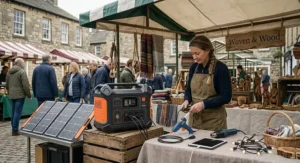
At 512Wh and 6.4kg, it’s the lightest unit on this list, with a 500W continuous output (1,000W surge) that comfortably covers a card reader dock, phone charger, LED lighting rig and a small Bluetooth speaker without breaking a sweat. The pure sine wave inverter matters here — it’s the cleaner power waveform that sensitive electronics like tablet POS systems and card readers actually prefer, versus the rougher modified sine wave found in some cheaper alternatives.
Based on the spec comparison, this is the pick for anyone doing a power station for car boot sale run — where you’re carrying the unit from car to boot to pitch, possibly more than once a morning, and 6.4kg is the difference between a minor inconvenience and a genuine ache by midday. Jackery’s UK warranty support is also one of the more established among the smaller brands, which matters if something goes wrong six months in.
Pros:
- ✅ Lightest unit here, easy for solo carrying
- ✅ Pure sine wave output suits sensitive card readers
- ✅ Well-established UK warranty and support network
Cons:
- ❌ 500W continuous limits it to light-duty electronics only
- ❌ No pass-through charging while running devices
Priced in the £380–£450 range at most UK retailers, this is the sensible pick for anyone who values their shoulders over spec sheets.
3. EcoFlow RIVER 2 Pro — best all-rounder for a full trading day
The EcoFlow RIVER 2 Pro sits in the sweet spot between “light enough to carry” and “powerful enough to stop thinking about it.”
768Wh of capacity and an 800W continuous output (1,600W surge) means it comfortably runs a card reader dock, string lighting, a phone and tablet charging station, and even a small portable fan on a warm day, all at once. EcoFlow’s X-Boost software mode can push supported low-draw appliances up to 1,000W by softening the inrush current — what most buyers overlook about this feature is that it doesn’t add real power, it just lets certain devices start without tripping the inverter.
What the spec sheet won’t tell you, but reviewers note, is how well this unit copes with a genuinely long day: several long-term reviews mention it lasting a full farmers’ market shift with lighting and charging running continuously, battery to spare. The trade-off is weight — at 7.8kg it’s noticeably heavier than the Jackery above, so it suits a static stall more than repeated car-to-pitch carrying. It’s also the unit worth reaching for if you’re after a power station for day fishing, where a long, unpredictable session rewards genuine capacity over featherweight carrying.
Pros:
- ✅ Comfortably covers a full trading day of mixed devices
- ✅ Fast recharge — usable again within the hour
- ✅ X-Boost mode adds real flexibility for edge-case devices
Cons:
- ❌ Heavier than the Jackery and BLUETTI options above
- ❌ App connectivity via Bluetooth only, no standalone WiFi
Usually found in the £430–£500 range, this is the one to buy if you only want to buy one power station and be done with it.
4. Anker SOLIX C1000 (Gen 2) — fastest recharge between market days
The Anker SOLIX C1000 (Gen 2) answers a very specific market-trader problem: what happens when you’ve got back-to-back trading days and no time to wait eight hours for a recharge.
At roughly 1,056Wh capacity and 1,800W continuous output (2,400W surge), it has enough headroom for a card reader dock, full lighting rig, laptop, tablet and phone charging simultaneously, plus occasional heavier draws like a small heater on a cold morning. The standout figure, though, is recharge speed: a full charge from empty in around 49 minutes on mains power, roughly six to eight times faster than older-generation units of similar capacity.
Here’s what to weigh: that speed matters enormously if you’re doing a Friday market and a Saturday car boot sale on consecutive days and only have an evening at home to top up, but it’s largely irrelevant if you only trade once a fortnight. Aggregated UK reviewer feedback consistently praises the build quality and app control, with the main recurring gripe being the premium price relative to the EcoFlow DELTA 2 at similar capacity.
Pros:
- ✅ Full recharge in under an hour via mains
- ✅ 1,800W output handles genuinely demanding setups
- ✅ Strong app control and build quality reported by users
Cons:
- ❌ Priced at a premium versus similar-capacity rivals
- ❌ Overkill for occasional, single-day traders
Typically priced in the £650–£800 range, this is the pick for frequent, back-to-back traders rather than the occasional weekend seller.
5. EcoFlow DELTA 2 — the trader’s workhorse
If there’s one unit that keeps coming up as the default recommendation for outdoor trading, it’s the EcoFlow DELTA 2 — and the reasons are less about any single standout spec and more about how well the whole package balances.
1,024Wh capacity and 1,800W continuous output (2,700W surge) is enough to run a card reader, a full LED lighting setup, phone and tablet charging, a small portable heater on cold mornings, and still have headroom for a coffee machine during quiet periods — genuinely useful for a food or drink stall. The battery is also modular: EcoFlow sells an extra battery pack that doubles capacity for traders who need to cover multi-day events without a recharge.
Based on aggregated review sentiment across UK retailers, this unit’s reputation rests on reliability more than any flashy feature — it’s the one people mention lasting years of weekly use without a noticeable drop in runtime, which matters more than any single spec once you’re using it every week rather than occasionally.
Pros:
- ✅ Balanced capacity and output for almost any stall setup
- ✅ Expandable battery for multi-day events
- ✅ Strong reputation for long-term reliability
Cons:
- ❌ Bulkier to store than the lighter options above
- ❌ Extra battery pack is a separate, additional cost
Usually available in the £470–£540 range, this is the closest thing on this list to a genuinely safe default choice.

6. Oukitel P2001 — biggest capacity per pound spent
The Oukitel P2001 is the lesser-known name on this list, and that’s precisely why it’s worth including: it delivers genuinely premium-tier capacity from a brand that hasn’t built the same UK retail presence as Jackery or EcoFlow, which tends to mean sharper promotional pricing.
At 2,000Wh capacity and 2,000W continuous output (4,000W surge), it comfortably runs an entire multi-appliance stall — lighting rig, card reader, tablet POS, a mini fridge for a drinks stall, and charging for several devices at once — with genuine reserve capacity left over. Recharge from empty to 80% takes around 90 minutes on a 1,500W mains input, respectable for a unit this size, though nowhere near the Anker’s headline speed above.
What most buyers overlook about brands like this is that build quality and after-sales support are the real question, not raw specs — the numbers on paper are excellent, but the smaller UK support network is a genuine trade-off worth weighing. Reviewers consistently praise the sheer capacity for the asking price, with the recurring caveat being its considerable weight, which makes it a two-person carry to a pitch rather than a solo one.
Pros:
- ✅ Exceptional capacity-to-price ratio versus major brands
- ✅ 2,000W output covers genuinely demanding multi-device setups
- ✅ Solar input compatible for off-grid top-ups
Cons:
- ❌ Considerably heavier — a two-person carry in practice
- ❌ Smaller UK support network than Jackery or EcoFlow
Prices fluctuate significantly with promotions on this one, so check the current price before assuming a figure — as a guide, it typically sits as a genuine premium-capacity alternative at a mid-premium price point.
7. EcoFlow DELTA 2 Max — built for multi-stall setups
At the top of this list, the EcoFlow DELTA 2 Max is overkill for a single card-reader-and-lights stall — and exactly right for anyone running multiple gazebos, a food trailer, or a stall that genuinely needs serious, continuous power.
2,048Wh capacity (expandable to around 6kWh with additional battery packs) and a 2,400W continuous output (5,000W surge) means it can run several lighting rigs, multiple card readers and tablets, a fridge, and a hot-drinks setup simultaneously without flinching. This is the unit where “capacity matters more than output” flips — at this size, the 2,400W ceiling is what unlocks running genuinely power-hungry catering equipment that smaller units simply can’t touch.
On paper this means it’s the right call for a small business running several stalls or a multi-day event where mains hookup isn’t available and a generator isn’t permitted under the market’s licence conditions. Aggregated reviewer feedback consistently rates the build quality and app monitoring highly, with the understandable caveat that most reviewers bought it for van life or home backup rather than market trading specifically, so trader-specific feedback is thinner than for the DELTA 2 below it.
Pros:
- ✅ Genuine multi-appliance, multi-stall power headroom
- ✅ Expandable capacity for extended, multi-day events
- ✅ Strong app monitoring and build quality reputation
Cons:
- ❌ Significant overkill and cost for a single small stall
- ❌ Considerably heavier and bulkier than every other option here
Typically priced in the £1,050–£1,250 range, this is a considered investment for a genuinely power-hungry setup, not a default first purchase.
Setting Up Your Power Station for a Trading Day
Get the boring bit right the night before and the trading day looks after itself. Charge your unit to 100% the evening before a market — not the morning of, since most units take longer to charge than the average trader has before setting off.
On arrival, position the power station somewhere flat, dry and off the ground if possible — a plastic crate or the underside shelf of a stall table keeps it away from puddles and morning dew, a genuinely common cause of avoidable damage. Run your card reader and any tablet from a USB or USB-C port rather than the AC inverter where the device supports it; it’s more efficient and puts less load on the unit overall.
Common first-30-days mistakes worth avoiding: running an extension lead loosely across a walkway (a trip hazard and a liability risk under your public liability insurance), overloading a single AC socket with an adaptor block instead of using the unit’s separate outputs, and forgetting to switch the display or WiFi/Bluetooth monitoring off between uses, which quietly drains standby charge for no reason.
A simple maintenance routine — top up to 100% before each trading day, avoid letting it sit below 20% for long stretches, and give it a full charge cycle every month or so even during quieter seasons — is genuinely all most units need to hit their rated cycle life.
✨ Don’t Miss These Exclusive Deals!
🔍 Take your outdoor trading setup to the next level with these carefully selected power stations. Check current pricing and availability on any of the picks above and stop worrying about power on your next trading day! ⚡🔌
Three Trader Profiles: Which Power Station Actually Fits You
Profile 1: the Saturday car boot regular. Sells general household items from a fold-out table, trades roughly 8am–1pm, needs a card reader, phone charger and maybe a small speaker. The Jackery Explorer 500 v2 fits perfectly here — light enough for two trips from car to pitch, and 512Wh is comfortably more than a five-hour session needs.
Profile 2: the weekend angler who occasionally sells tackle at a table. Fishes from before dawn until mid-afternoon, running a phone, a bite alarm and a head torch, then packs up and heads to a small table-top sale of spare gear on the way home. The EcoFlow RIVER 2 Pro covers both halves of that day comfortably — enough capacity for a long fishing session, with AC output in reserve for the occasional card payment at the table-top sale.
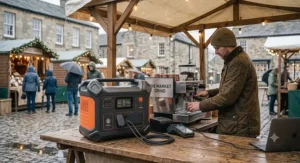
Profile 3: the full-time market trader running a food or drinks stall five days a week. Needs lighting, a card reader dock, a small fridge or hot-water setup, and charging for multiple devices across an 8–10 hour trading day, every week, for months. The EcoFlow DELTA 2 — or the EcoFlow DELTA 2 Max if the stall includes genuinely power-hungry catering equipment — is the realistic choice, since anything smaller means a second purchase within months once the true daily load becomes clear.
The common thread across all three: buy for your longest, most demanding day, not your average one.
Common Power Problems at Markets, Car Boot Sales and Fishing Pegs — Solved
Problem: the card reader dies mid-transaction on a busy Saturday. Solution: keep the reader’s own charging dock plugged into the power station throughout the day rather than waiting until it’s low — most readers charge fine while idle on a low-draw USB port, so there’s no real reason not to leave it topped up continuously.
Problem: lights fail just as dusk falls at a winter market. Solution: run lighting from a DC or USB output rather than the AC inverter where possible, and check your rough Wh budget for lighting against your unit’s remaining charge before the afternoon rush.
Problem: condensation or damp affecting the unit on an early, dewy fishing morning. Solution: keep the unit inside a simple dry bag or under a stall table rather than directly on wet grass or paving, and avoid opening ports or charging while damp.
Problem: running out of charge before pack-down. Solution: this is almost always a sizing mistake rather than a battery fault — revisit the wattage calculation in the next section and consider whether your actual load has grown since you bought the unit.
Problem: needing to charge several devices at once without enough ports. Solution: a simple USB hub plugged into one of the unit’s ports, or choosing a model with more built-in USB-C PD outputs from the comparison table above, solves this more cheaply than buying a second power station.
How to Choose a Power Station for Outdoor Trading
- Work out your real wattage needs. List every device — card reader dock, lights, phone/tablet chargers, any catering equipment — and add up their wattage; this tells you the minimum continuous output (W) you need, which is a completely different number from capacity.
- Estimate your runtime, not just your peak draw. Multiply your typical combined wattage by the hours you trade to get a rough Wh requirement, then buy a little above it rather than exactly to the number.
- Check the inverter type. Pure sine wave protects sensitive electronics like card readers and tablets; modified sine wave is cheaper but riskier for that equipment.
- Weigh portability against capacity. If you’re carrying the unit from car boot to pitch repeatedly, weight matters as much as watt-hours — see the trader profiles above.
- Confirm your market’s rules on generators and equipment. Some licences explicitly ban combustion generators but say nothing about battery units, which is worth checking before you buy rather than on the morning of a market.
- Look at recharge speed if you trade on consecutive days. A six-to-eight-hour recharge is fine for weekly traders, but not for back-to-back weekend events.
- Factor in weatherproofing. Outdoor trading means rain, damp mornings and dust; check the IP rating or at least plan a cover, since most units aren’t rated for direct rain exposure.
Before you choose, it’s also worth seeing how battery units genuinely stack up against the alternatives traders have historically used:
| Factor | Battery Power Station | Petrol Generator | Mains Hookup (where available) |
|---|---|---|---|
| Noise | Silent | Loud, often restricted at markets | Silent |
| Fumes/emissions | None | Yes — banned indoors, restricted outdoors | None |
| Permitted at most licensed markets | Yes | Often banned or restricted | Site-dependent |
| Setup time | Under a minute | Several minutes, needs fuel | Depends on site |
| Ongoing cost | Electricity to recharge (pence) | Petrol (pounds per litre) | Site hookup fee |
The clearest takeaway here is regulatory, not technical: several UK councils that issue street trading licences explicitly disallow generators on pitches, which makes a power station for outdoor markets the only realistic off-grid option for many traders rather than simply the quieter one. Running costs also favour batteries considerably — recharging from mains at typical UK electricity rates costs a few pence per session, versus the ongoing cost of petrol and generator upkeep.

Card Reader Power Draw: What Contactless Payments Actually Cost You in Watts
One of the most common misconceptions among new traders is that a card reader is a significant power draw. It isn’t — the reader itself is the least demanding thing in your entire setup.
Most modern card readers draw around 10W while charging on their dock and use a fraction of that — closer to 1–2W — during an actual contactless transaction, since the reader runs from its own internal battery rated for hundreds of sales per charge. What most traders overlook about card reader power draw is that the real cost isn’t the reader at all — it’s the phone or tablet paired with it via Bluetooth, running the payment app, a screen, and often mobile data, which can draw 5–10W continuously through a trading day.
Based on the spec comparison earlier, this means even the smallest unit on this list, the BLUETTI EB3A, has more than enough headroom to keep a card reader and its paired phone topped up for an entire day — the constraint only becomes real once you add lighting, a laptop, or catering equipment into the same setup. Reviewers running card-only stalls consistently report barely denting a mid-range power station’s charge across a full trading day, which matches the maths above.
If there’s one practical takeaway here, it’s this: don’t oversize your power station purely because of the card reader — size it for the lighting and charging load sitting around it instead.
Portable Lighting for Market Stalls and Fishing Pegs
Portable lighting is the quiet power hog most traders underestimate — not because any single light draws much, but because a full rig of them adds up faster than a phone charger ever will.
A typical LED strip light draws somewhere between 5W and 15W per metre depending on brightness, while a small rechargeable floodlight for a winter evening market can pull 20–50W on its own. Run three or four of these off your power station for six hours at a winter market, and you can realistically use 150–300Wh on lighting alone — worth checking against the capacity figures in the comparison table above before you assume your unit has spare capacity to burn.
For a power station for day fishing specifically, the priority is different: it’s less about total lighting load and more about a single, reliable head torch or bivvy light lasting through a pre-dawn start and a late finish, alongside charging a phone and a bite alarm. Here, drawing lighting via a USB or 12V output rather than the AC inverter is genuinely more efficient, since it skips the inverter’s conversion losses entirely.
The spec sheet won’t tell you this, but reviewers across market-trader forums note that DC-output lighting noticeably outlasts AC-powered equivalents run from the same battery — a detail worth building into how you wire up your stall or peg.
Power Station for Car Boot Sale vs Power Station for Day Fishing: What Changes When Your Setting Does
On paper, a power station for car boot sale trading and a power station for day fishing look like the same purchase — a portable battery with USB and AC outputs. In practice, the two use cases pull the requirements in genuinely different directions.
A car boot sale setup usually means multiple trips from car to pitch, a compact footprint on a fold-out table, and a few hours of trading — often ending by lunchtime. Weight and physical size matter more here than raw capacity, which is exactly why the lightweight Jackery Explorer 500 v2 earns its standout tag above: 6.4kg carried twice is manageable, 7.8kg or more carried repeatedly is not.
Day fishing power needs, by contrast, are less about weight and more about duration and reliability in damp conditions. A typical session runs from before dawn to well into the afternoon, with a phone, a fish finder or bite alarm, and a head torch all needing charge across that whole window — and the unit is likely to sit on damp ground or in a rucksack rather than on a clean market table. This shifts the priority toward genuine capacity (the EcoFlow RIVER 2 Pro‘s 768Wh comfortably covers a long session) and away from AC output, since almost everything an angler runs is a low-draw USB or 12V device rather than mains-voltage equipment. Anyone fishing needs a valid Environment Agency rod fishing licence too, of course — a different kind of paperwork entirely, but worth mentioning since it catches out more anglers than a flat battery ever does.
Here’s what to weigh if you do both: buying for the more demanding use case — typically the longer fishing session — and simply carrying spare capacity to the car boot sale is usually more practical than buying two separate units, unless weight genuinely rules that option out for you.
Common Mistakes When Buying a Power Station for Outdoor Trading
The single most common mistake is buying on capacity (Wh) alone and ignoring continuous output (W) — a huge battery with a low wattage ceiling still can’t run a kettle or a space heater, no matter how many hours of charge it holds.
The second is assuming any battery unit is automatically welcome at a licensed market. It’s genuinely worth checking your specific market’s conditions before you buy: some councils’ street trading terms explicitly restrict generators on pitches while saying nothing at all about battery power stations, but rules vary by authority, and it’s far easier to check in advance than to argue about on the morning of a market.
A third mistake, less obvious but genuinely costly: ignoring UKCA/CE marking and buying from unverified third-party sellers rather than the manufacturer or an authorised UK retailer. Counterfeit or grey-market lithium battery units are a real fire risk, and it’s not a corner worth cutting for the sake of a slightly cheaper price.
Finally, traders regularly under-buy on output because they only think about the card reader, then discover mid-season that a coffee machine, heater or extra lighting rig they’ve since added won’t run on their existing unit — buying with a little headroom for growth avoids a second purchase within a year.
Long-Term Cost & Maintenance
A power station’s real cost isn’t the sticker price — it’s the sticker price divided by how many trading seasons it lasts, and that comes down almost entirely to charging habits.
| Product | Price Range | Capacity | Approx. Price per Wh |
|---|---|---|---|
| BLUETTI EB3A | £190–£240 | 268Wh | ~71–90p/Wh |
| Jackery Explorer 500 v2 | £380–£450 | 512Wh | ~74–88p/Wh |
| EcoFlow DELTA 2 | £470–£540 | 1,024Wh | ~46–53p/Wh |
| EcoFlow DELTA 2 Max | £1,050–£1,250 | 2,048Wh | ~51–61p/Wh |
Cost per watt-hour drops sharply once you move past the smallest units, which is the main argument for buying slightly bigger than you think you need rather than upgrading twice. The EcoFlow DELTA 2 offers the strongest pence-per-Wh value on this list once you weigh in its 1,800W output ceiling, while the BLUETTI EB3A remains the only sensible option if your total budget is genuinely capped under £250.
LiFePO4 cells, used in every product on this list, are rated for 3,000–4,000+ full charge cycles before capacity noticeably drops — at even twice-weekly trading, that’s a genuinely multi-year lifespan. The habits that shorten it are avoidable: leaving a unit on charge overnight and unattended, storing it fully depleted for long stretches over winter, or charging it in direct sun on a hot summer stall day. Fire and rescue services’ lithium battery safety guidance — aimed broadly at e-bikes and rechargeables but equally relevant here — recommends charging on a hard, non-combustible surface, never overnight unattended, and storing units cool and dry between markets.
Total cost of ownership also favours slightly bigger units than you initially budget for: undersizing means a second purchase within a season once your setup grows, while a unit with genuine headroom tends to be the one traders are still using three years later.
Frequently Asked Questions
❓ How much power do I need for a day at the market?
❓ Can I run a card reader and phone charger all day on a power station?
❓ Are power stations allowed at car boot sales and street markets?
❓ How long does a power station for outdoor markets last on one charge?
❓ Is a power station better than a generator for market trading?
Conclusion
Choosing a power station for outdoor markets really comes down to one honest question: what’s your longest, most demanding trading day actually going to ask of it? Answer that properly, using continuous output and realistic watt-hours rather than guesswork, and every other decision on this list gets a lot easier.
For most solo traders and car boot sellers, the Jackery Explorer 500 v2 or BLUETTI EB3A cover the basics without any wasted spend. Anyone trading a full day, most weekends, or running lighting alongside a card reader is better served by the EcoFlow RIVER 2 Pro or EcoFlow DELTA 2 — the two units that came up again and again across the comparisons above as the genuine all-rounders. Frequent, back-to-back traders should weigh the Anker SOLIX C1000 (Gen 2)‘s recharge speed against its price, and anyone running a multi-stall or catering setup should look straight to the EcoFlow DELTA 2 Max or the value-driven Oukitel P2001.
None of these is the “best” power station in the abstract — only the best one for how you actually trade, whether that’s a fold-out table at a Sunday car boot sale, a full pitch at a weekly farmers’ market, or a rucksack at the water’s edge before sunrise.
✨ Ready to stop worrying about your battery and start focusing on your stall? Check current prices on the picks above and get set up before your next trading day! 🔌🛒
Recommended for You
- Power Station For Day Trips: 7 Brilliant 2026 Picks Slug
- Power Station For Van Life Starter: 7 Best Picks 2026
- Power Station 300-500Wh: 7 Best Picks UK 2026
Disclaimer: This article contains affiliate links. As an Amazon Associate, I earn from qualifying purchases. If you purchase products through these links, we may earn a small commission at no additional cost to you.
✨ Found this helpful? Share it with your friends! 💬🤗
