In This Article
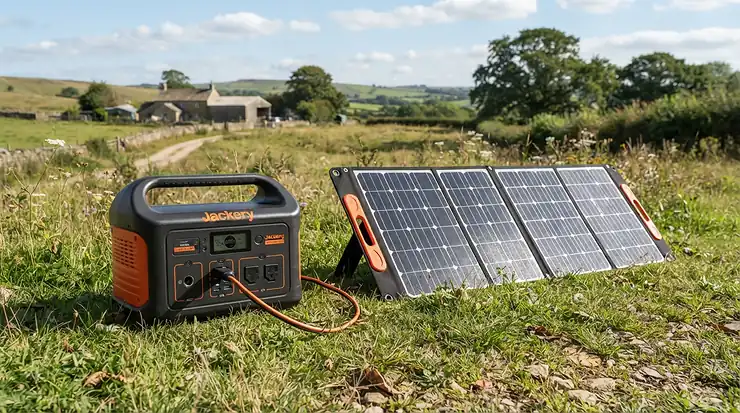
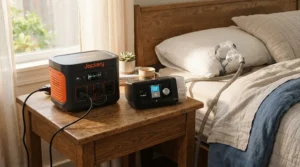
A power station for CPAP camping is a rechargeable battery with a built-in mains inverter and 12V sockets, sized to run your sleep apnoea machine through the night when there is no electric hook-up. Unlike a petrol generator it is silent and fume-free, which matters when it sits a metre from your pillow.
This is more than a comfort question. NICE recommends CPAP as a treatment option for adults with moderate or severe symptomatic obstructive sleep apnoea/hypopnoea syndrome. A flat battery at 2am is therefore a real problem, and you’ll feel the missed therapy on the walk back to the car.
The catch is that a CPAP’s appetite depends on its settings. Retail listings for the ResMed AirSense 11 AutoSet quote a typical draw of about 56W and a maximum of 73W. The heated humidifier is the biggest single swing factor, with the heated hose adding more. Over eight hours the top end works out at roughly 450Wh, which rules out many of the pocket-sized batteries marketed at campers.
This guide covers seven real, UK-available models, from compact to motorhome-grade, plus honest runtime maths. It also covers the things other roundups skip:
- solar reality
- distilled water for humidifier care
- the quirks of a power station for CPAP in a caravan or motorhome
- the airline battery limits that mean none of these units can fly with you
One honesty note up front: I haven’t hands-on tested any of these units. Everything below comes from published specifications, manufacturer documents and independent coverage I could verify. Where review evidence is thin, I say so. This isn’t medical advice, so check settings changes with your sleep clinic or machine supplier.
Quick Comparison: Power Station for CPAP Camping at a Glance
Prices below are ranges at the time of research and move constantly, so check current price before buying.
| Product | Capacity | Weight | Price range | Best For |
|---|---|---|---|---|
| Anker SOLIX C300 DC | 288Wh | ~3kg | £150-£220 | Humidifier-off nights via a 12V route |
| EcoFlow RIVER 2 | 256Wh | 3.5kg | £200-£260 | Short trips with quick top-ups |
| Jackery Explorer 300 Plus | 288Wh | 3.75kg | £200-£300 | Quiet, light single-night use |
| EcoFlow RIVER 2 Max | 512Wh | ~6kg | £400-£550 | One heated-humidifier night in a tent |
| Anker SOLIX C800 Plus | 768Wh | ~10.9kg | £500-£650 | Full night plus buffer, car camping |
| Jackery Explorer 1000 v2 | 1070Wh | ~10.8kg | £350-£500 | Two-night motorhome trips |
| EcoFlow DELTA 2 | 1024Wh | 12kg | £600-£900 | Expandable, solar-heavy van setups |
Reading across the table, capacity is the number that matters, not wattage. Every model here can deliver far more than a CPAP needs, so the real question is how many hours of sleep fit inside the battery. The Jackery Explorer 1000 v2 is the surprise on cost per watt-hour. The compact trio of the Anker SOLIX C300 DC, EcoFlow RIVER 2 and Jackery Explorer 300 Plus only suit lighter-draw nights.
💬 Just one click — help others make better buying decisions too!😊
Top 7 Power Station for CPAP Camping Picks: Expert Analysis
1. Anker SOLIX C300 DC — efficient 12V route without an inverter
The Anker SOLIX C300 DC is defined by what it leaves out. There is no mains socket at all, so no inverter is idling away your watt-hours just to keep AC alive. It packs 288Wh of LiFePO4 cells into roughly 3kg, with a 12V car-style socket rated up to 120W, four USB-C ports and two USB-A. That 12V socket is your CPAP route: pair it with ResMed’s matching DC converter and the machine runs straight off the battery. Solar input is capped at 100W, so panels are a top-up, not a lifeline.
On paper this suits a CPAP running with the humidifier off or set low. With heated humidification at full tilt, 288Wh is a one-night-at-best proposition. The big gotcha is compatibility. With no AC socket, your machine’s original mains adapter can’t plug in, and the AirSense 10 and 11 use different converters. If you want both options, the AC-equipped Anker SOLIX C300 exists.
Independent reviewers praise the information-rich display and generous port count. One noted they couldn’t test solar charging because no solar cable is included. A Czech retailer listing for the same unit (sold as the C300X DC) shows 4.5 out of 5 from 20 ratings, which is a small sample and a hint rather than a verdict.
Pros:
- ✅ Direct 12V output avoids the inverter stage
- ✅ Light at roughly 3kg and easy to carry
- ✅ Plenty of USB-C ports for phones and lanterns
Cons:
- ❌ No AC socket, so a compatible converter is mandatory
- ❌ 100W solar ceiling limits off-grid top-ups
Expect roughly £150-£220 at the time of research; check current price. It is excellent value if your machine has an approved 12V route and a false economy if it doesn’t.
2. EcoFlow RIVER 2 — one-hour mains top-up
EcoFlow quotes a 0-100% mains recharge of around an hour for the EcoFlow RIVER 2. That is a genuine perk on a campsite pitch: plug in over a late breakfast and it is topped up before your second brew. Inside is 256Wh of LiFePO4 and a 300W pure-sine AC socket. Look for the UK version (code ZMR600-B-UK) so you get a three-pin socket. There is also a 12V car-style output good for up to 100W and a 60W USB-C port. At 3.5kg it is easy to carry. Solar input runs to 110W, enough for one decent panel.
Honestly, this is a one-night tool for lighter-draw settings. With the heated humidifier on, 256Wh falls well short of a full night. It suits short weekend trips where you top up between nights, and the fast recharge makes that realistic if you have a hook-up or a car. The app also lets you tweak charging behaviour, which is handy where a pitch’s supply is modest.
I couldn’t find a large pool of independent UK owner reviews to aggregate with confidence, so what is verifiable here is mostly the specification. Read the retailer’s review tab and search it for “CPAP” before committing.
Pros:
- ✅ Very fast mains recharge for quick top-ups
- ✅ UK-socket version available
- ✅ Compact and light at 3.5kg
Cons:
- ❌ Capacity too thin for heated-humidifier nights
- ❌ Only one AC socket
Expect around £200-£260; check current price. It is good value as a lightweight weekend unit, but only if your CPAP runs lean.
3. Jackery Explorer 300 Plus — whisper-quiet bedside manner
Noise matters more than you’d think when a battery sits next to your head, and the Jackery Explorer 300 Plus is listed as operating below 30dB. It holds 288Wh of LiFePO4 and delivers 300W of pure-sine AC. Ports include USB-C up to 100W, USB-A and a 12V car port. It weighs about 3.75kg and has Bluetooth app monitoring. A mains recharge takes roughly two hours, and Jackery’s own panels from 45W to 200W plug straight in.
The practical advantage is flexibility. You can use the original AC adapter or the 12V port with a suitable converter. That lets you test at home which route gives longer runtime for your exact machine, and the answer isn’t always obvious. The 288Wh capacity carries the same caution as the Anker SOLIX C300 DC: great for lighter settings, tight with heated humidification. Third-party panels need an adaptor cable with the right Jackery connector.
TechRadar’s coverage frames this model as a smart pick for people wanting reliable power without carrying something oversized, and notes a five-year warranty. That piece is a deal write-up rather than a lab test, and warranty terms vary by seller.
Pros:
- ✅ Listed as running quietly beside the bed
- ✅ Both AC and 12V routes available
- ✅ Light at about 3.75kg
Cons:
- ❌ 288Wh is short for heated-humidifier nights
- ❌ Third-party panels need an adaptor cable
Expect around £200-£300; check current price. It is fair value, with the premium paying for quiet running and a polished app.
4. EcoFlow RIVER 2 Max — the first realistic heated-humidifier night
At 512Wh, the EcoFlow RIVER 2 Max is where a heated-humidifier night becomes plausible in a single, still-carryable unit. It delivers 500W of pure-sine AC and weighs about 6kg. The 12V output goes up to 126W and USB-C reaches 100W. Mains charging peaks at 660W, which EcoFlow quotes at about an hour for a full charge. Solar input goes up to 220W (11-50V), so two 110W panels are the natural pairing.
My arithmetic puts usable energy at roughly 435Wh after losses. That runs a 56W draw for nearly eight hours, which is close to a full night with only a thin buffer. At lighter settings it stretches towards two nights. It is the sensible step up for tent campers who refuse to compromise on humidification.
As with its smaller sibling, I couldn’t verify a meaningful independent review pool, so the specification is the main evidence. Some UK retailers list a five-year guarantee, but confirm with the seller.
Pros:
- ✅ Gets close to a full heated-humidifier night
- ✅ 220W solar input allows a two-panel kit
- ✅ Mains recharge in about an hour
Cons:
- ❌ Roughly 6kg is a proper carry
- ❌ Heated-humidifier runtime leaves little buffer
Expect roughly £400-£550; check current price. It is good value for the one-night-plus tent camper.
5. Anker SOLIX C800 Plus — 768Wh with built-in camp lights
The Anker SOLIX C800 Plus has two detachable camp lights, which slightly reduces how many separate gadgets you need to charge. It carries 768Wh of LiFePO4 with 1200W output and 1600W surge. Anker quotes a full wall recharge in about 58 minutes and a 300W solar ceiling, plus a 20ms UPS-style changeover. It weighs about 10.9kg.
By my arithmetic, about 650Wh is usable. That runs a 56W CPAP for nearly 12 hours, a full night with three hours to spare, which is exactly the margin cold, damp pitches demand. The 300W solar window suits a two-panel kit, though UK skies rarely deliver rated power. The trade-off is weight: at nearly 11kg this is a car-to-pitch carry, not a bedside hop.
TechRadar’s first-look coverage highlighted the LED light bar and 300W solar input. A first look isn’t a long-term test, and I found no verified UK owner-review pool, so assess independent evidence as it accumulates.
Pros:
- ✅ Comfortable full night with spare capacity
- ✅ 300W solar input suits two-panel kits
- ✅ Built-in camp lights double as tent lighting
Cons:
- ❌ At about 10.9kg it’s no bedside carry
- ❌ Limited verifiable independent long-term reviews
Expect roughly £500-£650; check current price. It is solid value for car campers who want margin.
6. Jackery Explorer 1000 v2 — lowest cost per watt-hour here
The Jackery Explorer 1000 v2 packs 1070Wh of LiFePO4 into about 10.8kg, with 1500W AC (3000W surge), two AC outlets, two USB-C ports, USB-A and a 12V car port. Jackery lists roughly 1.7 hours for a normal wall charge. On Jackery’s own listing, solar input goes up to 400W with matching panels, but confirm against the UK spec sheet before buying.
For CPAP, 1500W is wildly more than you need, and you’re really buying the capacity. My arithmetic puts usable energy at about 910Wh, which stretches towards two nights at 56W. It suits motorhomes and caravans where weight matters less than runtime. TechRadar’s review credits the Jackery Explorer 1000 v2 with mains-style power and silent operation. It marks it down for being capped at 1500W, expensive at launch and not weatherproofed. That last point matters: keep it inside the van and off damp ground.
This is the most substantive independent coverage I found for any model on this list. It is still one review, so treat it as a strong signal rather than consensus.
Pros:
- ✅ Lowest cost per watt-hour in this list
- ✅ Silent running praised by TechRadar
- ✅ Stretches towards two nights on heated settings
Cons:
- ❌ 1500W output is overkill for CPAP
- ❌ Not weatherproofed, per TechRadar
Expect roughly £350-£500; check current price. It is the value leader for long trips.
7. EcoFlow DELTA 2 — expandable, with a 500W solar window
The EcoFlow DELTA 2 is the only unit here you can grow. The 1024Wh LFP battery expands to 2048Wh with an extra battery or 3040Wh with the DELTA Max extra battery. The UK version has four UK AC sockets, 1800W output (2700W with X-Boost) and a 12V output up to 126W. It weighs 12kg. Mains charging reaches 1200W (0-80% in about 50 minutes) and the solar ceiling is 500W (11-60V, 15A). Many listings show a five-year warranty.
At 56W, my arithmetic gives about 15 hours from the base unit, enough for roughly two nights. Add an extra battery and four-plus nights becomes plausible. It is a motorhome resident rather than a tent companion. The 500W solar window supports serious arrays, but in UK shoulder seasons you’ll rarely see rated output.
I couldn’t verify aggregated review data for this model, though its specifications are consistent across UK retailers.
Pros:
- ✅ Expandable to 2048Wh or 3040Wh
- ✅ 500W solar window for serious panel arrays
- ✅ UK-socket version with four AC sockets
Cons:
- ❌ 12kg suits vans, not tent trails
- ❌ Highest price in this round-up
Expect roughly £600-£900; check current price. It is excellent for long-haul vans but unnecessary for weekenders.
✨ Ready to Pick Your Power Station?
🔍 Compare these models against your own nightly watt-hours, then click any highlighted product name to check current pricing and availability. Your best camping sleep setup starts with the right battery!
How to Choose a Power Station for CPAP Camping
Choose by nightly watt-hours, not headline wattage: multiply your CPAP’s real overnight draw by your sleeping hours, add a buffer, then pick the lightest unit that clears that number.
- Measure your real draw. A plug-in energy monitor on your mains lead shows what your settings actually use. Manufacturer figures are a guide, not your reality.
- Convert to watt-hours. Watts × hours, then add roughly 30% for inverter losses, cold nights and bad luck.
- Pick the right output route. Pure sine AC lets you use the original adapter. A 12V route needs the correct model-specific converter, never an unregulated adaptor or generic cable.
- Check UK compatibility. Look for UK-socket versions, UKCA or CE marking, and a UK warranty and returns route.
- Match charging to your trips. Hook-up pitches suit fast wall charging. Vans benefit from car charging. Solar is a top-up.
- Weigh weight and noise. It sits beside your head, and you will carry it.
- Check temperature limits. Anker lists 0-40°C charging for the Anker SOLIX C800 Plus, and Jackery lists a -10 to 45°C operating range for the Jackery Explorer 300 Plus. UK autumn nights can challenge both.
How Long Will a Power Station for CPAP Camping Actually Run?
Here is the runtime maths, assuming roughly 85% of label capacity is usable. That 85% is my planning assumption, not a measurement, and the three draw scenarios are illustrative rather than tested.
| Product | Usable Wh | ~25W | ~45W | ~56W | Best For |
|---|---|---|---|---|---|
| Anker SOLIX C300 DC | ~245 | 9.8h | 5.4h | 4.4h | Humidifier-off nights |
| EcoFlow RIVER 2 | ~218 | 8.7h | 4.8h | 3.9h | Light-draw single night |
| Jackery Explorer 300 Plus | ~245 | 9.8h | 5.4h | 4.4h | Quiet light-draw night |
| EcoFlow RIVER 2 Max | ~435 | 17.4h | 9.7h | 7.8h | One night with humidifier |
| Anker SOLIX C800 Plus | ~653 | 26.1h | 14.5h | 11.7h | Full night plus buffer |
| Jackery Explorer 1000 v2 | ~910 | 36.4h | 20.2h | 16.2h | Two nights |
| EcoFlow DELTA 2 | ~870 | 34.8h | 19.3h | 15.5h | Two nights, expandable |
The table shows why the compact trio only works at lighter settings: at 56W they fall under five hours. The EcoFlow RIVER 2 Max is the first model that nearly clears a full night. Measure your own draw before trusting any row, because the spread between 25W and 56W is enormous.
Your Camping Sleep Setup: A Step-by-Step Practical Guide
A good camping sleep setup is mostly rehearsal. Do these in order:
- Run a home trial. Charge fully, run your exact camping settings overnight, and note the percentage used. That number beats any spec sheet.
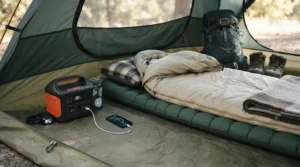
- Position it sensibly. Put the unit on a hard, dry, level surface, off the groundsheet and away from bedding. Never cover it while running, and keep cables out of footfall.
- Manage the hose. Cold air causes condensation, and heated tubing costs watts. An NHS trust leaflet advises keeping as much of the tube as possible under the covers in cold weather, which is a free way to reduce heating load.
- Sort your water. See the next section.
- Recharge daily. Top up from a hook-up or car each day. Anker’s guidance warns never to run a vehicle in an enclosed space while charging.
- Avoid first-month mistakes. Don’t assume the 12V route is free of losses, since converters aren’t perfectly efficient. Don’t forget to check for any standby or auto-off timers in your unit’s app so AC doesn’t switch off mid-night.
Distilled Water for Humidifier: What to Pack and What to Skip
Distilled water for humidifier use is the official recommendation. ResMed advises filling the water tub with distilled water because tap water contains particulates and impurities that cause build-up. An NHS trust patient leaflet from Oxford University Hospitals says the chamber ideally holds distilled or deionised water. It also accepts filtered water or cooled boiled tap water, noting that purer water means less limescale. For descaling, it suggests soaking the chamber in one part white vinegar to nine parts water, then rinsing thoroughly with tap water.
For camping, the practical rules are:
- Pack a labelled bottle of distilled water per night, plus a spare.
- Fill from a clean bottle, not a campsite tap.
- If supplies run short, ask your clinic before improvising.
There is also a power angle. The humidifier is your biggest power hog, so some campers switch it off to stretch battery life. ResMed’s own materials note you can forgo the humidifier and heated tubing, in consultation with your doctor, to reduce consumption. Without humidification you don’t need distilled water at all, which makes this a trade-off worth discussing with your clinician, not deciding alone at 11pm on a cold pitch.
Power Station for CPAP in a Caravan or Motorhome
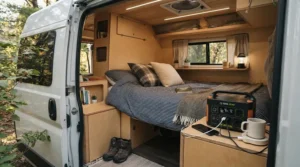
A power station for CPAP in a caravan or motorhome solves a different problem from tent camping: not runtime panic, but cables, continuity and charging logistics.
Even on a hook-up pitch, a bedside battery avoids trailing a lead across the floor. Several units here quote UPS-style switchover (the Anker SOLIX C800 Plus lists 20ms), which helps if a site’s supply trips. Test that your CPAP rides through the changeover without resetting.
Charging on the move is where vans differ. At roughly 100W, car charging adds only 200-300Wh over a typical drive. EcoFlow’s spec has the EcoFlow RIVER 2 full in about three hours from a car socket, while the EcoFlow DELTA 2‘s default 8A input implies roughly ten hours for its full 1024Wh. Jackery lists a DC-DC alternator charger as an accessory for the Jackery Explorer 1000 v2 on its US site; check UK availability. The Jackery Explorer 1000 v2 and EcoFlow DELTA 2 are the natural van pair, with their roughly two-night capacity covering most trips between hook-ups.
Solar-Ready Power Station for CPAP Off-Grid: What It Really Takes
A solar-ready power station for CPAP off-grid needs more than a solar socket. Check four things: maximum input watts, the voltage window, the connector type, and whether a cable is even included. The Anker SOLIX C300 DC accepts up to 100W (11-28V), and a reviewer noted the box lacks a solar cable. The EcoFlow RIVER 2 takes 110W (11-30V) and the EcoFlow RIVER 2 Max 220W (11-50V). The Anker SOLIX C800 Plus takes 300W and the EcoFlow DELTA 2 500W (11-60V). For the Jackery Explorer 1000 v2, matching panels must be used on both inputs.
Now the reality check. Jackery itself quotes about 15 hours for a full recharge of the Jackery Explorer 1000 v2 from a single 100W panel under ideal conditions. UK autumn and spring skies are rarely ideal. Multiply panel watts by hours of genuinely bright sun, then knock off a chunk for angle, shade and cable losses. A 100W panel may restore only a fraction of one heated-humidifier night. Treat solar as a top-up and keep a car or hook-up charge as your fallback.
Airline Battery Limits: Why Your Power Station Stays Home
Airline battery limits are blunt. Under UK CAA rules, as summarised in Anker’s UK guidance, power banks up to 100Wh need no operator approval. Between 100Wh and 160Wh they need operator approval, and above 160Wh they aren’t permitted as ordinary passenger baggage. Every unit in this guide starts at 256Wh, so none can fly as hand luggage.
Other rules apply too. The CAA says spare batteries and power banks belong in the cabin, and you must never charge the power bank itself on board. Airlines can be stricter: Anker’s guide notes that Ryanair, Qatar Airways and Etihad cap ordinary power banks at 100Wh, while Jet2 gives qualifying packs automatic approval. A 100Wh pack runs a 56W CPAP for under two hours, and 160Wh barely reaches three, so battery-powered CPAP while flying is a specialist job.
The practical answer is to check your airline’s medical-equipment policy well before booking. Consider a CPAP-specific, airline-compliant battery for travel, and use a mains-powered stay at the destination rather than shipping a power station there.
Which Power Station Suits Which Camper? Real-World Scenarios
The weekend tent camper. Two nights, no hook-up, hatchback boot, CPAP with heated humidifier. A budget of £400-£650 points to the EcoFlow RIVER 2 Max or Anker SOLIX C800 Plus. The Anker SOLIX C800 Plus wins if cold pitches worry you, since its capacity leaves a buffer.
The light-packing traveller. One night, humidifier off after a clinic conversation, carrying everything from a car park. A budget under £300 makes the Anker SOLIX C300 DC (if your machine has a 12V route) or the Jackery Explorer 300 Plus sensible. Quiet running tips it towards the Jackery Explorer 300 Plus.
The motorhome pair. Weeks away, wild camping between hook-ups, two people possibly each using a machine. The Jackery Explorer 1000 v2 suits a single-machine van, while the EcoFlow DELTA 2 earns its premium once you add extra batteries and a serious solar array. Frequency of use matters here: nightly use favours bigger capacity and cheaper cost per watt-hour.
Camping Problems and Their Fixes
Battery dying at 3am. Run the home trial, keep a 30% buffer, and reduce heated-tube load by keeping the hose under bedding.
Humidifier chamber drying out. Check the fill level before bed and confirm your machine’s chamber capacity. The HumidAir 11 tub holds 380ml, which a retailer notes should avoid mid-night refills.
AC output switching off. Check the unit’s app for any standby or auto-off timer, and look at your CPAP’s draw against the unit’s minimum load behaviour.
Condensation in the hose. Keep the tube close to your body under the covers and avoid draping it across cold tent fabric.
Solar shortfall. Plan a car or hook-up top-up on travel days, and carry more capacity than the sunny-day sums suggest.
Power Station vs Alternatives: How They Compare
| Option | Noise & fumes | Portability | Recharge | Best For |
|---|---|---|---|---|
| Power station | Silent, no exhaust | 3-12kg | Mains, car, solar | Tents and vans |
| Dedicated CPAP battery pack | Silent | Very compact | Usually mains or car | Backpacking, some air travel |
| Petrol or inverter generator | Noisy, exhaust fumes | Heavy, needs fuel | Refuelling | Not ideal near sleeping areas |
| Leisure battery plus inverter | Silent | Fixed in van | Alternator, solar, hook-up | Vans already fitted |
| Electric hook-up | Silent | None | Site supply | Serviced pitches |
A power station is the all-rounder, but it isn’t always the best tool. Dedicated CPAP packs are smaller and often easier for travel, though advertised multi-night runtimes vary with your settings. Generators are the poor fit for a sleeping area, and many sites restrict them, so check site rules. If your van already has a healthy leisure battery and inverter, a power station is a bedside convenience rather than a necessity.
Long-Term Cost and Maintenance
| Product | Price range | Approx £ per Wh | Max solar input | Best For |
|---|---|---|---|---|
| Anker SOLIX C300 DC | £150-£220 | ~£0.52-£0.76 | 100W | 12V-route users |
| EcoFlow RIVER 2 | £200-£260 | ~£0.78-£1.02 | 110W | Quick top-ups |
| Jackery Explorer 300 Plus | £200-£300 | ~£0.69-£1.04 | Up to 100W | Quiet light use |
| EcoFlow RIVER 2 Max | £400-£550 | ~£0.78-£1.07 | 220W | One heated night |
| Anker SOLIX C800 Plus | £500-£650 | ~£0.65-£0.85 | 300W | Buffered nights |
| Jackery Explorer 1000 v2 | £350-£500 | ~£0.33-£0.47 | Up to 400W (Jackery US listing) | Long trips |
| EcoFlow DELTA 2 | £600-£900 | ~£0.59-£0.88 | 500W | Expandable vans |
The £ per Wh column is rough arithmetic from the ranges above. It shows the Jackery Explorer 1000 v2 as the cost-per-watt-hour leader, with the small units the most expensive per Wh despite the lowest sticker prices.
On longevity, EcoFlow and Anker quote 3,000+ cycles, and Jackery quotes up to 4,000 for the Jackery Explorer 1000 v2. As back-of-envelope maths, a £400 unit rated for 3,000 cycles works out at roughly 13p per full cycle, though real-world life will vary. Follow each maker’s storage guidance, top up periodically if stored, and check warranty terms with the seller.
Common Mistakes When Buying a Power Station for CPAP Camping
- Sizing from the label alone. Usable energy is lower than label capacity, so size from your measured draw.
- Assuming 12V is automatically better. Converters aren’t perfectly efficient, and ResMed’s own materials show the DC converter can draw up to 90W at maximum.
- Buying a non-UK version. Check for UK sockets and UK warranty.
- Overestimating solar. UK skies rarely deliver rated output.
- Ignoring cold. Check charging limits before autumn trips.
- Forgetting the water. Sort distilled water for humidifier use, or discuss alternatives with your clinic, before you leave.
FAQ: Power Station for CPAP Camping
❓ How much does a power station for CPAP camping cost in the UK?
❓ Can a power station for CPAP camping also run a kettle or heater?
❓ How long does a power station for CPAP camping last before replacement?
❓ Do I need a special cable to run my CPAP from a power station?
❓ Is a bundle with a solar panel worth buying?
Conclusion: Choose by Watt-Hours, Sleep by the Plan
The best power station for CPAP camping is the one sized to your measured nightly draw with a buffer, not the one with the biggest headline wattage. Light-draw sleepers and weekenders can live happily with the Anker SOLIX C300 DC, EcoFlow RIVER 2 or Jackery Explorer 300 Plus. The EcoFlow RIVER 2 Max is the first realistic single-night heated-humidifier unit. The Anker SOLIX C800 Plus adds comfortable margin, while the Jackery Explorer 1000 v2 and EcoFlow DELTA 2 cover caravan and motorhome trips.
Remember the extras that separate a good night from a bad one: a home trial run, distilled water for humidifier care (or an agreed alternative), realistic solar expectations, and the airline battery limits that keep your power station at home when you fly. Treat this guide as research, not medical advice, and speak to your sleep clinic about settings.
Recommended for You
- Portable Power Station For CPAP Machine: 7 Safe Picks (2026)
- CPAP Power Station Vs CPAP Battery Pack: 7 Top Picks (2026)
- Power Station For Campervan: 7 Best Proven Picks For UK (2026)
Disclaimer: This article contains affiliate links. As an Amazon Associate, I earn from qualifying purchases. If you purchase products through these links, we may earn a small commission at no additional cost to you.
✨ Found this helpful? Share it with your friends! 💬🤗
