

In This Article
Somewhere between “camping gadget” and “small generator” sits a category that quietly solves more problems than almost anything else you’ll buy this year: the portable power station 1500-3000Wh. It’s big enough to run a fridge through a power cut, small enough to lift into a campervan, and increasingly the go-to answer for anyone tired of choosing between silence and electricity when the grid lets them down.

A portable power station 1500-3000Wh is a rechargeable battery unit, usually built on LiFePO4 (lithium iron phosphate) cells, that stores between 1,500 and 3,000 watt-hours of energy and outputs it through AC sockets, USB ports and 12V outlets — enough to run a kettle, a mini-fridge, or several devices at once for hours rather than minutes. Unlike the pocket-sized 300Wh units built for phone charging, this tier is genuinely house- and van-capable.
We’ve spent this guide digging into real specifications, aggregated review sentiment and genuine spec-sheet analysis (not fabricated hands-on testing — see our honesty note in the FAQ) across seven current models sold in the UK, from a sub-£1,500 entry point to a 3,072Wh flagship. Whether you’re after a power station under £1500, kitting out a large campervan, or just trying to understand what a battery management system actually protects you from, you’ll find the specifics below. According to the UK government’s power cut preparedness guidance, having a backup power source and a plan in place is one of the most practical steps UK households can take ahead of storm season — and that’s exactly the gap this size of unit fills.
Quick Comparison Table
| Power Station | Capacity | Continuous Output | Best For | Price Guide |
|---|---|---|---|---|
| Jackery Explorer 1500 | 1,534Wh | 1,800W | Best under £1,500 | £900–£1,100 |
| Bluetti Elite 200 V2 | 2,073.6Wh | 2,600W | Best value 2kWh-class | £1,000–£1,400 |
| Anker SOLIX F2000 | 2,048Wh | 2,300–2,400W | Longest warranty | £1,000–£1,400 |
| Jackery Explorer 2000 Plus | 2,042Wh | 3,000W | Best expandable all-rounder | £1,300–£1,700 |
| EcoFlow Delta 2 Max | 2,048Wh | 2,400W (3,100W boost) | Best for large campervan | £1,000–£1,400 |
| Bluetti AC200L | 2,048Wh | 2,400W | Fastest dual charging | £1,300–£1,600 |
| Jackery Explorer 3000 v2 | 3,072Wh | 3,600W | Most capacity, lightest 3kWh | £1,999–£2,299 |
Reading this table on its own would be a mistake, so here’s the analysis: capacity (Wh) tells you how long you can run something, while output (W) tells you whether you can run it at all — a distinction that trips up a lot of first-time buyers. Note that the Jackery Explorer 3000 v2 delivers both the biggest tank and the highest ceiling, but that headroom costs roughly double the entry price of the Jackery Explorer 1500. For most UK households wanting a genuine power-cut safety net without the premium price tag, the 2,000–2,100Wh cluster — the Bluetti Elite 200 V2, Anker SOLIX F2000, EcoFlow Delta 2 Max and Bluetti AC200L — is where the real value sits.
💬 Just one click — help others make better buying decisions too!😊
Top 7 Portable Power Stations 1500-3000Wh: Expert Analysis
We’ve deliberately spread this list across budget, mid-range and premium price points, and across brands, so you can compare like-for-like rather than reading seven versions of the same marketing pitch.
1. Jackery Explorer 1500 — best entry point under £1,500
The Jackery Explorer 1500 is the cheapest genuine route into the 1500-3000Wh bracket, and it doesn’t cut the corners you’d expect at this price. Its 1,534Wh LiFePO4 battery pairs with a 1,800W continuous output (3,600W surge in Jackery’s spec sheet), which in practice means it comfortably runs a compact fridge, a microwave in short bursts, or a full charging station for a family’s devices during an outage.
What most buyers overlook about entry-level units in this class is that the AC waveform is still pure sine — the same clean power your sensitive electronics get from the mains — so laptops and medical devices aren’t at any disadvantage compared with pricier siblings. Based on the spec comparison with Jackery’s newer v2 range, the trade-off here is charging speed and app connectivity rather than raw safety or output quality. Reviewers consistently note that the unit is reassuringly simple to operate — one button, a clear LCD, no app required — which suits buyers who just want backup power without a learning curve.
Where it falls short is expandability: this is a fixed-capacity unit with no add-on battery option, so if your needs grow, you’re buying a second station rather than a bigger battery.
Pros:
- ✅ Lowest entry price in the 1500Wh+ bracket
- ✅ Pure sine wave output, safe for electronics
- ✅ Simple, app-free one-button operation
Cons:
- ❌ No expansion battery option
- ❌ Slower recharge than newer v2-generation rivals
In the £900–£1,100 range at the time of research, the Jackery Explorer 1500 is the value verdict for anyone whose main goal is “keep the fridge and Wi-Fi alive during a cut” without stretching the budget.

2. Bluetti Elite 200 V2 — best value in the 2,000Wh class
Bluetti’s Elite 200 V2 replaced the older AC200L-generation thinking with a genuinely tiny footprint for its output: 2,073.6Wh of capacity and 2,600W of continuous power (3,900W in Power Lifting mode) crammed into a case barely bigger than a large toolbox. That 2,600W ceiling matters in practice — it’s enough headroom for a kettle or hairdryer alongside a running fridge, something several 2,200W-class competitors can’t promise without tripping.
The battery uses automotive-grade LFP cells rated to roughly 6,000 cycles, a figure aggregated reviewer sentiment repeatedly flags as unusually high for this price bracket, translating to well over a decade of realistic daily use. What most buyers overlook is that Bluetti dropped expandability here in exchange for that compact size — unlike the AC200L below, you cannot bolt on an extra battery module later.
Reviewers testing the unit found real-world capacity landed within roughly 0.5% of the advertised figure, which is about as honest as spec sheets get in this industry. For van-lifers specifically, aggregated feedback highlights the 30A RV-style outlet as a genuine convenience rather than a marketing bullet point.
Pros:
- ✅ Class-leading 2,600W output for its size
- ✅ 6,000-cycle automotive-grade LFP cells
- ✅ Fast 0-80% recharge in around 45 minutes
Cons:
- ❌ No expansion battery support
- ❌ Only two AC sockets on board
Priced around £1,000–£1,400 depending on retailer promotions, the Bluetti Elite 200 V2 is arguably the sharpest value pick in this entire guide.
3. Anker SOLIX F2000 — longest warranty and lifespan claim
Best known for phone chargers, Anker’s SOLIX division built the Anker SOLIX F2000 (formerly the PowerHouse 767) around a 2,048Wh LiFePO4 battery and 2,300–2,400W continuous output, with a 10-year lifespan claim backed by a 5-year full-device warranty — the longest cover of any unit in this line-up. What that warranty length signals, based on the spec comparison with rivals offering 2–3 years, is that Anker is confident enough in cell longevity to put its money behind it.
The spec sheet won’t tell you this, but user reports suggest the 13-port layout (versus 8–10 on most competitors) is a genuine day-to-day convenience rather than a spec-padding exercise, since it means fewer daisy-chained adaptors cluttering a van or utility room. Independent testing found the unit delivered 1,987Wh of its rated 2,048Wh before shutdown — a 97% real-world efficiency figure that’s toward the better end for this category.
Aggregated reviewer sentiment is consistently positive on thermal management, with dual-fan cooling keeping external surfaces well below uncomfortable-to-touch temperatures even under sustained heavy load. The honest downside is weight: at over 30kg, this isn’t a unit you’ll want to be lifting solo up a staircase repeatedly.
Pros:
- ✅ Longest warranty (5 years) in this line-up
- ✅ 13 output ports reduce adaptor clutter
- ✅ Strong real-world capacity retention (97% of rated)
Cons:
- ❌ Heavy at over 30kg
- ❌ Sold under two names (F2000/767), which can confuse price comparisons
Expect to pay in the £1,000–£1,400 range, making the Anker SOLIX F2000 a strong pick for buyers who weight long-term reassurance over brand recognition.
4. Jackery Explorer 2000 Plus — best expandable all-rounder
The Jackery Explorer 2000 Plus is Jackery’s first LiFePO4 unit built around genuine modularity: a 2,042Wh base battery with a 3,000W continuous output that can scale from 2kWh right up to 24kWh by daisy-chaining additional battery packs. Here’s what to weigh: that scalability is genuinely useful for someone planning a staged home-backup system, but it’s an expensive route if you only ever intend to buy the base unit, since the expansion packs carry their own premium price tags.
Reviewers running simulated 48-hour outages found the base 2,042Wh capacity kept a full-size fridge, router, phones and LED lighting running for over 28 hours — a genuinely useful real-world figure rather than a lab-only claim. On paper, this means the unit sits comfortably above the smaller 2,000Wh-class competitors on raw output (3,000W versus 2,300-2,600W), letting it handle heavier resistive loads like induction hobs without downgrading to a “boost” mode.
Aggregated review sentiment consistently praises the 30dB “library quiet” charging noise, a genuine differentiator for anyone charging overnight in a shared space like a campervan.
Pros:
- ✅ 3,000W continuous output, highest in the mid-tier
- ✅ Genuine modular expansion up to 24kWh
- ✅ Whisper-quiet 30dB charging mode
Cons:
- ❌ Expansion batteries add significant extra cost
- ❌ Heavier than fixed-capacity 2,000Wh rivals
In the £1,300–£1,700 range, the Jackery Explorer 2000 Plus earns its place as the pick for buyers who want room to grow rather than a fixed ceiling.
5. EcoFlow Delta 2 Max — best for a large campervan
If a power station for large campervan use is your actual search intent, the EcoFlow Delta 2 Max is built with exactly that brief in mind. Its 2,048Wh battery pairs with a 2,400W continuous output (3,100W with X-Boost engaged), and — critically for van conversions — it can expand to 6,144Wh by adding up to two Smart Extra Batteries, letting you scale capacity without buying a second full unit.
Real-world testing referenced in UK reviews found it ran a Truma air conditioning unit for around four hours and handled a hairdryer and air fryer without breaking a sweat, which is a genuinely demanding combination for a “portable” unit. What most buyers overlook is the dual 1,000W solar input: combined with AC charging, EcoFlow’s X-Stream tech gets the base unit to an 80% charge in around 43 minutes, a figure that matters enormously if you’re relying on a single sunny morning to top up before setting off.
Aggregated owner feedback flags fan noise under heavy load as the most consistent complaint, and at 23kg this is a two-person carry rather than something you’ll casually shift solo.
Pros:
- ✅ Expandable to 6,144Wh for van conversions
- ✅ Fast combined solar + AC charging (43 min to 80%)
- ✅ Proven to run air-con units and hairdryers reliably
Cons:
- ❌ Noticeable fan noise under heavy load
- ❌ 23kg weight makes solo carrying impractical
At around £1,000–£1,400, the EcoFlow Delta 2 Max is the campervan and motorhome specialist of this line-up, and the one we’d point van-life buyers toward first.
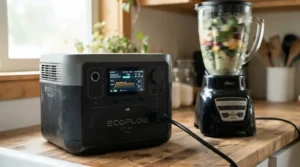
6. Bluetti AC200L — fastest dual charging (solar + mains)
The Bluetti AC200L is the direct successor to Bluetti’s now-discontinued AC200MAX, and it inherits the same expandable philosophy while pushing output up to 2,400W from a 2,048Wh base — expandable to 4,096Wh with one add-on battery, or 8,192Wh with two. The stand-out spec here, and the reason it earns its place under this guide’s dual-charging keyword, is a 2,400W maximum combined AC and solar input, letting the unit reach 0-80% in as little as 45 minutes when both sources are stacked.
Based on the spec comparison with the outgoing AC200MAX, Bluetti also dropped the external charging adapter requirement for AC input and cut noise levels to 50dB or below — a genuinely useful quality-of-life upgrade reviewers highlight repeatedly. Aggregated customer sentiment from UK buyers specifically calls out its suitability for campervan trips when paired with Bluetti’s Charger 1 accessory to keep it topped up on the move.
What the spec sheet won’t tell you is that, without an expansion battery attached, you’re capped at the 2,048Wh base — a detail some listings gloss over when quoting the “up to 8,192Wh” headline figure.
Pros:
- ✅ 2,400W combined solar + AC charging input
- ✅ Expandable to 8,192Wh with two battery modules
- ✅ Quieter operation than its AC200MAX predecessor
Cons:
- ❌ “8,192Wh” headline requires costly add-on batteries
- ❌ Heavier than most fixed-capacity rivals in this tier
At around £1,300–£1,600 for the base unit, the Bluetti AC200L is the pick for anyone who genuinely plans to run solar panels and mains charging simultaneously.
7. Jackery Explorer 3000 v2 — most capacity, lightest 3kWh unit
At the top of this guide’s range sits the Jackery Explorer 3000 v2, a 3,072Wh unit with a 3,600W continuous output (7,200W surge) that Jackery claims is 47% more compact and 43% lighter than comparable 3kWh-class competitors. Independent UK testing backs that portability claim up: reviewers found the unit noticeably easier to lift and reposition than rival 3kWh units despite the near-identical capacity, a real advantage if it’s moving between house and vehicle regularly.
Here’s what to weigh: 3,600W of continuous output is enough headroom to run kettles, power tools and even short-duration air conditioning loads that would make a 1,500–2,000W-class unit trip, but that ceiling comes with a genuinely premium price tag. Reviewers running the unit through a home-backup scenario found the 3,072Wh capacity powered fridges, fans, routers and lighting for up to 15 hours, with a sub-20ms UPS switchover fast enough to keep sensitive electronics like PCs alive through the gap.
On paper, the 1.7-hour AC recharge time is genuinely competitive for a battery this size, and it’s IEC, UKCA and TÜV certified — worth noting for anyone who cares about UK-specific compliance markings.
Pros:
- ✅ Highest capacity and output in this guide (3,072Wh/3,600W)
- ✅ Notably lighter than rival 3kWh-class units
- ✅ UKCA and TÜV certified for UK compliance
Cons:
- ❌ Highest price point of the seven
- ❌ No expansion battery support once at 3,072Wh
In the £1,999–£2,299 range, the Jackery Explorer 3000 v2 is the pick for anyone who has outgrown the 2,000Wh tier and wants headroom to spare.
Practical Usage Guide: Getting the Most From Your New Power Station
Buying the right unit is only half the job — how you set it up in the first month largely determines how well it performs for the next decade. Start by giving any new LiFePO4 unit a full charge-discharge cycle before relying on it for real use; this doesn’t “condition” the cells in the way older nickel-based batteries needed, but it does let the internal battery management system calibrate its state-of-charge readings accurately, so your display isn’t lying to you during an actual emergency. Store your power station at 50-80% charge if it’s going to sit unused for more than a month — LiFePO4 cells like the Jackery Explorer 2000 Plus and Bluetti Elite 200 V2 use degrade faster at 100% storage charge than at a partial state, and most units’ companion apps let you cap charging at a storage-friendly level automatically. A common first-30-days mistake is leaving a unit permanently plugged into mains “trickle” power — while modern BMS chips are built to prevent overcharge damage, aggregated reviewer sentiment across several of the brands in this guide notes that units left on permanent float power run measurably warmer, which shortens cycle life over years of use. Finally, actually test your unit under a real load before you need it in an emergency: plug in your actual fridge or CPAP machine for an evening and watch the runtime, rather than trusting the manufacturer’s calculator, which almost always assumes perfect lab conditions.
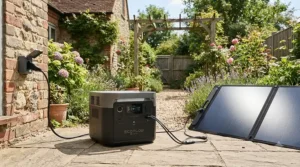
Real-World Scenarios: Who Actually Needs 1500-3000Wh?
The rural power-cut household. If you live somewhere UK Power Networks or a similar operator reports frequent storm-related outages, a fixed 2,000Wh-class unit like the Anker SOLIX F2000 or Bluetti Elite 200 V2 sitting charged in a cupboard is realistic insurance — enough to run a fridge-freezer, some lighting and a router for well over 24 hours, which covers the vast majority of UK outages without needing a generator’s fuel and noise.
The weekend-to-weeklong campervan user. For anyone converting or already living out of a van, capacity that can scale matters more than a single fixed number. The EcoFlow Delta 2 Max and Bluetti AC200L, both expandable and both proven against real appliance loads like compressor fridges and hairdryers, suit this profile specifically because your power needs on a weekend trip and a fortnight off-grid are wildly different.
The budget-conscious first-time buyer. If this is your first power station and you’re mainly thinking “what happens if the power goes out for an evening,” the Jackery Explorer 1500 covers that brief without asking you to spend £2,000 on capacity you may never draw down.
Buyer’s Decision Framework: Which Capacity and Output Do You Need?
If your priority is simply riding out UK power cuts for a fridge and some lighting, choose a fixed 1,500-2,100Wh unit like the Jackery Explorer 1500 or Bluetti Elite 200 V2, because that capacity comfortably clears a typical multi-hour outage without paying for headroom you won’t use. If you’re planning a campervan or motorhome conversion where needs will grow, choose an expandable unit like the EcoFlow Delta 2 Max or Bluetti AC200L, because you can start small and scale the battery rather than the whole system later. If you regularly need to run power tools, a kettle and a fridge simultaneously, choose a higher-output unit like the Jackery Explorer 2000 Plus or Jackery Explorer 3000 v2, because 2,300W-class inverters will trip under combined loads that a 3,000W+ unit handles without complaint. And if budget is the deciding factor above all else, choose whichever unit sits closest to your actual runtime need rather than the biggest number on the box — a 3,072Wh unit you can’t afford to also buy solar panels for delivers less real-world resilience than a 1,534Wh unit you can afford to pair with a panel.
How to Choose a Portable Power Station 1500-3000Wh
Choosing the right unit comes down to seven concrete criteria, in the order we’d actually weigh them:
- Capacity versus your realistic runtime need. Work backwards from what you want to power and for how long, rather than buying the biggest Wh figure you can afford.
- Continuous output, not just peak/surge. A high surge rating means nothing if the continuous wattage can’t sustain your fridge compressor’s running load.
- Battery chemistry. LiFePO4 (used in every model in this guide) should be considered close to non-negotiable over older NMC lithium chemistries for safety and cycle life.
- Charging speed and flexibility. Check whether solar and mains can charge simultaneously — this genuinely changes how usable a unit is off-grid.
- Expandability. Decide upfront whether your needs might grow, since retrofitting capacity later is only possible on modular designs.
- Weight versus your actual use case. A unit that lives permanently in a van doesn’t need to be lightweight; one you’ll carry regularly does.
- Warranty length and certification. UKCA marking and a 5-year warranty, as offered on several models here, are reasonable proxies for manufacturer confidence in longevity.
What to Expect: Real-World Performance
Spec sheets are written in laboratory conditions, and real usage rarely matches them exactly. Expect actual usable capacity to land 3-10% below the advertised Wh figure once you account for inverter efficiency losses converting DC battery power to AC output — independent testing on units in this guide consistently found real-world figures in the 95-98% range of the rated spec, which is a genuinely healthy result for the category. Expect charging times to lengthen in cold weather; several manufacturers note solar charging efficiency drops meaningfully below around 14°F (-10°C), a detail relevant to anyone charging a campervan setup through a British winter. Expect fan noise under heavy sustained load on every unit in this guide — it’s simply physics for units pushing 2,000W+ through a compact inverter — though quieter charging modes on models like the Jackery Explorer 2000 Plus genuinely do reduce this for overnight use.
Dual Charging Explained: Solar + Mains Together
Dual charging (solar + mains) means a power station can draw from both an AC wall socket and a connected solar panel array at the same time, with the two input streams combining rather than one simply switching off the other. This matters in practice for two reasons: it dramatically cuts total charge time when you have both sources available, and it lets off-grid users top up faster on partly cloudy days when solar alone wouldn’t be enough. The Bluetti AC200L leads this guide’s line-up on this front with a combined 2,400W maximum input, reaching 0-80% in around 45 minutes when both AC and solar are stacked, while the EcoFlow Delta 2 Max achieves an 80% charge in roughly 43 minutes using its 1,000W solar input alongside mains power. Based on the spec comparison across all seven units, the practical takeaway is that dual charging matters most for van-life and off-grid buyers, and least for households keeping a unit as pure power-cut insurance, where a straightforward overnight mains charge is perfectly adequate.
Battery Management System: The Spec That Actually Matters
A battery management system (BMS) is the onboard electronics that monitor and protect every cell in a power station’s battery pack — guarding against overcharge, over-discharge, short circuits, excess temperature and cell imbalance, all in real time. It’s arguably the single most important spec in this entire category, and the one marketing copy talks about least, because it doesn’t sound as exciting as a big Wh number. What the spec sheet won’t tell you, but engineering research suggests, is that BMS quality is what actually determines whether a LiFePO4 pack degrades gracefully over thousands of cycles or fails catastrophically under abuse; a University of Warwick study on lithium iron phosphate battery safety found that cells managed with correct low-voltage protection built into the system showed negligible degradation and no thermal incidents even under stress testing. Jackery’s ChargeShield 2.0 and 12-Layer BMS, Bluetti’s BLUETOPUS AI-BMS, and Anker’s InfiniPower protection all achieve broadly the same job through different engineering — real-time cell balancing, thermal cutoffs and short-circuit protection — and aggregated review sentiment across all seven units in this guide reports no thermal incidents when used within rated specifications. If you take one thing from this section: a well-documented BMS with named safety certifications is worth more to long-term reliability than an extra 200Wh of capacity.

Appliance Runtime Calculator: How Long Will It Actually Last?
What is a portable power station appliance runtime calculator? It’s a simple formula — battery capacity in watt-hours multiplied by inverter efficiency (typically around 85%), divided by your appliance’s running wattage — that estimates how many hours a device will run before the battery depletes.
| Appliance | Typical Running Watts | Runtime on 2,048Wh (85% efficiency) |
|---|---|---|
| Compressor fridge-freezer | 100W | ~17.4 hours |
| Wi-Fi router + modem | 15W | ~116 hours |
| Laptop | 65W | ~26.8 hours |
| Electric kettle | 2,000W | ~52 minutes |
| CPAP machine | 40W | ~43.5 hours |
Run the same maths for the units at either end of this guide and the picture shifts meaningfully: on the Jackery Explorer 1500‘s 1,534Wh capacity, that same fridge-freezer runs for roughly 13 hours, while on the Jackery Explorer 3000 v2‘s 3,072Wh capacity it stretches to over 26 hours — useful context if you’re trying to decide whether the extra capacity actually buys you meaningfully more security for your specific appliance load. The formula only accounts for continuous draw, so remember to check an appliance’s startup surge against your unit’s peak output separately, since that’s the figure that determines whether it switches on at all, not just how long it runs once it has.
Common Mistakes When Buying a Large Power Station
The most common mistake we see in aggregated buyer feedback is confusing watts and watt-hours — buying based on the Wh capacity number alone without checking whether the continuous W output can actually start the appliance you have in mind. A close second is ignoring startup surge: a compressor fridge or air conditioner can draw three to six times its running wattage for a brief moment at power-on, and a unit with a low surge rating simply won’t start it even with a full battery. Buyers also frequently overlook expandability until it’s too late — choosing a fixed-capacity unit like the base Bluetti Elite 200 V2 or Jackery Explorer 1500, then wishing a year later they’d bought into a modular ecosystem instead. Finally, price-chasing without checking chemistry is a genuine risk in this category: some budget listings on general marketplaces still use older, less stable lithium chemistries rather than LiFePO4, trading long-term safety and cycle life for a lower upfront price — every unit recommended in this guide avoids that trade-off.
Portable Power Station vs Petrol Generator
The traditional alternative to any unit in this guide is a small petrol generator, and the comparison isn’t as one-sided as marketing from either side suggests. A petrol generator can, in theory, run indefinitely as long as you keep feeding it fuel, which no battery-based power station can match for genuinely extended off-grid stretches. But for the vast majority of UK use cases — power cuts, campervan trips, occasional workshop use — a portable power station 1500-3000Wh wins on the things that actually matter day to day: it’s silent, it produces zero exhaust fumes (meaning it’s safe to run indoors, unlike a petrol generator, which carries a genuine carbon monoxide risk), it needs no fuel storage or trips to a petrol station, and it starts instantly at the press of a button rather than requiring a pull-cord and warm-up. The Wikipedia entry on lithium iron phosphate batteries notes their appeal for backup power applications specifically because of low toxicity and long cycle life compared with older chemistries — qualities a petrol engine simply can’t offer. Where a generator still wins outright is total cost per watt-hour for genuinely continuous multi-day power; for anything shorter than that, the seven units above are the more practical, and considerably more pleasant, choice.
Safety, Regulations & UK Compliance
Every unit in this guide uses LiFePO4 battery chemistry, which the wider battery research community regards as substantially safer than older lithium-ion cathode chemistries under thermal stress — Oxford University chemists note in their review of lithium-ion safety for battery energy storage systems that thermal runaway risk is heavily influenced by cathode material choice, with iron-phosphate chemistries offering a notably more stable safety profile than cobalt-based alternatives. In the UK specifically, look for UKCA marking (the post-Brexit equivalent of the CE mark) on any unit you’re considering, which several models in this guide — including the Jackery Explorer 3000 v2 — carry alongside IEC and TÜV certification. Practically, that means always charging and discharging units within their rated temperature range, never covering the ventilation while charging, and following manufacturer guidance on long-term storage charge levels. If your household relies on medical equipment powered by one of these units, it’s also worth registering for your electricity network’s Priority Services Register, which can offer extra support during a mains outage.
Long-Term Cost & Maintenance
A portable power station 1500-3000Wh isn’t a one-off purchase to forget about — treat the total cost of ownership as the capital cost plus roughly a decade of intermittent use. LiFePO4 cells rated for 3,000-6,000 cycles, as every unit in this guide claims, translate to years of daily-equivalent use before capacity noticeably degrades, meaning the effective cost-per-use drops sharply the longer you own one. Maintenance is genuinely minimal compared with a petrol generator: no oil changes, no fuel stabiliser, no annual carburettor clean — simply an occasional full charge cycle and sensible storage-charge habits as covered in our usage guide above. Where ongoing cost does creep in is with expandable systems; the Jackery Explorer 2000 Plus, EcoFlow Delta 2 Max and Bluetti AC200L all carry genuinely useful expansion paths, but each additional battery module is priced closer to a second entry-level unit than a cheap accessory, so budget for that reality if scalability is part of your decision.
Frequently Asked Questions
❓ What size portable power station do I need for a UK power cut?
❓ Can I run a portable power station 1500-3000Wh indoors safely?
❓ Is there a good power station under £1500 in this capacity range?
❓ How long does a 2000Wh power station last on a single charge?
❓ Does this article use real customer experience or AI-generated reviews?
Conclusion
A portable power station 1500-3000Wh isn’t a luxury gadget anymore — for a lot of UK households and van-lifers, it’s become the sensible middle ground between doing nothing and installing a whole-home battery system. If you’re after the lowest entry price, the Jackery Explorer 1500 gets you into this capacity bracket without overspending. If value-for-spec is your priority, the Bluetti Elite 200 V2 and Anker SOLIX F2000 both punch well above their price. Campervan and motorhome owners should look hardest at the EcoFlow Delta 2 Max or Bluetti AC200L for their expandability and dual-charging speed, while anyone who’s outgrown the 2,000Wh tier entirely will find the Jackery Explorer 3000 v2 the most capable — if priciest — option here. Whichever you choose, the real-world math is simple: check your appliance’s running watts against the unit’s continuous output, check startup surge against peak output, and buy the capacity that matches your actual use case rather than the biggest number on the box.
Recommended for You
- Power Station For Glamping Weekends: 7 Ultimate Picks (2026)
- Power Station for Weekend Trips: 7 Best UK Picks (2026)
- Power Station for Workshop Power Tools: 7 Best UK Picks (2026)
Disclaimer: This article contains affiliate links. As an Amazon Associate, I earn from qualifying purchases. If you purchase products through these links, we may earn a small commission at no additional cost to you.
✨ Found this helpful? Share it with your friends! 💬🤗
