In This Article
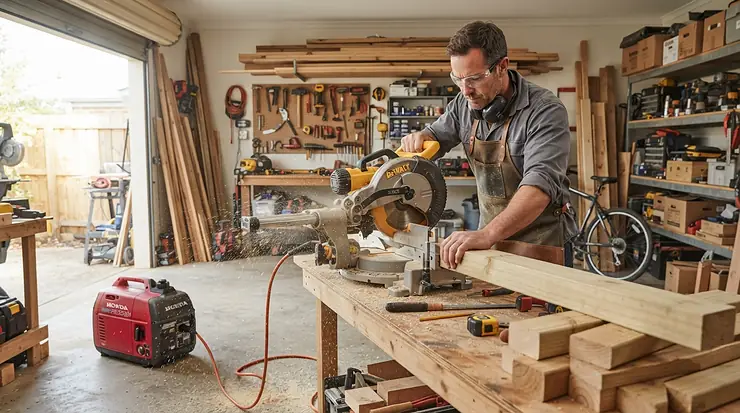
There’s a particular kind of frustration that only workshop owners understand: the moment your circular saw bogs down mid-cut because the extension lead you ran from the house is three sockets and forty metres away from a proper supply. A power station for workshop power tools solves that exact problem, and it does it without diesel fumes, without a 110-volt site transformer clunking away in the corner, and without you tripping the house RCD every time the compressor kicks in.

What is a power station for workshop power tools? In plain terms, it’s a battery-based unit with a built-in inverter that turns stored DC power into the AC mains voltage your corded tools expect, plus enough surge capacity to survive the split-second current spike when a motor first spins up. Get the sizing wrong, though, and you’ll find out the hard way — usually with a dead cut halfway through a stud wall.
This guide walks through seven real, currently available units spanning budget chargers through to genuine site-duty power banks, explains why surge wattage matters more than the headline number on the box, and covers the camper conversion, outdoor event, and extension lead angles that most buying guides skate straight past. Everything below is drawn from published specifications and aggregated review sentiment rather than guesswork — because a workshop is not the place to find out your research was wrong.
Quick Comparison Table
| Power Station | Capacity | Continuous / Surge Output | Weight | Best For |
|---|---|---|---|---|
| Anker SOLIX C300 | 288Wh | 300W / 600W | 3.75kg | Charging tool batteries & small gear |
| EcoFlow RIVER 3 Max | ~1,024Wh | 1,200W / — | ~11kg | Camper conversion & event backup |
| Anker SOLIX C800 Plus | 768Wh | 1,200W / 1,600W | 10.7kg | Mixed-load outdoor events |
| Jackery Explorer 1000 v2 | 1,070Wh | 1,500W / 3,000W | 10.8kg | Daily workshop power tools |
| EcoFlow DELTA 3 Plus | 1,024Wh | 1,800W / 3,600W | 12.5kg | Heavier tools, fast recharge |
| Ecowizard EcoFlow DELTA 3 Max Plus | 2,048Wh (expandable to 10kWh) | 2,400W+ | ~24kg | Multi-tool, all-day site work |
| FOSSiBOT F2400 | 2,048Wh | 2,400W / 4,800W | 22kg | Heavy-duty tools & long events |
Reading this table left to right, capacity in watt-hours tells you how long a session you get, while the continuous/surge pairing tells you what you can actually plug in without the unit shutting itself down in self-defence. Notice the surge figure roughly doubles the continuous rating on most of these — that headroom exists specifically because motor-driven tools draw far more current for a fraction of a second on start-up than they do once running. Jackery Explorer 1000 v2 and FOSSiBOT F2400 stand out for genuine tool duty because their surge ratings comfortably clear the inrush spike of a mitre saw or router, whereas the Anker SOLIX C300 is honestly a battery charger for cordless tool packs, not a corded-tool power source.
💬 Found a combo that fits your workshop already? Bookmark this page before prices shift.
Top 7 Power Stations for Workshop Power Tools: Expert Analysis
1. Anker SOLIX C300 — smallest footprint for topping up cordless batteries
The Anker SOLIX C300 is the one to buy if your “workshop power tools” mostly means cordless drills, impact drivers, and the occasional jigsaw that lives on a battery rather than a lead. Its 288Wh LiFePO4 cell and 300W continuous output (600W surge) aren’t trying to compete with the bigger units on this list, and that’s rather the point.
In practice, that 600W surge is enough to run a cordless tool charger, a small bench light, and a phone simultaneously, but it will not start a corded circular saw or a compressor — the maths simply isn’t there. Where it earns its keep is the 140W two-way USB-C charging, which means the unit itself tops up quickly and can push power back out to laptops or tool chargers at a genuinely useful speed, a detail that matters when you’re switching between three battery-powered tools in an afternoon.
Reviewers consistently describe the C300 as the sensible small-workshop pick precisely because it doesn’t overpromise: it’s positioned as a companion for cordless tool chargers and jobsite lighting rather than a corded power source, and aggregated feedback tends to praise the seven-port layout for letting several devices trickle-charge at once. What the spec sheet won’t tell you is how often a small unit like this gets left permanently on a workbench simply because it’s light enough that nobody minds moving it.
Pros:
- ✅ Genuinely portable at 3.75kg — fits in a tool bag
- ✅ 140W USB-C charging is fast for its size
- ✅ Seven ports cover most cordless-tool charging needs
Cons:
- ❌ 300W output can’t run corded power tools
- ❌ 288Wh capacity drains fast under any real load
At around £250-£320, the C300 sits in the budget bracket, and the value case holds up well as a tool-charging companion — just don’t buy it expecting to run a table saw.

2. EcoFlow RIVER 3 Max — best for camper conversion power
If your project is less “workshop” and more “converting a van into somewhere you can actually live,” the EcoFlow RIVER 3 Max is the one worth a proper look. Its 1,200W continuous output handles most power tools, small appliances and kitchen equipment in one compact unit, which is exactly the mixed bag a camper build throws at you — a drill in the morning, a kettle in the evening.
The standout spec for conversions specifically is the 220W solar input paired with a wall-charge time of roughly 1.2 hours from flat, meaning a day’s driving with a rooftop panel can realistically refill it before you’ve finished cooking dinner. What most buyers overlook is the built-in UPS function, which switches to battery within milliseconds — genuinely useful if you’re running a 12V fridge in the van and can’t afford even a brief power gap while cutting over between shore power and battery.
Aggregated review sentiment on this RIVER-series unit tends to flag the built-in UPS and fast solar refill as the two features that justify the mid-range price point over cheaper alternatives, particularly for anyone treating the power station as semi-permanent van infrastructure rather than a grab-and-go unit. On the downside, at 1,200W it’s not the pick if you’re planning to run a corded angle grinder or a site kettle at the same time as everything else.
Pros:
- ✅ Fast 1.2-hour recharge from empty via mains
- ✅ Built-in UPS protects sensitive electronics like fridges
- ✅ 220W solar input suits rooftop van conversion panels
Cons:
- ❌ No expansion battery option if you outgrow capacity
- ❌ 1,200W ceiling rules out heavier corded tools
Priced in the £500-£650 range depending on bundle, this is a strong middle-ground buy for anyone whose “workshop” is really a garage conversion project on wheels.
3. Anker SOLIX C800 Plus — best for outdoor events needing mixed loads
Outdoor events — a market stall, a garden party with a PA system, a weekend of camping-adjacent work — tend to need several small-to-medium loads running at once rather than one big power-hungry tool. The Anker SOLIX C800 Plus is built for exactly that scenario, with five separate AC outlets rated at up to 1,200W continuous and a SurgePad peak of 1,600W.
That five-outlet spread matters more than the headline wattage here: rather than one socket doing all the work, you can spread a speaker, a string of festoon lights, a laptop charger and a small fridge across separate ports without daisy-chaining adapters. The 768Wh LiFePO4 battery recharges to 80% in around 2.3 hours via a 300W solar input, which is a genuinely useful turnaround between event days if you’re camping alongside the stall.
Reviewers highlight the SurgePad tech specifically for handling heat-generating devices like kettles and toaster ovens that would trip a lesser unit’s surge protection, and the three-mode built-in camping light is repeatedly mentioned as a nice touch for events running into the evening. The honest trade-off is capacity: 768Wh is comfortable for a day of light-to-moderate use but won’t stretch across a multi-day festival without a recharge.
Pros:
- ✅ Five AC outlets spread load across multiple devices
- ✅ SurgePad handles heat-generating appliances well
- ✅ Built-in camping lights add genuine event utility
Cons:
- ❌ 768Wh capacity needs daily recharging for heavy use
- ❌ Heavier than the C300 at nearly 11kg
Sitting around £500-£600 at full price (regularly discounted toward the £450-£550 range), it’s the mid-tier pick for anyone running an outdoor stand or event setup rather than a fixed workshop.
4. Jackery Explorer 1000 v2 — best all-rounder for daily workshop power tools
This is the one most workshop buyers should actually be comparing everything else against. According to one detailed UK buying comparison, the 1500W output on this unit handles a 700W power drill, a 1500W circular saw, and an electric kettle for the brew break, while its 3000W surge handles the inrush current of motor-based tools without tripping — which is about as direct a description of “workshop-ready” as you’ll find.
The 1,070Wh LiFePO4 battery strikes a genuinely useful middle ground: enough for a working day of light-to-moderate tool use, with a 1-hour fast charge from the mains meaning you’re not stuck waiting overnight if you drain it mid-project. At 10.8kg, it’s light enough to carry between a workshop and a job site without needing a trolley, and the fold-down handle (new on this version) makes that carrying genuinely comfortable rather than a two-handed wrestle.
Aggregated reviews are unusually consistent here — one detailed test called it “one of the best portable power stations” tested, awarding it 4.5 stars and highlighting the balance of capacity, performance and portability, while a separate UK comparison singled it out as the default site/tradies pick specifically because it runs power tools without the buyer needing to think about app ecosystems or expansion batteries. The one recurring caveat across sources is the lack of an expansion battery option — if 1,070Wh isn’t enough for your workload, you’re buying a second unit rather than adding capacity.
Pros:
- ✅ 3,000W surge comfortably absorbs motor-tool inrush
- ✅ 1-hour fast charge minimises workshop downtime
- ✅ Genuinely well-reviewed build quality and warranty support
Cons:
- ❌ No expansion battery if you need more than 1,070Wh
- ❌ 10.8kg is manageable but not pocket-portable
Typically found in the £400-£550 range on Amazon (with occasional promotional drops lower), this is the benchmark workshop pick on this list — the one to default to if you’re not sure which category fits you.
5. EcoFlow DELTA 3 Plus — fastest recharge for back-to-back tool sessions
Workshop time is often stop-start — drill for ten minutes, break, saw for twenty, break — and what actually matters in that rhythm is how fast the power station bounces back between uses. The EcoFlow DELTA 3 Plus is built around exactly that: a 1,024Wh LiFePO4 battery that recharges from 0-100% in 56 minutes via a 1,500W AC input, independently verified as one of the fastest charging speeds in its class.
On paper, the 1,800W continuous output with 3,600W surge (boosted via X-Boost technology to handle loads over 2,400W) means it can drive a decent corded circular saw or a small compressor without hesitation, while the four separate AC outlets let you split a load across a saw and a shop-vac at the same time rather than juggling a single socket. What most buyers overlook about the DELTA 3 Plus specifically is that the X-Boost feature effectively lets the inverter borrow headroom for tools that briefly exceed the rated continuous output — useful for tools with a punchy start-up but a modest running draw.
Review sentiment across UK retailers consistently praises the charge speed and the quiet 30dB operation, while noting the 12.5kg weight as noticeably heavier than the Jackery equivalent — worth factoring in if you’re regularly moving it between a van and a workshop bench. The battery is expandable up to 5kWh with an add-on pack, which is a genuine advantage over the Jackery if your workload is likely to grow.
Pros:
- ✅ 56-minute full recharge from mains, among the fastest tested
- ✅ Expandable to 5kWh with additional battery packs
- ✅ Four AC outlets split loads across multiple tools
Cons:
- ❌ 12.5kg makes it noticeably heavier to carry daily
- ❌ Premium pricing compared with the Jackery equivalent
Currently sitting in the £750-£950 range depending on retailer promotions, it’s a strong pick for anyone who values recharge speed over raw portability.

6. EcoFlow DELTA 3 Max Plus — best for scaling up to whole-workshop power
For a genuinely capable workshop — one with a table saw, dust extraction, and lighting all wanting power at once — the EcoFlow DELTA 3 Max Plus is where this list moves from “portable power bank” into “small generator replacement” territory. Its base 2,048Wh capacity is expandable up to 10kWh with additional battery packs, which is a meaningfully different proposition to the single-battery units earlier on this list.
The continuous output comfortably clears 2,400W with X-Boost engaged, and the near-silent 25dB noise rating at 600W load is a detail that matters more than it sounds in a workshop where you’re standing next to the unit for hours. Based on the spec comparison with smaller units on this list, the real advantage here isn’t outright power — several units already clear typical tool surge needs — it’s that expandability lets you buy into the ecosystem once and scale capacity later rather than purchasing a second standalone unit.
Because this is a newer, higher-tier release, independently verified UK customer review volume is still thinner than for the established Jackery and DELTA 3 Plus models, so treat early sentiment with appropriate caution rather than over-reading a handful of reviews; what can be verified is the published spec sheet and the UPS switchover time of roughly 10 milliseconds, which is respectable for protecting sensitive workshop electronics during a mains dropout.
Pros:
- ✅ Expandable up to 10kWh for genuine multi-tool workshops
- ✅ Near-silent 25dB operation at moderate load
- ✅ Fast 10ms UPS switchover protects sensitive kit
Cons:
- ❌ At ~24kg, this is a stationary unit, not a carry-around
- ❌ Premium price puts it beyond casual DIY budgets
Priced from around £1,100-£1,400 depending on bundle and promotional discount, this is the pick for anyone treating their power station as permanent workshop infrastructure rather than a portable add-on.
7. FOSSiBOT F2400 — highest surge headroom for heavy-duty tools and events
When the tool in question is a serious corded compressor, a large mitre saw, or you’re running an entire outdoor event’s lighting and sound rig off one unit, the FOSSiBOT F2400 has the numbers to match. Its 2,048Wh LiFePO4 battery pairs with a 2,400W continuous pure sine wave output and a genuinely substantial 4,800W surge rating — roughly double the surge of the Jackery Explorer 1000 v2 on this list.
That surge figure is the standout feature in practice: it’s the headroom that lets a heavy-duty tool or a bank of equipment spike hard on start-up without the unit cutting out defensively, something smaller units simply can’t match. The three separate 2,400W AC outlets, plus thirteen ports in total, mean you can genuinely run several demanding devices simultaneously — a detail one detailed video review specifically flagged as giving “a lot of extra headroom to handle initial surges” before settling into stable running current. Charging is similarly quick for the capacity: 0-80% in an hour, full in 1.5 hours via combined AC and solar input.
Aggregated feedback describes the F2400 as a heavy-duty tools and emergency-medical-gear class of unit, and the LiFePO4 cell’s 3,500+ cycle rating (roughly a decade of regular use) supports treating it as long-term site equipment rather than a seasonal purchase. At 22kg, though, this is not something you casually sling in a van — it’s built to live in one place, or be moved on a trolley.
Pros:
- ✅ 4,800W surge is the highest on this list by some margin
- ✅ Three 2,400W AC outlets run multiple heavy tools at once
- ✅ 1.5-hour full recharge despite the large 2,048Wh capacity
Cons:
- ❌ 22kg weight makes it a fixed-position unit, not portable
- ❌ Premium price reflects its site-duty positioning
Typically priced in the £650-£850 range on UK retailers, it represents strong value for the surge capacity on offer, provided you actually need that level of headroom.
Looking at all seven side by side, the Jackery Explorer 1000 v2 earns its place as the best all-round workshop pick because its surge-to-weight ratio hits the sweet spot most DIYers and tradespeople actually need, while the FOSSiBOT F2400 justifies its higher price only if your tools genuinely draw the kind of surge that smaller units can’t absorb. Budget buyers should note that the Anker SOLIX C300 sacrifices corded-tool capability entirely for its compact size — a trade-off that’s fine for cordless charging but a dealbreaker if a circular saw is on your shopping list.
Surge Wattage for Power Tools: What the Number Actually Means
Surge wattage — sometimes called peak or startup wattage — is the maximum power a motor draws for a fraction of a second when it first switches on, before settling down to its steady running (continuous) wattage. Motors need this extra push to overcome the inertia of a stationary blade, bit, or fan; skip past that spike and the tool simply won’t start.
This is the single most misunderstood spec on any power station box, and getting it wrong is the most common reason a “powerful enough” unit trips out the moment you pull the trigger. A 1,500W circular saw might genuinely only draw 1,500W once cutting, but its startup surge can briefly hit 3,000W or more — which is precisely why the ukhomeenergy.co.uk comparison guide treats the 3,000W surge rating on the Jackery Explorer 1000 v2 as the spec that actually matters for tool use, not the 1,500W continuous figure most shoppers fixate on.
The practical rule of thumb: check the nameplate on your specific tool for its rated starting current (often listed as “LRA” or given as a multiple of running current), then choose a power station whose surge rating clears that figure with some margin — 20-30% headroom is a sensible buffer rather than cutting it precisely to the wire. Running two tools simultaneously means adding both continuous ratings together for your baseline, then checking the surge rating against whichever tool has the higher individual startup spike, since surges from separate tools rarely overlap perfectly in practice.
Site Power Alternatives: Power Stations vs 110V Transformers vs Generators
For anyone coming from a traditional building-site background, the obvious comparison is a 110V site transformer, and it’s worth being honest about where each option actually wins. UK construction sites have long favoured 110V centre-tapped-to-earth (CTE) systems specifically because HSE guidance treats a 110V reduced low-voltage system as the standard means of effectively eliminating shock risk on site, with 230V permitted only after a risk assessment and additional control measures like RCD protection are in place.
A 110V transformer, in other words, is a safety device that steps mains voltage down for standard site tools — it doesn’t store energy, so it’s only useful where you already have a mains supply to plug it into. A portable power station does the opposite job: it stores energy so you can run standard 230V tools somewhere there’s no mains supply at all — a remote outbuilding, a field, a driveway rebuild fifty metres from the consumer unit. For anyone running tools that are only rated for 110V transformer supply, a power station’s 230V output isn’t a direct swap-in, so check your tool’s rated voltage before assuming compatibility.
Where does a small petrol generator fit into this? Generators still win on sustained output for genuinely heavy, all-day tool use with no mains access whatsoever, but they bring fuel, fumes, noise, and maintenance that a battery unit simply doesn’t. For anyone working indoors, in a garage, or anywhere near a building with people in it, the near-silent operation of units like the EcoFlow DELTA 3 Max Plus is a genuine practical advantage that a generator can’t match, quite apart from the emissions question.
Setting Up Your Power Station: A Practical First-Use Guide
Getting a new power station workshop-ready takes about twenty minutes if you follow a sensible order, and skipping steps is exactly how people end up with a flat unit on day one or a tripped internal protection circuit they don’t understand.
First, fully charge the unit before first use — most LiFePO4 units ship at a partial charge for safe transit, and running a full charge cycle early on lets the battery management system calibrate its capacity readings accurately. Second, before connecting any tool, check the unit’s continuous and surge ratings against your specific tool’s nameplate rather than assuming “powerful enough” — this single step prevents the vast majority of first-week disappointment. Third, position the unit on a stable, ventilated surface away from sawdust and metal swarf; workshop dust is genuinely harder on these units than outdoor grit because it’s finer and gets pulled into cooling vents by the internal fan.
A common first-month mistake is running the unit down to near-zero repeatedly rather than topping up between sessions — LiFePO4 cells don’t suffer memory-effect problems the way older chemistries did, so partial recharges are perfectly fine and arguably better for long-term cycle life than deep discharges. Another is ignoring the app (where one exists) — Jackery, EcoFlow, and Anker all offer companion apps that show real-time load, and glancing at that during a session tells you exactly how much headroom you have left before you overload a socket, which is far more useful than guessing.
Real-World Scenarios: Matching the Right Unit to Your Situation
The weekend DIYer with a garage workshop: drilling, sanding, the occasional circular saw cut, maybe three sessions a week. The Jackery Explorer 1000 v2 fits this profile almost exactly — enough surge headroom for genuinely motor-driven tools, a battery that lasts a working session, and a price point that doesn’t feel like overkill for hobby use.
The van-life convert mid-build: running a drill and jigsaw during the day, then needing to keep a 12V fridge and lighting going overnight once the build is finished. The EcoFlow RIVER 3 Max covers both phases of that project — tool-capable during construction, UPS-protected and solar-rechargeable once it’s living in the finished van.
The market trader or small events operator: speakers, string lighting, a card reader, maybe a small fridge for drinks, running across a full day outdoors with no mains hookup. The Anker SOLIX C800 Plus, with its five separate outlets and built-in camping lights, was built almost precisely for this brief — spreading modest loads across multiple sockets rather than needing one enormous single-socket capacity.
How to Choose a Power Station for Workshop Power Tools
- List your tools’ rated continuous and surge wattage. Check the nameplate on each tool you’ll actually run, not the marketing copy — this single number drives every other decision.
- Add up simultaneous continuous loads, then check the single highest surge figure. If you’ll run a saw and a shop-vac together, add their continuous wattages, but size surge capacity against whichever one spikes hardest on start-up.
- Decide portable versus stationary. Anything over about 15kg stops being something you casually carry between a van and a job — factor that into whether you need wheels or a fixed spot.
- Check recharge speed against your actual downtime. A 1-hour fast charge matters enormously if you’re doing back-to-back jobs; it matters far less if the unit sits on charge overnight regardless.
- Factor in expandability if your workload might grow. Units offering add-on battery packs (like the DELTA 3 series) let you scale later rather than buying a second unit from scratch.
- Confirm your extension lead and socket setup can actually deliver the load. A power station’s output is only as good as the lead carrying it to your tool — more on this below.
- Read aggregated review sentiment on surge reliability specifically, not just battery life — a unit that reviews well for camping can still underperform on genuine tool inrush current.
Extension Lead Compatibility: The Detail Most Guides Skip
A power station’s rated output means nothing if the extension lead between it and your tool can’t safely carry that current, and this is genuinely one of the most overlooked failure points in home workshop setups. UK domestic extension leads are typically rated at either 10A or 13A per socket, which at 230V works out to roughly 2,300W or 3,000W maximum — comfortably above what most single power tools draw, but worth checking against your power station’s peak continuous output if you’re running it near its ceiling.
Cable length and gauge matter more than most people expect: a long, thin extension lead introduces voltage drop and heat build-up under sustained load, which is precisely the scenario a workshop creates — a tool running continuously for twenty minutes rather than a brief burst. As a rule of thumb, keep runs under 25 metres on a standard 1.25mm² cable for anything drawing close to the lead’s rated maximum, and always fully unwind a reel-type extension lead before use, since a coiled cable under load traps heat and can, in rare cases, become a fire risk. Electrical Safety First’s guidance on extension lead safety covers this in more detail and is worth a look if you’re running leads regularly in a workshop setting.
One detail specific to power stations rather than mains sockets: most units cap their total AC output across all sockets combined, not per socket, so plugging two tools into two separate outlets on the same unit doesn’t double your available power — it splits the single continuous rating between them. Check your unit’s total AC wattage rather than assuming each socket delivers its full rated output independently.

Common Mistakes When Buying a Power Station for Workshop Power Tools
Buyers regularly fixate on watt-hour capacity as the headline number, when for tool use, surge wattage is usually the figure that actually determines whether a unit works for you at all — a large-capacity unit with a modest surge rating will still trip when a compressor kicks in. Another recurring mistake is ignoring weight until delivery day; a 22kg unit sounds abstract on a spec sheet but becomes very real the first time you need to move it up a step into a shed.
Buyers also frequently overlook recharge speed, assuming any unit will simply “charge overnight” without checking whether that’s actually true for their specific use pattern — a tradesperson doing two jobs in a day needs a fast recharge window between them, not an 8-hour trickle charge. Finally, it’s worth being sceptical of manufacturer-only marketing claims around “runs X hours of continuous tool use” — these figures are frequently calculated against a single small tool at partial load, not the mixed, intermittent, high-surge reality of actual workshop use, so cross-reference against independent review sentiment rather than the box copy alone.
Long-Term Cost & Maintenance: What Ownership Actually Costs
LiFePO4 batteries — the chemistry used in every unit on this list — are rated for 3,000 to 4,000+ full charge cycles before dropping to around 80% of original capacity, which in practical terms works out to roughly a decade of regular workshop use before you’d notice meaningful capacity loss. That longevity is precisely why the upfront price of these units, which can look steep next to a basic generator, tends to work out favourably over a five-to-ten-year ownership period: no fuel costs, no annual servicing, and no oil changes.
Total cost of ownership should factor in the electricity used to recharge (a genuinely small figure — recharging a 1,000Wh unit costs pennies at typical UK electricity rates), plus the eventual, though distant, cost of an expansion battery if your workload outgrows the base unit. Compared with a 110V site transformer plus a running generator, the power station’s running costs are negligible; the trade-off is a higher purchase price and a hard capacity ceiling per charge that a fuel-fed generator simply doesn’t have.
Buyer’s Decision Framework
If your workshop tools are entirely cordless, choose a small charging unit like the Anker SOLIX C300, because you’re topping up batteries, not running corded loads directly. If you need one unit to genuinely run a circular saw or mitre saw for a full working day, choose the Jackery Explorer 1000 v2, because its surge-to-price ratio is the strongest all-round match for typical workshop tools. If your workshop is scaling toward multiple simultaneous heavy tools or permanent installation, choose the EcoFlow DELTA 3 Max Plus or FOSSiBOT F2400, because their surge headroom and expandability suit sustained, heavier demand rather than occasional DIY sessions.
Features That Actually Matter (And Those That Don’t)
Surge wattage, LiFePO4 battery chemistry, and total AC output genuinely matter — they determine whether the unit does the job at all. Wi-Fi app connectivity is a genuine convenience for monitoring load in real time, but it’s not a dealbreaker if a unit lacks it; a simple LCD display tells you almost everything you need mid-job. Built-in camping lights, while a nice touch on units like the Anker SOLIX C800 Plus, are marketing dressing rather than a purchase-deciding feature for anyone buying primarily for tool use rather than camping.
Solar input capability matters enormously for camper conversions and off-grid events, but is largely irrelevant if your power station lives permanently near a mains socket in a fixed workshop — don’t pay a premium for a large solar input spec you’ll never actually use.

FAQ
❓ What size power station do I need for power tools?
Match the surge rating (not just continuous watts) to your tool’s startup spike — most single power tools need at least 1,500-2,000W surge, while compressors or table saws often need 3,000W+. Check your specific tool’s nameplate rating before buying…
❓ Can a power station run a table saw?
Yes, provided its surge rating clears the saw’s startup spike — units like the Jackery Explorer 1000 v2 (3,000W surge) or FOSSiBOT F2400 (4,800W surge) are built for this. Smaller units under 1,000W surge generally cannot…
❓ Is a power station better than a generator for workshop power tools?
For indoor, near-silent, fume-free use, yes — power stations win on convenience and running cost. For genuinely heavy, all-day, off-grid tool use, a petrol generator still offers greater sustained output…
❓ How long does a power station last powering tools?
Runtime depends entirely on your tool’s continuous draw versus the unit’s watt-hour capacity — a 1,070Wh unit running a 700W drill intermittently might last several hours, while continuous heavy use drains it much faster…
❓ Do I need a special extension lead for a power station?
A standard 13A-rated UK extension lead is fine for most single-tool use, but fully unwind it before use and avoid long thin cables for sustained high-draw tools to prevent voltage drop and heat build-up…
Conclusion
Choosing a power station for workshop power tools really comes down to one honest question: what does your surge rating actually need to clear? Get that number right, and the rest of the decision — capacity, weight, recharge speed — becomes a straightforward trade-off between portability and runtime. The Jackery Explorer 1000 v2 remains the strongest all-round pick for typical DIY and light trade use, the Anker SOLIX C300 covers cordless-only workshops well, and the FOSSiBOT F2400 or EcoFlow DELTA 3 Max Plus are worth the extra outlay only once your tool load genuinely demands that level of headroom.
Whichever unit you land on, the research pays off the first time a power cut, a lack of mains access, or a genuinely awkward extension lead run would otherwise have stopped a job dead. A power station doesn’t just save you a trip back to the fuse box — it changes where you’re able to work at all.
✨ Don’t Miss These Exclusive Deals!
🔧 Take your workshop setup to the next level with these carefully selected power stations. Click on any highlighted product to check current pricing and availability. The right unit means fewer interrupted cuts and more finished projects!
Recommended for You
- Power Station 1000-1500Wh: 7 Best Picks for UK Homes (2026)
- Power station for food truck: 7 best picks UK traders trust (2026)
- Power Station 500-1000Wh: 7 Proven UK Picks (2026)
Disclaimer: This article contains affiliate links. As an Amazon Associate, I earn from qualifying purchases. If you purchase products through these links, we may earn a small commission at no additional cost to you.
✨ Found this helpful? Share it with your friends! 💬🤗
