
In This Article
It’s a wet Tuesday evening in late October. The kitchen lights flicker, the router blinks out, and the house falls silent the way only a power cut can manage. You reach for the thermostat and nothing happens. Here’s the twist most of us learn mid-outage: gas central heating isn’t gas-only. Which? explains that a boiler still needs electricity to operate, so a live gas supply alone won’t keep the radiators warm. That is why the portable power station vs petrol generator question matters more every autumn.
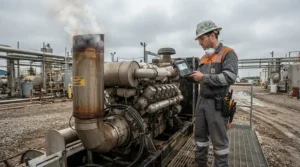
A boiler wants a trickle of clean power. A fridge-freezer wants a steady supply, and your router and phone want almost nothing. Two very different machines can deliver it. One is a silent battery, and the other is a thirsty engine that must live outdoors. Each comes with trade-offs on safety, noise, running costs and even the law.
This guide compares seven real models: five power stations and two petrol inverter generators. It explains how a power station to run gas boiler during power cut works in practice. It also covers carbon monoxide risk, quiet indoor operation and fuel storage rules in plain English. Everything rests on published specifications and aggregated published reviews. Nothing here claims hands-on testing, and where independent reviews were thin, the article says so.
What Is a Portable Power Station vs Petrol Generator?
A portable power station is a rechargeable lithium battery with a built-in inverter, supplying mains-style 230V power silently with no exhaust. A petrol generator burns unleaded fuel in an engine to make electricity. It runs as long as you keep refuelling it, but it is noisy and produces poisonous carbon monoxide, so it must stay outdoors.
Portable Power Station vs Petrol Generator: Quick Comparison Table
| Feature | Portable power station | Petrol inverter generator |
|---|---|---|
| Energy source | LiFePO4 battery, recharged by mains, solar or car | Unleaded petrol, refuelled by hand |
| Runtime limit | Battery capacity (about 250Wh to 4,096Wh in this guide) | Fuel supply (roughly 3.5 to 10 hours per tank, depending on load) |
| Noise | Fan hum; EcoFlow Delta Pro 3 is claimed as low as 30 dB under 2,000W | About 51-53 dB at 7m at light load, around 61 dB at full load (Yamaha EF2000iS) |
| Indoor use | Yes, in a ventilated space, following the manual | Never; outdoors only |
| Carbon monoxide | None at the point of use | Serious hazard |
| Boiler suitability | Excellent: clean power, tiny load | Works, but wildly oversized for 100-150W |
| Fuel storage | None | Legal limits apply |
| Upkeep | Top up the charge occasionally | Oil, spark plug, fresh fuel, annual service |
| Typical cost | Roughly £150 to £2,500+ | Roughly £900 to £1,250 |
| Best For | Short, frequent cuts, flats, quiet homes | Multi-day rural outages |
The table tells a clear story. For the typical UK household facing a few hours without power, the power station wins on safety, noise and hassle. The generator earns its place only when outages last days and recharging isn’t possible. Many households land on the hybrid option: a battery for daily resilience, with a generator as the long-haul reserve.
💬 Just one click — help others make better buying decisions too!😊
Top 7 Picks: Portable Power Station vs Petrol Generator Options Compared
These seven span budget to premium and battery to petrol. Each is judged on what the spec sheet means in a real UK power cut. Prices are ranges only, so check current prices before buying.
1. Anker SOLIX C1000 Gen 2 — fastest recharge in its class
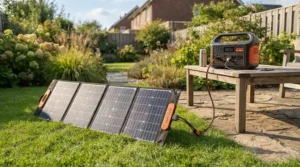
When the mains returns at 2am, a battery that refills in under an hour is a very civilised thing. The Anker SOLIX C1000 Gen 2 has a 1,024Wh LiFePO4 battery and 2,000W output with a 3,000W peak. Anker claims a 49-minute full recharge at 1,600W once enabled in the app, and up to 600W of solar input.
Those numbers matter. A boiler plus pump plus router needs perhaps 150W, so a full battery could in theory stretch across most of an evening. Add a fridge-freezer and lamps and you’ll still be comfortable. Note that many UK kettles draw close to 3kW, so this unit can’t run one.
Reviewers rate it highly. OutdoorGearLab named the first-generation C1000 its pick for most people, and Outdoor Life rated it best for solar generators. Independent long-term coverage of Gen 2 is still thin, so much of that praise carries over from Gen 1.
Pros:
- ✅ Very fast recharge between outages
- ✅ 2,000W output handles several appliances at once
- ✅ Solar-ready, with 600W maximum input
Cons:
- ❌ Gen 2 long-term reviews are still limited
- ❌ Can’t run a 3kW kettle
Bundles with 100W to 400W panels run roughly £1,250-£1,850 at list, so check current price. It’s strong value if fast turnaround matters.
2. Jackery Explorer 1000 v2 — lighter carry, one-hour top-up
If your meter cupboard or boiler sits upstairs, weight is a feature. The Jackery Explorer 1000 v2 offers 1,070Wh, 1,500W AC output, a 100W USB-C port and a one-hour fast charge. A comparison by Mayfair Farms puts the Jackery at about 23.8 lb (around 10.8kg), lighter than the first-generation Anker.
At 1,500W it comfortably handles a boiler, fridge-freezer, router and lamps together. A 2kW fan heater is beyond it. In practice that makes it a “keep life ticking” unit rather than a “recreate normality” one. Based on the spec comparison, it suits flats and second-floor carries best.
TechRadar picked the Jackery for on-site work and called the brand a safe choice. UK deal coverage by Gareth Butterfield reported steep Amazon discounts from a list price around £899. I couldn’t verify a consistent list of complaints beyond its lower output.
Pros:
- ✅ Noticeably lighter than rivals
- ✅ One-hour fast recharge
- ✅ Brand with a long UK track record
Cons:
- ❌ 1,500W ceiling is lower than the Anker’s
- ❌ Street price swings make timing important
List price sits around £900-£1,200 with a panel. Discounts have been reported, so check current price. Verdict: great value on a good day.
3. EcoFlow Delta 3 Plus — best all-rounder with 1,000W solar input
The EcoFlow Delta 3 Plus is the unit that blurs the portable power station vs petrol generator divide. It has a 1,024Wh LFP battery and 1,800W pure sine wave output. It charges in about 56 minutes from 1,500W AC, takes up to 1,000W of solar, and can even accept a petrol or LPG generator as an input.
That last feature is the clever bit. You get silent battery power day to day, with a generator on the patio topping it up in a week-long outage. Retail listings also describe UPS-style switchover on its sibling models, which helps keep electronics from rebooting. For boiler controls, check the manual first.
TechRadar called it the best overall and said its simulated outages kept a router, laptop and lights running until the battery emptied. The Star’s reviewer noted it costs around £200 more than the older Delta 2. He also noted that the doubled solar input only pays off if you own enough panels.
Pros:
- ✅ Accepts mains, solar and generator input
- ✅ Smart app monitoring
- ✅ Expandable with compatible batteries
Cons:
- ❌ Costs more than the previous generation
- ❌ 1,000W solar needs a sizeable panel setup
Expect roughly £600-£900 depending on retailer, so check current price. It’s the best fit for anyone wanting future flexibility.
4. EcoFlow Delta Pro 3 — 4kWh for whole-evening backup
For families who want heating, fridge, lights and Wi-Fi to carry on, the EcoFlow Delta Pro 3 is the heavyweight. It has a 4,096Wh battery and 4,000W output, rising to 6,000W with X-Boost. Capacity expands up to 12kWh, and the maker claims noise as low as 30 dB under 2,000W.
A rough sum: a boiler (about 120W), fridge-freezer, router and lamps might average around 200W. A 4kWh battery could then run that load for well over half a day. This is illustrative arithmetic, not a tested figure.
OutdoorGearLab picked it for home backup. An Australian review called the 4,000W overkill for small loads and noted the sparse accessories in the box. It’s heavy and best treated as semi-portable.
Pros:
- ✅ Huge capacity, expandable to 12kWh
- ✅ Runs nearly any household appliance
- ✅ Five-year warranty listed by UK retailers
Cons:
- ❌ Heavy and bulky for stairs
- ❌ Expensive for boiler-only backup
UK listings sit in the mid-£2,000s, so a £2,200-£3,000 range is realistic. Check current price. It’s worth it only if you’ll use the capacity.
5. EcoFlow River 3 — pocket-sized boiler lifeline on a budget
Not everyone needs a washing-machine-sized battery. TechRadar’s budget pick weighs just 7.8 lb (about 3.5kg) and measures 10 x 8.3 x 4.4 in. On the maker’s spec sheet the EcoFlow River 3 is a roughly 245Wh, 300W-class unit, so verify the figures on the current listing.
That is enough for the 100-150W a boiler draws. It will bridge an hour or two of heating, plus phones and a router, but it won’t keep a household going through a long evening. It can’t power a kettle either. Think of it as a boiler-and-Wi-Fi lifeline for short, frequent cuts.
TechRadar rated it best on a budget. I couldn’t verify a large body of independent owner reviews, so treat this as a spec-led recommendation.
Pros:
- ✅ Very light and easy to store
- ✅ Affordable entry into backup power
- ✅ Enough for boiler, router and phones
Cons:
- ❌ Small capacity limits runtime
- ❌ No chance of running a kettle or heater
Generally priced in the low hundreds, so check current price. It’s good value if short cuts are your main worry.
6. Honda EU22i — the benchmark petrol inverter generator
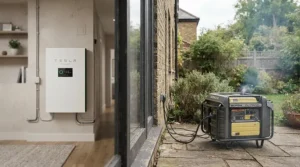
If the portable power station vs petrol generator contest has a heavyweight on the petrol side, it’s the Honda EU22i. It delivers 1.8kW rated and 2.2kW maximum from a 3.6-litre tank, weighs about 21kg, and carries a 5-year domestic warranty subject to annual service. Dealer listings quote about 3 hours 30 at rated load. Honda’s own figure is 8.1 hours at light load.
Those runtimes shape your night. At full tilt, someone must refuel every few hours, outdoors, ideally after the engine cools. At the 100-150W a boiler draws, the generator is loafing, which wastes its strengths. Noise figures vary by listing: about 53 dB(A) at 7m at quarter load, but 71 dB(A) at the workstation and 89 dB guaranteed sound power.
It is best for multi-day outages where recharging isn’t possible. I couldn’t gather enough independent buyer reviews to summarise sentiment fairly, so this verdict rests on specs and dealer information.
Pros:
- ✅ Runtime limited only by your fuel supply
- ✅ Inverter output suits sensitive electronics
- ✅ Long domestic warranty
Cons:
- ❌ Carbon monoxide: outdoors only
- ❌ Petrol storage rules and refuelling hassle
Dealer listings run roughly £900-£1,250. Check current price. Good value only if you genuinely face long outages.
7. Yamaha EF2000iS — fuel gauge and parallel-ready
The Yamaha EF2000iS is the Honda EU22i‘s closest rival. It weighs 20-21kg and has a 4.2-litre tank, roughly 17% more fuel than the Honda. Yamaha quotes 10.5 hours at quarter load. Its noise figures are 51.5 dB(A) at quarter load and 61 dB(A) at rated load, measured at 7m. It has a fuel gauge and an optional kit to link two units.
The gauge sounds trivial until it’s 3am and raining. Based on the spec comparison, the Yamaha EF2000iS wins on tank size and visibility, while the Honda EU22i has the stronger UK warranty story. The parallel option lets you add a second unit rather than buy a bigger one.
Again, I couldn’t verify enough independent reviews to summarise buyer sentiment honestly. Warranty terms vary by market, so confirm the UK terms before buying.
Pros:
- ✅ Larger tank and a handy fuel gauge
- ✅ Parallel kit available for two units
- ✅ Pure sine wave output claimed by the maker
Cons:
- ❌ Same carbon monoxide and fuel-storage burdens
- ❌ Can’t run a 3kW kettle
I couldn’t pin down a consistent UK price, so treat it as comparable to the Honda and check current price. Verdict: good value if the gauge and tank matter to you.
Top 7 Comparison Table
| Product | Type | Capacity / Output | Runs indoors? | Price range | Best For |
|---|---|---|---|---|---|
| Anker SOLIX C1000 Gen 2 | Power station | 1,024Wh / 2,000W | Yes | Around £1,250-£1,850 with panels | Fast recharging |
| Jackery Explorer 1000 v2 | Power station | 1,070Wh / 1,500W | Yes | Around £900-£1,200 | Lighter carry |
| EcoFlow Delta 3 Plus | Power station | 1,024Wh / 1,800W | Yes | Around £600-£900 | Hybrid flexibility |
| EcoFlow Delta Pro 3 | Power station | 4,096Wh / 4,000W | Yes | Around £2,200-£3,000 | Whole-home backup |
| EcoFlow River 3 | Power station | About 245Wh / 300W | Yes | Low hundreds | Budget boiler bridge |
| Honda EU22i | Petrol generator | 1.8kW rated / 2.2kW max | Never | Around £900-£1,250 | Long outages |
| Yamaha EF2000iS | Petrol generator | 2,000W class | Never | Comparable; check price | Bigger tank, gauge |
Looking at the comparison above, the EcoFlow Delta 3 Plus is the safest all-rounder, because it can take mains, solar or a generator for recharging. If heating plus a fridge is the goal, the Jackery Explorer 1000 v2 and Anker SOLIX C1000 Gen 2 handle it, and the EcoFlow Delta Pro 3 covers a full day. Budget buyers should note that the EcoFlow River 3 trades runtime for portability.
Power Station to Run Gas Boiler During Power Cut: A Practical Setup Guide
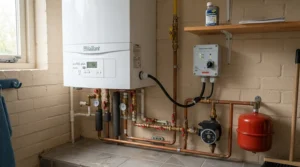
Why does a gas boiler stop dead when the grid fails? Because the gas only fuels the burner. The ignition, fan, control board and pump need electricity. Northern Gas Networks confirms that a power cut stops your boiler working. Its advice is to check power status via 105, and to call the Gas Emergency Service on 0800 111 999 if you smell gas.
Here’s how to plan a power station to run gas boiler during power cut without drama:
- Find the real number. Check the boiler’s data plate for its electrical rating, often somewhere around 100-150W including the pump. Add the programmer and any wireless thermostat.
- Mind the wiring. Most UK boilers are fixed to a fused spur rather than a plug. Ask a qualified electrician to fit a safe plug-in or changeover arrangement. Never back-feed power into a wall socket.
- Insist on pure sine wave. Heating forums are full of warnings about cheap modified-sine inverters upsetting pumps and controls. Every power station in this guide’s top five is described as pure sine, but confirm it on the listing.
- Do a dry run now. It’s 10 October. Test the setup before the first frost, not during a storm.
- Know your limits. A power station to run gas boiler during power cut will heat water and radiators, but never your cooking, which is why batteries beat petrol on safety here.
Common mistakes in the first month: forgetting to charge the unit, plugging in a heater, and assuming your boiler manufacturer approves. Check the manual and ask a Gas Safe engineer for boiler-side questions.
Should You Buy Power Station and Solar Panel Bundle for Power Cuts? A Decision Framework
It’s tempting to buy power station and solar panel bundle for power cuts as a single tidy package. In winter, though, a UK roof or lawn won’t give you much. A 400W array on a grey December day might yield only a modest fraction of its summer output. Treat that as an approximate rule of thumb, not a measurement. Panels are best seen as a bonus charger for autumn, spring and long outages, plus a way to use the kit for camping or a garden office.
Use this simple framework:
- If your cuts are short and rare: skip the panels and buy a bigger battery.
- If outages can last days: bundles help. The Anker SOLIX C1000 Gen 2 is sold in UK bundles with 100W, 200W and 400W panels at roughly £1,250 to £1,850 list. The Jackery Explorer 1000 v2 has been bundled with 100W and 200W panels.
- If you already own panels: match their voltage to the input range (for example, 11-60V on EcoFlow units, 60V maximum on the Anker SOLIX C1000 Gen 2).
- Check the totals: compare the bundle price with buying separately, because deals fluctuate.
A 1,000W input is wasted on a 100W panel, so size your array to the EcoFlow Delta 3 Plus or whichever unit you choose. When you buy power station and solar panel bundle for power cuts, check current price and what’s actually in the box.
Real-World Scenarios: Three UK Households, Three Different Answers
The terraced-house commuter. A 1990s combi boiler, a short power cut or two a year and a £300-£600 budget. The EcoFlow River 3 bridges boiler and Wi-Fi for short cuts. Step up to the Jackery Explorer 1000 v2 if you want the fridge covered too. No fuel, no fuss.
The rural smallholder. Storms can take the lines down for days, and there’s a shed and outdoor space. A Honda EU22i or Yamaha EF2000iS earns its keep here. Better still, pair a generator with the EcoFlow Delta 3 Plus, which accepts generator input, so the engine runs outside for an hour while the battery handles the night silently.
The third-floor flat dweller. No garage, no shed and possibly a lease banning petrol storage. That decides the portable power station vs petrol generator question outright. The Anker SOLIX C1000 Gen 2 or the Jackery Explorer 1000 v2 fits the stairs, the lease and the neighbours.
How to Choose Between a Portable Power Station vs Petrol Generator
- List your loads. Write down each appliance’s watts. Boiler plus pump, router, fridge-freezer and lamps is usually a few hundred watts.
- Work out capacity. Multiply watts by hours, then divide by about 0.85 to allow for inverter losses.
- Match the outage pattern. Short, frequent cuts favour batteries. Multi-day outages favour generators or hybrids.
- Check where it will live. No outdoor space means no petrol generator.
- Plan the recharge. Fast AC charging is great. Solar and generator input add resilience.
- Verify safety marks. Look for CE or UKCA marking, pure sine output and a UK warranty.
- Total the cost. Include fuel storage, servicing and spare parts for a petrol unit.
Carbon Monoxide Risk: The Safety Gap That Matters Most
Carbon monoxide is colourless and odourless, and it’s the single biggest argument in the portable power station vs petrol generator debate. The Health and Safety Executive for Northern Ireland’s generator safety guidance is unambiguous. Never run a generator in homes, garages or partially enclosed spaces, even with some ventilation, and fans won’t prevent a build-up. It also recommends battery-powered carbon monoxide alarms and fuelling generators outdoors.
Symptoms are easy to dismiss. A Welsh local-authority safety page notes they resemble flu, food poisoning or simple tiredness. So the carbon monoxide risk is highest when you’re cold, tired and improvising.
A battery has no exhaust, so at the point of use its carbon monoxide risk is nil. That doesn’t make it hazard-free. Keep it ventilated, away from heat, and follow the manual. Whatever you choose, fit alarms marked to BS EN 50291, and keep gas hobs, barbecues and camping stoves out of living spaces.
Quiet Indoor Operation: Why Decibels and Location Matter
“Quiet” means different things in a living room and in a garden. Petrol inverters are among the quietest engines going, but the figures come with caveats. The Yamaha EF2000iS is quoted at 51.5 dB(A) at quarter load and 61 dB(A) at rated load, both at 7m. The Honda EU22i is listed at about 53 dB(A) at 7m at quarter load, though other listings quote 71 dB(A) at the workstation and 89 dB sound power.
None of that helps indoors, because a generator can’t go there. Quiet indoor operation belongs to batteries. The EcoFlow Delta Pro 3 is claimed as low as 30 dB under 2,000W, so fans hum quietly, though they’ll ramp up under heavy load. Overnight, a power station running the boiler and fridge won’t disturb sleep or the neighbours.

Fuel Storage Rules: What the Law Actually Says
If you choose petrol, the Petroleum (Consolidation) Regulations 2014 apply to homes. Schedule 2 of the regulations sets the framework for England, Wales and Scotland. Northern Ireland has its own arrangements, so check locally.
- Up to 30 litres: you can keep it at home without telling your local Petroleum Enforcement Authority. Fire-service guidance specifies plastic containers up to 10 litres, metal containers up to 20 litres, or one demountable tank up to 30 litres.
- 30-275 litres: you must notify the authority in writing.
- Over 275 litres: a licence is required.
- Where to keep it: never in living accommodation. Use a ventilated garage or shed away from ignition sources, with containers labelled “PETROL” or “HIGHLY FLAMMABLE”.
For scale, 30 litres is roughly eight fills of a 3.6-litre Honda EU22i tank. Fuel storage rules apply to petrol only. A battery needs no fuel, though you should still check the manual for storage temperatures.
Long-Term Cost & Maintenance: Total Cost of Ownership
Sticker price is only the start. A power station’s running cost is recharging, typically a few tens of pence per kilowatt-hour at UK tariffs. LiFePO4 cells are rated for thousands of cycles, with listings quoting 3,000+ cycles on the EcoFlow Delta 3 Plus and 4,000 cycles to 80% on the EcoFlow Delta Pro 3. For occasional use, warranty length and shelf behaviour matter more than cycle counts.
A petrol generator adds recurring chores. These are oil changes, spark plugs, fresh fuel and an annual service. The Honda EU22i‘s domestic warranty is conditional on that service. Stale petrol is the classic failure, because a generator that hasn’t run for a year may not start when the lights go out. The Honda EU22i has a fuel-off feature that lets you run the carburettor dry before storage.
Over a decade of rare cuts, the battery is usually the lower-maintenance option. A generator wins only when long outages recur.
Portable Power Station vs Petrol Generator: Benefits vs Traditional Alternatives
| Option | Keeps boiler running? | Typical outlay | CO risk | Hassle | Best For |
|---|---|---|---|---|---|
| Portable power station | Yes | £150 to £2,500+ | None at point of use | Low | Short, frequent cuts |
| Petrol generator | Yes | £900 to £1,250 | High if misused | High | Multi-day outages |
| Small power bank | No (phones only) | Low | None | Low | Phones and Wi-Fi |
| Blankets and hot-water bottles | No | Minimal | None | Low | Very short cuts |
The table shows why batteries have become the default recommendation. A power bank keeps phones alive but can’t heat anything, and a generator heats everything while demanding the most from you. A power station sits in the sweet spot for most households, and the EcoFlow Delta 3 Plus covers the long-haul scenario too.
Common Mistakes When Buying a Portable Power Station vs Petrol Generator
- Buying on watt-hours alone. Output watts decide what you can run, and the 3kW UK kettle is the classic trap.
- Assuming the boiler plugs in. Most are hard-wired, so budget for an electrician.
- Ignoring waveform. Choose pure sine for pumps and controls.
- Running a generator in the garage. Open doors don’t fix it, as the HSENI guidance makes clear.
- Skipping the dry run. Test before winter.
- Mismatching panels and inputs. Check voltage limits first.
- Ignoring weight. The EcoFlow Delta Pro 3 is not a stair-friendly unit.

FAQ
❓ What size portable power station do I need to run central heating?
❓ Is a power station worth it for occasional UK power cuts?
❓ Can I charge a power station from a petrol generator?
❓ Do solar panels work during a UK winter power cut?
❓ Do I need an electrician to connect my boiler to a power station?
Conclusion
So who wins the portable power station vs petrol generator contest? For most UK households with a gas boiler and a few hours of outage, the battery. It’s quiet, it has no exhaust, and there’s no petrol to store, so carbon monoxide risk and fuel storage rules barely enter the conversation. The EcoFlow Delta 3 Plus is the safest all-rounder, the Jackery Explorer 1000 v2 and Anker SOLIX C1000 Gen 2 handle the evening, the EcoFlow River 3 bridges short cuts, and the EcoFlow Delta Pro 3 covers a full day.
The petrol generator keeps one genuine edge: unlimited runtime. If your area loses power for days and you have a shed and a sensible head, the Honda EU22i or Yamaha EF2000iS is a sound reserve. Pair it with a battery and you get the best of both.
Whichever route you choose, make the plan before the first frost: size the load, sort the boiler connection, fit carbon monoxide alarms and run a dry test.
✨ Ready to Stay Warm When the Grid Goes Down?
🔥 Compare the picks above, check current pricing and availability, and choose the setup that fits your home. A little planning now means a warmer, safer, calmer night when the lights go out!
Recommended for You
- EcoFlow Vs Jackery For Home Backup: 7 Best Picks
- Portable Power Station For Power Cuts: 7 Reliable UK Picks (2026)
- Power Station For Long Power Outages: 7 Best UK Picks (2026)
Disclaimer: This article contains affiliate links. As an Amazon Associate, I earn from qualifying purchases. If you purchase products through these links, we may earn a small commission at no additional cost to you.
✨ Found this helpful? Share it with your friends! 💬🤗
