In This Article
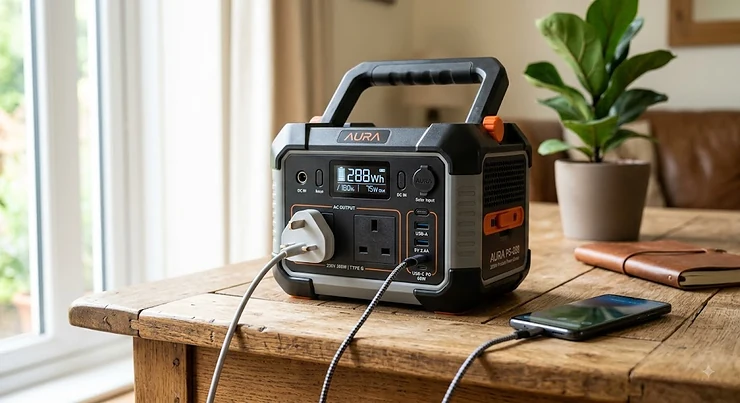
A power station under 300Wh is the sweet spot that nobody talks about enough. Go smaller and you’re basically carrying an overgrown phone charger. Go bigger and suddenly you’re lugging a breeze-block-sized unit up three flights of stairs because the lift’s broken again. This capacity band — roughly 180Wh to 290Wh — sits right where portability and usefulness actually meet, and it’s exactly why so many UK buyers land here first.

Here’s what a power station under 300Wh actually is: a rechargeable battery pack, almost always built around LiFePO4 or lithium-ion cells, with a UK three-pin AC socket, USB ports, and often a solar input, capable of storing enough energy to run a laptop for a full workday, keep a phone topped up for a week of camping, or bridge a short power cut without the whole household descending into candlelit chaos.
Whether you’re chasing something to power photography gear on a shoot, a genuinely compact unit for phone and tablet duty, or simply the best power station under £150 you can find without compromising on battery chemistry, this guide covers real products with real specifications — not marketing fluff dressed up as a review. We’ve dug into seven genuine models spanning budget to premium, weighed up their carry weight against their output, and worked out which one actually suits your situation. No invented five-star reviews, no fantasy pricing — just honest analysis grounded in the numbers manufacturers publish and the patterns real owners report.
Quick Comparison Table
| Product | Capacity | Battery | Weight | Best For |
|---|---|---|---|---|
| Anker 521 PowerHouse | 256Wh | LiFePO4 | 4.34kg | All-round weekend power |
| EcoFlow River 2 | 256Wh | LiFePO4 | 3.5kg | Fastest recharge |
| Bluetti EB3A | 268Wh | LiFePO4 | ~4kg | Highest surge output |
| Jackery Explorer 300 v2 | 288Wh | LiFePO4 | 3.7kg | Longest cycle life |
| Goal Zero Yeti 200X | 187Wh | Lithium NMC | 2.27kg | Lightest carry weight |
| Ugreen PowerRoam 300 | 210Wh | Li-ion NMC | ~3.6kg | Mini phone/tablet duty |
| FlashFish T300PRO | 230Wh | LiFePO4 | ~3kg | Closest to £150 |
Looking at the table, the split comes down to chemistry and priorities rather than raw capacity, since every model here sits within about 100Wh of each other. The EcoFlow River 2 and Bluetti EB3A both lean into speed and power headroom, while the Goal Zero Yeti 200X trades capacity for the lightest carry weight of the group, which matters far more than the spec sheet suggests once you’re actually hauling one up a hillside. Budget-focused buyers should note the FlashFish T300PRO and Ugreen PowerRoam 300 get closest to entry-level pricing without dropping to older, less safe lithium-ion chemistry.
💬 Just one click — help others make better buying decisions too!😊
Top 7 Power Stations Under 300Wh: Expert Analysis
1. Anker 521 PowerHouse — best all-round weekend power
The Anker 521 PowerHouse is the model most UK buyers land on first, and there’s a reason it keeps showing up in every comparison list. It packs a 256Wh LiFePO4 battery into a genuinely portable frame with five output ports covering the basics.
Its 200W continuous output (boosted briefly through Anker’s SurgePad tech for higher-draw appliances) means it comfortably runs a mini-fridge, several fans, or a full weekend of laptop and phone charging. The 3,000+ life cycle rating to 80% capacity, backed by a five-year full-device warranty, is well above what budget lithium-ion units typically offer.
Based on the spec comparison, the 521 sits squarely in the “do everything reasonably well” category rather than excelling at any one thing. It suits campers, festival-goers, and anyone wanting a no-fuss backup for CPAP machines or laptops during a blackout, without needing to learn an app or fuss over settings.
Independent reviewers, including Parkers’ hands-on testing, flag the car-socket outlet as underused by most owners and note that, as an entry-level unit, its 200W ceiling can feel limiting once you try to run anything beyond small electronics.
Pros:
- ✅ 3,000+ cycle LiFePO4 battery with 5-year warranty
- ✅ Five ports including fast 60W USB-C PD
- ✅ Power-Saving mode cuts drain automatically
Cons:
- ❌ 200W continuous cap limits higher-draw appliances
- ❌ Car socket rarely gets used by most owners
At around £200-£230, the Anker 521 PowerHouse represents solid value if you want dependable capacity without chasing the fastest recharge or highest surge rating on the market.

2. EcoFlow River 2 — best for fastest recharge
The EcoFlow River 2 built its reputation on one standout figure: a full 0-100% recharge in roughly 60 minutes, which is genuinely unusual at this capacity and price point. That single spec changes how you plan a day around it.
Its 256Wh LiFePO4 pack pairs with a 300W continuous output, boostable to 600W via X-Boost mode for running “99% of consumer electronics,” according to EcoFlow’s own published specs. Weighing just 3.5kg, it’s noticeably lighter than the Anker 521 despite matching its capacity almost exactly.
What most buyers overlook about this model is the TÜV Rheinland safe-charge certification, which independently verifies the battery won’t degrade prematurely from fast charging — a legitimate concern with rapid-charge lithium packs that cut corners. The sub-30ms EPS auto-switch also makes it a credible micro-UPS for routers or fish tanks during short outages.
Structured owner feedback on Amazon and EcoFlow’s community channels consistently singles out the recharge speed as the standout real-world benefit, though the app’s Bluetooth range indoors has drawn occasional criticism in longer-term use reports.
Pros:
- ✅ 0-100% recharge in around 60 minutes
- ✅ 600W X-Boost output for demanding devices
- ✅ TÜV Rheinland-certified safe fast charging
Cons:
- ❌ App Bluetooth range can be patchy indoors
- ❌ 110W max solar input is modest for the class
Priced around £200-£250, the EcoFlow River 2 earns its premium over cheaper units through charging speed alone, which matters enormously if you only have a lunch break to top up before heading out.
3. Bluetti EB3A — best for highest surge output
The Bluetti EB3A punches noticeably above its 268Wh capacity thanks to a 600W continuous inverter that jumps to 1,200W in Power Lifting mode — a software trick that briefly stretches the inverter’s ceiling for appliances with a startup surge, like small kettles or hairdryers.
Reviewers’ running-time formula (268Wh × 0.85 ÷ device wattage) puts a 100W device at roughly 2.3 hours, which tracks with what BLUETTI publishes on its own spec sheet. The 430W max charging speed, combining AC and solar simultaneously, gets it to 80% in about the time it takes to make a coffee.
Here’s what the spec sheet won’t tell you, but user reports suggest: some early-production EB3A units have a documented battery management system (BMS) fault that a handful of owners have flagged on Bluetti’s own UK review page, alongside plenty of long-term users reporting years of trouble-free camping and off-grid use. That split is worth knowing about before buying secondhand or from an unofficial reseller.
Its 200W max solar input, the highest in this roundup, makes the Bluetti EB3A the strongest pick here if you’re planning to top it up primarily through a solar panel rather than mains power.
Pros:
- ✅ 600W continuous, 1,200W surge via Power Lifting
- ✅ 200W max solar input, best in this class
- ✅ 80% charge in around 30 minutes via AC+solar
Cons:
- ❌ Some units reported with a documented BMS fault
- ❌ Fan noise increases noticeably under fast charging
Typically priced in the low-to-mid £200s, the Bluetti EB3A suits buyers who want headroom for occasional higher-wattage appliances rather than pure phone-and-laptop duty.
4. Jackery Explorer 300 v2 — best for longest cycle life
The Jackery Explorer 300 v2 is Jackery’s 2026 refresh, and the generational jump is genuinely meaningful rather than cosmetic. The headline change is battery chemistry: it moves from the original’s standard lithium-ion cells to LiFePO4, lifting the rated cycle life from roughly 500 cycles to around 4,000 cycles to 80% capacity.
At 288Wh, it sits closest to the 300Wh ceiling of any product in this guide, while still weighing about 3.7kg — around 19% lighter than the outgoing model, according to independent testing coverage of the refresh. A 100W USB-C port allows genuinely useful laptop charging speeds, and the 0-80% recharge in around an hour keeps pace with the class leaders.
On paper this means buyers get more total lifetime energy throughput from the v2 than from almost anything else at this price, since a 4,000-cycle LiFePO4 pack will comfortably outlast a decade of weekly weekend trips. The Energy-Saving Mode, designed for continuous low-draw devices like CPAP machines, is a thoughtful touch missing from some rivals.
Professional testers at OutdoorGearLab, reviewing the original Explorer 300, praised its compact form for “recharging our phones and laptops” but flagged that small capacity and output limit heavier appliance use — a caveat that still broadly applies to the v2 despite its upgrades.
Pros:
- ✅ LiFePO4 chemistry rated for around 4,000 cycles
- ✅ 288Wh capacity, closest to the 300Wh ceiling here
- ✅ 100W USB-C fast charging for laptops
Cons:
- ❌ 300W output limits it against appliances with high startup draw
- ❌ No built-in app control on this base model
At around £230-£270, the Jackery Explorer 300 v2 is the pick for buyers who plan to keep their power station for years rather than upgrading every couple of seasons.
5. Goal Zero Yeti 200X — best for photography gear on the go
The Goal Zero Yeti 200X is the lightest unit in this entire roundup, at just 2.27kg, and that single figure is precisely why photographers and content creators gravitate toward it. Carry weight matters enormously when a power station is one more item in a bag that already holds two camera bodies, three lenses, and a tripod.
Its 187Wh capacity is deliberately modest, and Goal Zero doesn’t try to disguise that trade-off. What most buyers overlook about this model is that it’s not trying to compete on raw output; it’s optimised for topping up battery-hungry mirrorless cameras, drone batteries, and laptops repeatedly through a long shoot day, not for running appliances.
Reviewers’ side-by-side comparisons with rival budget units note that the Yeti 200X’s fast-charging tech gives it an edge for on-the-move top-ups, though independent comparisons also suggest the Anker equivalent holds a slight edge on raw battery longevity over repeated cycles. Its retailer listing explicitly markets it for “camping, photography, cabins,” which lines up with how most buyers actually seem to use it.
With four USB outputs (two USB-A, a USB-C, and a USB-C PD) plus a single AC socket and two 12V ports, it’s built to juggle several small devices simultaneously rather than one power-hungry appliance.
Pros:
- ✅ Lightest carry weight in this roundup at 2.27kg
- ✅ Genuinely pocketable footprint for camera bags
- ✅ Fast-charging tech well suited to camera batteries
Cons:
- ❌ 187Wh capacity is the smallest here by some margin
- ❌ No LiFePO4 chemistry, so cycle life trails rivals
Priced around £180-£230, the Goal Zero Yeti 200X only makes sense once you accept the capacity trade-off in exchange for genuinely forgettable carry weight.

6. Ugreen PowerRoam 300 — best mini pick for phone and tablet duty
The Ugreen PowerRoam 300 targets a narrower brief than most units here: keeping phones, tablets, and the odd laptop charged without the bulk of a full camping power station. Its 210Wh capacity, built from 48,000mAh of Li-ion NMC cells, comes packaged with a 300W continuous output and a smart digital display showing exact charge levels and port activity.
Based on the spec comparison, this is squarely a mini power station for phone and tablet use rather than an appliance-running workhorse — the sort of thing that lives in a rucksack side pocket for a week away rather than anchoring a whole campsite setup. Ugreen’s own PowerZip fast-charging tech, borrowed down from its larger PowerRoam siblings, gets it to a usable charge quickly from a standard wall socket.
Here’s what the spec sheet won’t tell you: this model uses Li-ion NMC chemistry rather than LiFePO4, which typically means a shorter total cycle life than the LiFePO4 units in this guide, even though day-to-day performance feels near-identical for the first year or two of ownership. If longevity matters more to you than upfront price, that’s the trade-off to weigh carefully.
Independent long-term owner reviews for this specific model remain limited, since it’s a comparatively recent addition to Ugreen’s lineup, so it’s worth checking current buyer feedback before committing.
Pros:
- ✅ Compact 210Wh capacity ideal for phones and tablets
- ✅ Clear smart digital display for charge monitoring
- ✅ PowerZip fast charging from a standard wall socket
Cons:
- ❌ Li-ion NMC chemistry, shorter cycle life than LiFePO4 rivals
- ❌ Limited independent long-term review data so far
Regularly discounted into the £150-£200 range from a higher list price, the Ugreen PowerRoam 300 is worth watching for sales if your needs stop at small devices.
7. FlashFish T300PRO — closest to a power station under £150
The FlashFish T300PRO is the value pick of this roundup, and notably one of the only sub-300Wh units here that pairs a genuinely low price with LiFePO4 chemistry rather than cheaper, shorter-lived lithium-ion cells. At 230Wh capacity and a 300W rated output, it covers phone, tablet, and light laptop charging comfortably.
What most buyers overlook about budget power stations is that battery chemistry matters more than the price tag alone. A cheap lithium-ion unit might undercut the T300PRO on price, but it will typically degrade far faster over repeated charge cycles. FlashFish choosing LiFePO4 at this price point is a genuinely buyer-friendly decision worth acknowledging.
Honestly, verified UK-specific long-term ownership data on this model is thinner than for the bigger brands in this guide, so rather than inventing detail we don’t have, it’s fairer to say: treat published specs as a strong starting point, but check current listings and buyer Q&A for the latest port layout and firmware notes before ordering.
Because it launches close to, and often under, the £150 mark during regular promotions, the FlashFish T300PRO is the most realistic answer to anyone specifically searching for a power station under £150 that still uses a genuinely safe, long-life battery chemistry rather than cutting corners.
Pros:
- ✅ LiFePO4 chemistry at a genuinely budget price point
- ✅ 300W output comfortable for phones, tablets, and laptops
- ✅ Realistically the closest match to a £150 budget here
Cons:
- ❌ Thinner independent long-term review coverage than rivals
- ❌ Fewer premium extras like app control or fast-charge tiers
At typically £130-£160 depending on promotions, the FlashFish T300PRO is the pragmatic pick for anyone whose budget is the primary constraint.
Practical Usage Guide: Getting the Most From Your Power Station
Setting a new unit up properly in the first month matters more than people expect. Charge it fully before first use, then run it down to roughly 20% and recharge once more — this calibrates most battery management systems accurately, so the displayed percentage actually matches reality rather than drifting.
For maintenance, LiFePO4 units are forgiving: store them at around 50-80% charge if they’ll sit unused for more than a month, and top up every three to six months. Full lithium-ion units (like the Yeti 200X and Ugreen PowerRoam 300 in this guide) benefit from the same approach but degrade slightly faster if left fully drained for extended periods.
A common first-30-days mistake is leaving a power station permanently plugged into mains power “just in case.” Most modern units handle trickle charging fine thanks to built-in protection circuits, but unplugging once full genuinely does extend total lifespan. Equally common: assuming solar input will work at rated wattage on a cloudy British afternoon — expect 30-60% of the panel’s rated output on all but the clearest days, and plan accordingly if solar is your primary charging method rather than a backup.
Real-World Scenarios: Which Buyer Are You?
Picture a freelance photographer heading out for a full day on location, three lenses deep and already tight on bag space. The Goal Zero Yeti 200X or a similarly compact unit makes sense here: the 2.27kg carry weight barely registers, and its job is topping up camera batteries repeatedly rather than running anything power-hungry.
Now picture a university student in a shared house with unreliable wiring, wanting something that quietly keeps a laptop and phone alive through evening study sessions without a big spend. The FlashFish T300PRO or Ugreen PowerRoam 300 fits that budget and use case far better than a premium unit whose extra output would simply go unused.
Finally, picture a family of four heading off for a long weekend of wild camping, wanting to run a small cool box, charge two phones overnight, and keep a torch topped up. Here the Bluetti EB3A or EcoFlow River 2 make more sense: the higher continuous wattage and faster recharge between short mains-access windows earn their keep across a demanding weekend where several devices compete for power simultaneously.
How to Choose a Power Station Under 300Wh
Choosing the right unit comes down to matching a handful of criteria against how you’ll actually use it, not chasing the highest number on the spec sheet.
- Work out your realistic daily wattage need. Add up the devices you’ll actually charge, not a hypothetical worst case, and check your chosen unit’s continuous output comfortably covers the total.
- Prioritise LiFePO4 chemistry if you’ll use the unit often. The higher upfront cost pays for itself in cycle life within a couple of years of regular use.
- Weigh carry weight against capacity honestly. An extra 500g might feel trivial in a shop, but adds up fast on a multi-mile hike.
- Check solar input wattage if that’s your main charging method, since a mismatched panel and input rating wastes potential charging speed.
- Confirm port variety matches your devices; a unit stacked with USB-A ports is less useful if everything you own charges via USB-C.
- Factor in warranty length as a genuine trust signal, since manufacturers rarely offer five years on a battery they don’t expect to last.
- Read current buyer feedback on the exact model and revision, since firmware and hardware often change between production runs even under the same product name.
⚡ Ready to Find Your Perfect Power Station?
🔋 Browse the full range of compact power stations and compare current pricing before you commit. Whether you’re after the lightest carry weight or the longest cycle life, checking today’s availability only takes a minute!
Power Station Under £150: What You Actually Get
Setting expectations here matters. At under £150, you’re generally looking at capacity somewhere between 150Wh and 230Wh, with output rarely exceeding 300W continuous. That’s genuinely enough for phones, tablets, laptops, and small lighting, but not for anything with a compressor or heating element.
The FlashFish T300PRO is the standout example in this guide of what a well-specified sub-£150 unit looks like: LiFePO4 chemistry rather than a cheaper lithium-ion pack, a sensible 300W ceiling, and enough capacity for a genuine weekend away. The trade-off compared with pricier rivals tends to be extras — app control, fast multi-source charging, and premium build materials — rather than core safety or performance.
Buyers should be wary of unbranded listings promising huge capacity figures at rock-bottom prices; if a 300Wh-plus unit appears well under £100, it’s worth checking the battery chemistry and safety certifications carefully before buying, since that combination rarely reflects genuine LiFePO4 cells at that cost.
Compact Power Station for Photography Gear: What Matters
For photographers and videographers, the calculus around a power station shifts noticeably. Raw capacity matters less than reliable, repeated top-ups for camera batteries, drone packs, and the occasional laptop for tethered shoots or quick edits on location.
A compact power station for photography gear should prioritise carry weight and USB-C PD output over sheer wattage. The Goal Zero Yeti 200X exemplifies this: its 187Wh capacity would frustrate someone wanting to run appliances, but for cycling through camera battery charges across a full shoot day, it’s genuinely well suited, and its 2.27kg weight barely registers alongside a loaded camera bag.
Look for units with multiple simultaneous USB outputs rather than a single high-wattage port, since photography workflows typically involve charging several smaller batteries at once rather than one large device. A built-in display showing remaining capacity also matters more here than in general camping use, since running out mid-shoot with no way to check remaining charge is a genuinely avoidable frustration.
Mini Power Station for Phone and Tablet: Do You Need One?
Not everyone needs 300Wh of capacity. If your actual use case is keeping a phone and tablet charged through a long day out, festival weekend, or daily commute, a genuinely mini power station for phone and tablet duty, sitting closer to 150-230Wh, is likely the smarter buy.
The Ugreen PowerRoam 300, at 210Wh with a clear digital display, exemplifies this category well: it’s specifically built around the reality that most people’s actual charging needs are a handful of small devices, not appliances. Buying a larger, heavier unit “just in case” for capacity you’ll rarely use is a common and avoidable mistake covered further in the section below.
The maths is straightforward: a typical phone battery is roughly 15-20Wh, and a tablet closer to 30-40Wh. Even a modest 200Wh unit comfortably delivers five-plus phone charges or several tablet top-ups before needing a recharge itself, which comfortably covers most weekend trips without needing anything larger.
Carry Weight: Why It Matters More Than Capacity
Carry weight is the spec buyers underrate most, and it’s a genuine mistake. The difference between the 2.27kg Goal Zero Yeti 200X and the 4.34kg Anker 521 PowerHouse is roughly 2kg — which sounds trivial until you’re carrying it alongside a tent, sleeping bag, and several days of food on a multi-mile approach to a campsite.
Weight matters differently depending on use case. For car camping, festival trips, or home backup, an extra kilogram or two is genuinely irrelevant since the unit rarely leaves the boot or a fixed spot. For hiking, backpacking, or photography work where the unit is carried for hours at a time, every 500g compounds into real fatigue over a full day.
Reviewers’ own weight-per-Wh comparisons across the class suggest the lightest units, like the Yeti 200X, sacrifice roughly 25-30% of the capacity you’d get from a similarly priced but heavier LiFePO4 alternative — a trade worth making deliberately rather than by accident.
LiFePO4 Battery vs Standard Lithium-Ion: What’s the Difference?
Battery chemistry is the single most important spec most buyers skip past, and it deserves proper attention. A LiFePO4 battery (lithium iron phosphate) uses a fundamentally different cathode chemistry from standard lithium-ion cells, and according to Wikipedia’s technical overview of the chemistry, LiFePO4 cells typically deliver 2,500 to 9,000 charge cycles versus a few hundred for older lithium-ion formats, alongside markedly better thermal stability.
In practical terms, that cycle-life gap translates to years of extra usable life. A LiFePO4 unit charged weekly should comfortably outlast a decade of regular use, while a standard lithium-ion pack used at the same frequency may noticeably lose capacity within two to three years. That’s precisely why the Jackery Explorer 300 v2‘s move to LiFePO4 chemistry in its 2026 refresh represents a genuinely meaningful upgrade rather than a marketing tweak.
The trade-off is weight and cost: LiFePO4 cells are somewhat heavier per watt-hour than lithium-ion NMC cells, which is part of why lighter units like the Goal Zero Yeti 200X and Ugreen PowerRoam 300 in this guide still use lithium-ion chemistry rather than LiFePO4. Neither approach is universally “better” — it depends entirely on whether you value maximum longevity or minimum carry weight more.
Solar Panel Input: What to Expect From a Sub-300Wh Unit
Solar charging sounds appealingly self-sufficient, but expectations need calibrating against British weather realities. Solar panel input on units this size typically ranges from around 60W up to the Bluetti EB3A‘s class-leading 200W maximum, and real-world charging speed depends heavily on panel wattage, angle, and cloud cover.
On a genuinely clear day, expect a 100W panel to recharge a 250Wh unit in roughly three to four hours. On a typical overcast UK afternoon, that same panel might deliver only 30-40W effectively, stretching the same charge to most of a day. Solar makes most sense as a top-up method during genuine off-grid stretches rather than a primary charging strategy for weekend trips where mains access is available before and after.
Matching your solar panel’s rated wattage closely to your power station’s max solar input avoids wasted potential; pairing a 200W panel with a unit rated for only 60W solar input, for instance, throws away most of that panel’s capability. Checking this figure before buying a solar panel separately is a genuinely easy way to avoid an expensive mismatch.
Common Mistakes When Buying a Power Station Under 300Wh
Buyers repeatedly fall into a handful of avoidable traps. Overbuying capacity “just in case” is probably the most common: most people’s actual weekend usage rarely exceeds what a 200-250Wh unit comfortably covers, yet many end up carrying (and paying for) significantly more than they need.
Ignoring battery chemistry until after purchase is another frequent misstep. As covered above, LiFePO4 versus lithium-ion NMC has real long-term consequences, but it’s easy to overlook when comparing units purely on price and capacity at a glance.
Underestimating solar charging realism trips up plenty of first-time buyers too, particularly those expecting rated panel wattage to translate directly into charging speed on a typical British day. Finally, skipping the warranty terms is a mistake that only becomes obvious when something goes wrong 18 months in — always check whether the warranty covers the battery specifically, not just the casing and electronics.
Power Station Under 300Wh vs Larger Power Stations
The obvious question is whether stepping up to a 500Wh-1000Wh unit makes more sense. For most of the use cases covered in this guide — camping, photography, phone and tablet charging, short power cuts — it genuinely doesn’t. Larger units add meaningful weight and cost for capacity that goes unused on typical trips.
Where a larger power station earns its keep is running appliances with genuine draw: mini-fridges for extended periods, power tools, or multi-day home backup covering more than lighting and small electronics. If your use case regularly involves running something with a compressor or heating element for hours at a time, the sub-300Wh category will frustrate you regardless of which model you choose.
For everyone else, the sub-300Wh category offers a genuinely better balance of carry weight, price, and practical output than stepping up “to be safe.” UK Civil Aviation Authority guidance also caps carry-on lithium batteries at 100Wh without airline approval (rising to 160Wh with permission), which is worth factoring in if air travel with your unit is ever on the cards — most units in this guide sit above that 100Wh threshold and would need prior airline approval to fly with as carry-on.
Long-Term Cost & Maintenance
Thinking in cost-per-cycle rather than upfront price changes the value picture considerably. A £250 LiFePO4 unit rated for 3,000+ cycles works out to roughly 8p per full charge cycle across its rated lifespan, while a £150 lithium-ion unit rated for 500 cycles works out closer to 30p per cycle — the cheaper unit is actually more expensive per use once chemistry and cycle life are factored in properly.
Maintenance costs stay genuinely low across this category: no consumable parts, no fuel, and minimal degradation if stored and charged sensibly as outlined in the usage guide above. The main long-term cost consideration is eventual battery disposal, and UK government guidance on recycling batteries and electrical waste confirms these units must go through a proper recycling collection point rather than general household rubbish, both for safety and environmental reasons.
Total cost of ownership over five years, factoring purchase price, expected cycle life, and typical usage frequency, consistently favours LiFePO4 units for anyone using their power station more than occasionally, even where the upfront price is £50-80 higher than a lithium-ion alternative.
Safety, Regulations & Flying With a Power Station
Battery safety deserves proper attention rather than an afterthought. LiFePO4 chemistry is inherently more thermally stable than older lithium-ion formats, significantly reducing (though never eliminating) the risk of thermal runaway, which is precisely why manufacturers increasingly favour it for larger-capacity units.
At home, storing any power station away from direct sunlight and extreme temperatures extends both safety margin and battery life. If a unit is ever damaged, swollen, or behaving unusually, stop using it immediately and follow proper disposal guidance rather than attempting a repair.
For travel, most units in this guide exceed the 100Wh carry-on threshold that UK and international aviation rules apply without prior approval, so checking your specific model’s watt-hour rating against current airline policy before flying is essential — never assume a smaller-looking unit automatically falls under the limit.
Features That Actually Matter (And Those That Don’t)
Genuinely useful features across this category include pass-through charging (letting you charge the unit and power devices simultaneously), a clear percentage display rather than a vague four-bar indicator, and pure sine wave AC output, which protects sensitive electronics far better than modified sine wave alternatives still found on some cheaper units.
Features that generate marketing excitement but rarely change real-world usefulness include flashy RGB lighting, oversized carry handles that add unnecessary bulk, and Bluetooth app control for units this small — genuinely convenient occasionally, but rarely essential when the unit itself has a perfectly readable display.

FAQ
❓ What size power station do I need for camping?
❓ Is a power station under 300Wh enough for a power cut?
❓ Can I take a power station on a plane?
❓ How long does a LiFePO4 power station last?
❓ Do I need solar panel input on a small power station?
Conclusion
A power station under 300Wh genuinely is the right call for most people reading this, whether the priority is compact power for photography gear, a mini power station for phone and tablet duty, or simply the best value under £150 without compromising on battery chemistry. The seven models covered here span that full range honestly: the Anker 521 PowerHouse and EcoFlow River 2 for dependable all-round use, the Bluetti EB3A and Jackery Explorer 300 v2 for buyers wanting more headroom and longevity, the Goal Zero Yeti 200X for anyone prioritising carry weight above all else, and the Ugreen PowerRoam 300 and FlashFish T300PRO for tighter budgets that still deserve genuine LiFePO4-adjacent value.
The right choice ultimately comes down to matching capacity, chemistry, and carry weight honestly against how you’ll actually use the unit, rather than chasing the highest number on a spec sheet. Whichever you land on, prioritising LiFePO4 chemistry wherever your budget allows will pay off across years of ownership rather than months.
✨ Don’t Miss These Exclusive Deals!
🔍 Take your portable power setup to the next level with these carefully selected picks. Click on any highlighted product to check current pricing and availability. These compact power stations will keep your devices charged wherever your next adventure takes you!
Recommended for You
- Portable Power Station vs Power Bank: 7 Best Picks for 2026
- Portable Power Station Under 500Wh: 7 Best Picks (2026)
Disclaimer: This article contains affiliate links. As an Amazon Associate, I earn from qualifying purchases. If you purchase products through these links, we may earn a small commission at no additional cost to you.
✨ Found this helpful? Share it with your friends! 💬🤗
