In This Article
Somewhere between “just buy a power bank” and “you need a whole power station” sits a genuinely confusing bit of shopping. A portable power station vs power bank decision looks simple on the surface — bigger box, more power, obviously better — until you’re staring at a spec sheet full of Wh, mAh and W ratings that all seem to be measuring the same thing but somehow aren’t

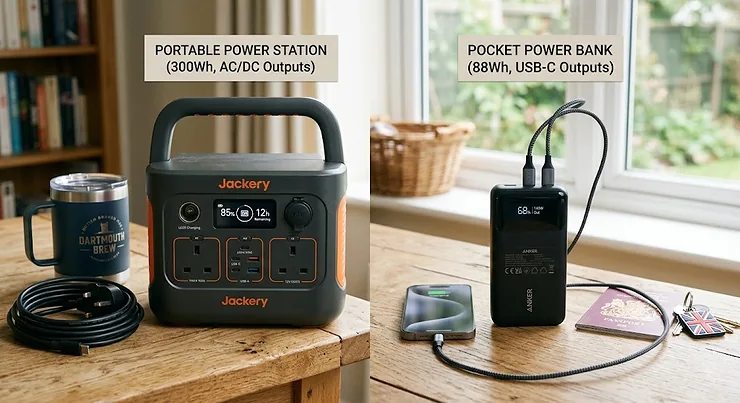
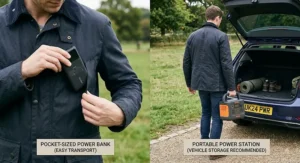
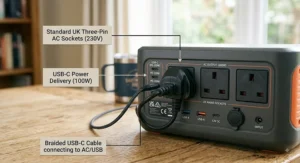
Here’s the short version. A power bank is a pocket-sized lithium battery, typically 5,000-27,000mAh, built almost entirely to top up phones, earbuds and the occasional tablet through USB. A portable power station is a much larger LiFePO4 battery system with a built-in inverter, proper UK three-pin AC sockets, and enough stored energy (measured in Wh, not mAh) to run laptops, mini-fridges, CPAP machines or a kettle for a few minutes. One lives in a coat pocket; the other lives in a car boot or under a caravan seat.
This guide breaks down seven real portable power stations currently sold in the UK, spanning genuine budget, mid-range and premium options, alongside honest analysis of when a power bank is still the smarter buy. Every spec here is interpreted, not just listed — because a number on a box means nothing until you know what it actually gets you through a wet Tuesday power cut or a weekend at a festival with a dead phone and a laptop deadline looming. For the official word on carrying lithium batteries safely, the UK Civil Aviation Authority’s packing guidance is worth a read before your next flight.
Portable Power Station vs Power Bank at a Glance
Before diving into individual products, here’s a quick-reference table comparing the two categories directly. This isn’t about which is “better” — it’s about which one matches what you’re actually trying to charge.
| Feature | Power Bank | Portable Power Station |
|---|---|---|
| Typical capacity | 5,000-27,000mAh (18-100Wh) | 250-2,200Wh |
| Output type | USB-A / USB-C only | AC mains socket + USB-C PD + DC/car outlet |
| Can run a laptop charger brick? | Rarely, and only via USB-C PD | Yes, directly into the AC socket |
| Can run a kettle, fridge or CPAP? | No | Yes, within its wattage limit |
| Typical weight | 100g-600g | 3kg-20kg+ |
| Best for | Pocket, daypack, flights | Car boot, caravan, home backup, campsite |
| UK flight rules | Carry-on only, under 100Wh generally fine | Usually too large for flights — check with airline |
A power bank wins on portability every single time — nothing beats slipping 200g into a coat pocket. But the moment you need to run anything with a UK three-pin plug, or you’re trying to keep a laptop, a portable fridge and three phones alive over a weekend, the wattage ceiling of a power bank becomes the limiting factor, not its capacity. That’s the real dividing line: power banks are rated for what they can hold, power stations are rated for what they can actually push out at once.
💬 Found this comparison useful so far? A quick share helps other buyers avoid the same confusion.🤗
Top 7 Portable Power Stations: Expert Analysis
Seven real, currently available models across budget, mid-range and premium tiers — chosen to cover everything from a spare-phone-charge day trip to a caravan weekend with the kettle running.
1. Anker SOLIX C300 DC — best for USB-only compact charging
The standout feature here is deliberate: Anker stripped out the AC inverter entirely, which is exactly why this thing is so light. At 288Wh, the SOLIX C300 DC skips mains sockets altogether and focuses purely on USB-A and USB-C PD output, which keeps the unit smaller, cheaper and noticeably lighter than anything with an inverter bolted in. In practice that means multiple full phone charges, several laptop top-ups via USB-C PD, and enough headroom for camping lights or a drone battery — but nothing that needs a UK plug. Based on the spec comparison against similarly priced units, this is less a mini power station and more a “power bank that grew up,” which is precisely the niche it’s built for. Reviewers consistently note that the lack of an AC socket is a deliberate trade-off rather than a flaw, since it’s what keeps the price and weight down. What most buyers overlook is that this makes it genuinely one of the few products that sits directly on the power-station-vs-power-bank fence — it’s essentially both.
Pros:
- ✅ Noticeably lighter than AC-equipped power stations
- ✅ Strong USB-C PD output for laptops and phones
- ✅ Compact enough to live in a daypack
Cons:
- ❌ No AC mains socket at all
- ❌ Not suitable for kettles, fridges or CPAP machines
Prices for the Anker SOLIX C300 DC sit under £300 at the time of research — check current price on Amazon UK, since stock and offers shift often. For anyone who only ever charges USB devices, it’s genuinely good value; anyone who needs a three-pin socket should look further down this list.
2. Jackery Explorer 300 Plus — quietest lightweight companion for short trips
Jackery built its reputation on quiet, no-fuss units, and the Explorer 300 Plus continues that streak with a fan that barely registers even under load. With roughly 288Wh of capacity and a 300W continuous output (600W surge), it comfortably handles phones, tablets, a laptop charger, and small camping essentials like a portable fan or LED lantern string. On paper this means you get about 20-25 phone charges or several laptop top-ups from a single charge, depending on the laptop’s power draw. Based on the spec comparison with rival budget models, Jackery’s advantage isn’t raw numbers — it’s the low-noise operation and simple, uncluttered interface, which matters more than people expect when you’re trying to sleep in a tent three feet from the unit. Aggregated owner reviews consistently flag the compact footprint and genuine portability as the headline strengths, alongside praise for Jackery’s UK customer support being easier to reach than some rivals.
Pros:
- ✅ Genuinely quiet operation, even while charging
- ✅ Compact and light enough for daily carrying
- ✅ Simple interface with clear battery percentage display
Cons:
- ❌ 300W output limits it to smaller appliances
- ❌ Capacity is on the low side for multi-day trips
The Jackery Explorer 300 Plus typically sits in the £280-£350 range, and it’s a sound pick for anyone who wants one dependable unit for laptop and phone charging without lugging around anything heavy.
3. EcoFlow River 3 — best compact pick for caravans and tents
EcoFlow’s River 3 earns its standout tag through sheer physical compactness relative to its output — it’s genuinely one of the smallest units here that still includes a full AC inverter. At around 245Wh capacity with a 300W continuous output (600W surge), it’s specifically sized to slot into a caravan cupboard or tent porch without hogging space, while still being able to run a laptop, a 12V cool box, or LED strip lighting off the AC or car-style DC outlet. What most buyers overlook about compact units like this is that the fast recharge speed matters more than the capacity number in caravan use, since you’re usually topping it up from a car socket or campsite hookup rather than running it flat between charges. Reviewers consistently report that the touchscreen display and app connectivity make it easy to monitor remaining charge overnight, which takes some of the guesswork out of caravan power management. It’s a genuinely honest “does one job well” product rather than an all-rounder.
Pros:
- ✅ Compact enough for tight caravan storage
- ✅ Fast recharge from a car socket or mains
- ✅ Clear app monitoring of remaining charge
Cons:
- ❌ 300W ceiling rules out higher-draw appliances
- ❌ Capacity drains quickly if running a cool box overnight
Expect the EcoFlow River 3 to sit around £250-£300, and for weekend caravanners or festival-goers who mainly need lights, phones and a laptop kept alive, it’s a genuinely sensible size.
4. Bluetti AC70 — best value mid-range all-rounder
The headline number for the AC70 is its charging speed: Bluetti gets this 768Wh unit from empty to 80% in around 70 minutes, which is unusually fast for the price bracket. With a 1,000W continuous output (2,000W peak), it steps up from the compact units above into genuinely useful territory — running a laptop, a mini-fridge, or a CPAP machine overnight without breaking a sweat. Based on the spec comparison against pricier rivals, the AC70 punches above its price point on raw output-per-pound, even if the display and app polish trail slightly behind Anker and EcoFlow’s flagship ranges. A common theme in aggregated user reviews is that the fan is noticeably louder than Jackery’s equivalent tier, a fair trade many buyers make for the faster recharge time. For anyone weighing up battery capacity mAh vs Wh confusion between a power bank and this unit: 768Wh converts to roughly 207,000mAh at typical phone-battery voltage — a number so large it illustrates exactly why power stations are rated in Wh rather than mAh in the first place.
Pros:
- ✅ Very fast recharge time for its capacity
- ✅ Strong 1,000W continuous output
- ✅ Good value against similarly specced rivals
Cons:
- ❌ Fan runs noticeably louder under load
- ❌ App and display feel less refined than flagship rivals
Pricing for the Bluetti AC70 typically falls in the £450-£550 range, making it one of the stronger value picks for anyone stepping up from a compact unit to genuine appliance-running power.
5. Anker SOLIX C1000 Gen 2 — highest continuous output in this line-up
What stands out immediately is the 2,000W continuous output from a unit that still counts as genuinely portable — a figure that puts it ahead of most rivals near its 1,056Wh capacity. That output ceiling matters in practice because it’s the difference between running a kettle or a small power tool and merely trickle-charging gadgets; many similarly sized power stations top out at 1,000-1,200W and simply can’t manage higher-draw devices. The LiFePO4 chemistry and roughly 70-minute AC recharge time bring it in line with EcoFlow’s fast-charging standard, while reviewers who’ve compared return rates across brands note that Anker’s SOLIX line has built a reputation for fewer reported failures than some longer-established rivals. Here’s what to weigh: the extra output headroom is genuinely useful for home-backup scenarios (a fridge plus lighting plus a laptop, simultaneously) but somewhat wasted if you only ever charge phones and a laptop.
Pros:
- ✅ Class-leading 2,000W continuous output
- ✅ Fast roughly 70-minute AC recharge
- ✅ LiFePO4 chemistry rated for long cycle life
Cons:
- ❌ Heavier than the compact units above
- ❌ Output headroom is overkill for light users
The Anker SOLIX C1000 Gen 2 generally sits in the £700-£850 range, and it earns that premium if you genuinely need to run multiple higher-draw devices at once rather than just keeping phones topped up.
6. EcoFlow Delta 2 — fastest-charging all-rounder for home backup
EcoFlow’s Delta 2 has become something of a default recommendation among UK reviewers, and the reason isn’t mysterious: it charges from 0 to 80% in well under an hour, a genuine rarity at its 1,024Wh capacity. The 1,800W continuous output (2,700W peak) means it comfortably handles a kettle, a microwave, or a full laptop-plus-monitor desk setup, putting it firmly into “emergency home backup” territory rather than just a camping accessory. Based on the spec comparison against the AC70 and SOLIX C1000, the Delta 2’s edge is less about any single number and more about the combination of speed, app polish and a five-year warranty that UK buyers consistently rate highly. What the spec sheet won’t tell you, but reviewers note, is that fan noise at full charging speed is a genuine, repeated gripe — worth knowing if you plan to charge it overnight in a bedroom.
Pros:
- ✅ Exceptionally fast recharge for its capacity
- ✅ 1,800W output handles kettles and microwaves
- ✅ Five-year warranty backing UK sales
Cons:
- ❌ Fan noise is loud during fast charging
- ❌ At roughly 12kg, it’s not something you’ll carry far
The EcoFlow Delta 2 is typically priced around £500 at the time of research, and for anyone treating this purchase as home power-cut insurance as much as a camping tool, it’s the most consistently recommended all-rounder on this list.
7. Jackery Explorer 2000 v2 — premium power-to-weight champion
At 2,042Wh for roughly 17.7kg, the Explorer 2000 v2’s standout achievement is efficiency: it delivers close to double the capacity of the SOLIX C1000 for barely a third more weight, a genuinely impressive power-to-weight ratio in this category. That capacity is enough to run a small fridge for the best part of a day, keep a CPAP machine going for several nights, or act as genuine emergency backup for a UK power cut lasting into the following morning. Based on the spec comparison against heavier rivals in the 2kWh class — many of which tip 30-40kg — the Explorer 2000 v2’s relative lightness makes it one of the few units in this bracket you can still lift into a caravan locker or car boot without a trolley. Aggregated owner feedback consistently praises Jackery’s build quality and quiet operation even at this scale, echoing the same low-noise reputation as the smaller Explorer 300 Plus above.
Pros:
- ✅ Excellent power-to-weight ratio for a 2kWh unit
- ✅ Quiet operation even under heavier loads
- ✅ Enough capacity for genuine multi-day backup
Cons:
- ❌ Premium price relative to the rest of this list
- ❌ Still heavy enough to need two hands to lift
Expect the Jackery Explorer 2000 v2 to sit in the £1,400-£1,700 range, positioning it firmly as an investment purchase for anyone who wants serious home-backup or long off-grid caravan capability rather than a casual weekend accessory.
Practical Usage Guide: Getting the Most From Your Power Station
Buying the right unit is only half the job — how you charge, store and run it in the first 30 days shapes how long it actually lasts. On first use, charge every model in this list to 100% before use, even though most arrive partially charged; this lets the battery management system calibrate properly. During the first month, avoid habitually running any unit down to 0% before recharging — LiFePO4 cells (used in the Bluetti AC70, Anker SOLIX C1000 Gen 2, EcoFlow Delta 2 and EcoFlow River 3) are rated for thousands of cycles, but shallow, frequent top-ups extend real-world lifespan more than deep discharges.
A common first-30-days mistake is overloading the AC output by plugging in a device that draws more than the unit’s continuous wattage rating — this typically trips a safety cutoff rather than causing damage, but it catches people out mid-use. Check the wattage printed on any appliance before connecting it; a standard UK kettle draws 2,000-3,000W, which exceeds every unit on this list except close to the ceiling of the largest ones. For maintenance, store any power station at roughly 50-80% charge if it won’t be used for months, in a cool, dry space away from direct sunlight — full or empty long-term storage measurably shortens LiFePO4 lifespan. A once-a-quarter top-up charge for stored units is a simple habit that keeps the battery management system healthy without any real effort.
Real-World Scenarios: Matching the Right Unit to Your Situation
The commuting student. If you’re a university student needing a portable power station for laptop and phone charging between lectures and a library with too few sockets, something like the Anker SOLIX C300 DC or Jackery Explorer 300 Plus covers a full day of laptop and phone use without the bulk of a larger unit — genuinely closer to a heavy-duty power bank in daily use than a home-backup device.
The caravan couple. For a weekend away with lighting, phone charging, a 12V cool box and the occasional laptop session, the EcoFlow River 3 hits the size and output sweet spot; its compact footprint matters as much as its capacity when caravan storage space is genuinely limited.
The prepared homeowner. Anyone budgeting for UK power cuts — increasingly common during winter storms — needs enough continuous wattage to run a fridge, some lighting and a router simultaneously; the EcoFlow Delta 2 or Jackery Explorer 2000 v2 are sized for exactly that, with the latter better suited to multi-day outages given its larger capacity.
Buyer’s Decision Framework
If you only ever charge a phone and maybe a tablet, choose a power bank, because a power station’s extra weight and cost buy you nothing you’ll use. If you need to charge a laptop via USB-C PD occasionally but never need a UK plug socket, choose a compact power station like the Anker SOLIX C300 DC, because it bridges the gap without the bulk of an AC inverter. If you need to run a UK-plug appliance — even briefly — choose any AC-equipped power station, because no power bank can substitute for a real mains socket. If your priority is caravan or festival portability over raw capacity, choose the EcoFlow River 3, because compactness matters more than headline Wh in tight storage. If your priority is genuine home power-cut backup, choose the EcoFlow Delta 2 or Jackery Explorer 2000 v2, because continuous wattage and total capacity outweigh portability in that scenario.
Portable Power Station vs Power Bank: The Real Difference
The comparison isn’t really about which product is “better” — it’s about two different jobs wearing similar-looking battery-shaped clothes. A power bank’s entire design brief is minimal weight and pocketability; strip away the marketing and it’s a lithium cell, a small circuit board, and a USB port. A portable power station’s design brief is the opposite: maximise usable output, including a genuine AC inverter that converts stored DC energy into the 230V AC that UK plugs expect. That inverter is the single biggest reason a 250Wh power station costs more and weighs more than a 74Wh power bank of similar battery chemistry — you’re not just paying for capacity, you’re paying for the electronics that make mains-socket output possible at all.
This is also where battery capacity mAh vs Wh confusion trips people up most often. A power bank’s mAh rating only tells you charge capacity at a fixed low voltage (typically 3.7V), which is fine for comparing two power banks against each other but meaningless for comparing against a power station rated in Wh, where the voltage is entirely different. As one detailed technical breakdown of the difference between mAh and Wh explains, without knowing voltage, a raw mAh number tells you nothing about total stored energy — which is exactly why every power station on this list is specced in Wh rather than mAh, while every power bank sticks to mAh out of consumer habit rather than technical accuracy.
How to Choose a Portable Power Station
Choosing the right unit comes down to matching a handful of specs to your actual use case, not chasing the biggest number on the box.
- Work out your total wattage need first. Add up the watts of everything you’d realistically run at once — this determines the minimum continuous output rating you need, not the capacity.
- Convert your daily energy use into Wh, not mAh. A laptop charger drawing 65W for two hours needs roughly 130Wh; build your capacity requirement from real numbers like this rather than guessing.
- Check the AC inverter’s continuous vs peak rating. Peak (surge) figures are often double the continuous rating and only apply for a few seconds — size around the continuous number.
- Prioritise recharge speed if you’ll use it daily. A unit that recharges in 70 minutes is far more useful for regular use than one that takes 4-6 hours, even at identical capacity.
- Match weight to how you’ll actually carry it. A 20kg unit that never leaves a caravan locker is fine; one you’re supposed to carry to a festival campsite needs to stay under roughly 8kg.
- Confirm USB-C PD wattage if you’re charging a laptop. Not every USB-C port on a power station supports full Power Delivery — check the port is rated for at least 60W if you’re charging a modern laptop.
- Factor in warranty length as a genuine differentiator. Most flagship UK models now carry five-year warranties; anything shorter on a similarly priced unit is worth questioning.
Battery Capacity Explained: mAh vs Wh
What is the difference between mAh and Wh? mAh (milliamp-hours) measures electrical charge at a fixed voltage, while Wh (watt-hours) measures total usable energy, accounting for both charge and voltage — which is why Wh is the more accurate figure for comparing devices that run at different voltages.
In practice, this matters because a power bank’s 3.7V cells make its mAh figure directly comparable to other power banks, but the moment you try to compare that number to a power station’s 12V-48V battery pack, the mAh figure becomes misleading. A 20,000mAh power bank at 3.7V stores roughly 74Wh; the same 20,000mAh rating at 12V would store 240Wh — identical mAh, wildly different real-world energy. This is precisely why the USB Implementers Forum’s own Power Delivery documentation focuses on wattage rather than mAh when discussing charging speed — watts and watt-hours are the units that actually describe usable power, while mAh alone is, at best, half the story. If a spec sheet only lists mAh for a large power station, treat that as a marketing simplification rather than the real number to shop by.
AC Output Explained: What It Actually Powers
AC output is the single biggest practical divider between a power bank and a power station, and it’s worth understanding in plain terms rather than just as a number on a spec sheet. The AC output rating (in watts) tells you the maximum continuous load the built-in inverter can safely convert from stored battery DC power into 230V mains-style AC through a UK three-pin socket. A 300W-rated unit like the Jackery Explorer 300 Plus or EcoFlow River 3 comfortably runs laptop chargers, phone chargers, LED lighting and small fans, but will trip out on a hairdryer or kettle, both of which typically draw well over 1,000W. Step up to the Bluetti AC70 or EcoFlow Delta 2, and 1,000-1,800W of continuous output opens up mini-fridges, microwaves and — briefly — a kettle. Peak (or surge) wattage figures, often listed separately and roughly double the continuous rating, only cover the split-second power spike some motors need to start up; they’re not a number you should plan sustained use around.
USB-C PD Charging: Why It Matters for Laptops and Phones
USB-C Power Delivery (PD) is the charging protocol that lets a single USB-C port negotiate variable voltage and wattage with whatever’s plugged in, rather than delivering a fixed 5V trickle. This matters enormously for the “portable power station for laptop and phone charging” use case specifically, because a phone might request 20-30W while a laptop requests 65-100W — and a proper PD port adjusts automatically rather than needing separate chargers for each. Every product on this list with a USB-C port supports some level of PD, but the wattage ceiling varies: budget units often cap at 60W (fine for phones and lighter laptops), while the Anker SOLIX C1000 Gen 2 and EcoFlow Delta 2 push higher, comfortably covering power-hungry laptops. The practical upshot is that USB-C PD charging can often replace the AC socket entirely for laptop charging, which matters on compact units like the Anker SOLIX C300 DC that skip the AC inverter altogether — its USB-C PD output is effectively doing the job an AC brick would do on a bulkier unit.
Compact Power Stations for Caravan Use
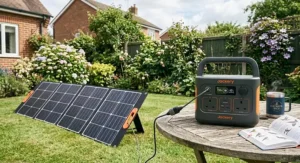
Caravan and motorhome owners have a genuinely different set of priorities to campers or preppers: storage space is fixed and small, and most trips involve topping up from a car socket, campsite hookup or a small solar panel rather than running the unit down from empty. A compact power station for caravan use needs to prioritise physical footprint and fast recharge over sheer capacity — which is exactly why the EcoFlow River 3 stands out on this list for that specific job, fitting into a cupboard shelf where a 2kWh unit simply wouldn’t. That said, caravanners running a 12V compressor fridge continuously overnight will drain a 245Wh unit faster than expected; anyone doing genuinely off-grid multi-night caravan stays should size up toward the Bluetti AC70 or larger. Solar input compatibility is also worth checking specifically for caravan use, since a panel propped against a windscreen on a sunny pitch can meaningfully extend a weekend without ever touching a hookup.
Common Mistakes When Buying a Portable Power Station
The single most common mistake is buying on capacity (Wh) alone while ignoring continuous wattage — a 1,000Wh unit rated at only 300W output still can’t run a kettle, regardless of how much energy it’s holding. A close second is assuming all USB-C ports support full-speed PD charging; some budget units include a USB-C port that’s data-speed-capable but capped at a low charging wattage, which quietly limits laptop charging speed. Buyers also frequently underestimate weight in the buying decision, picturing “portable” as pocket-sized when a 15-20kg unit is genuinely closer to a small suitcase. Finally, many people skip checking recharge time entirely, then find themselves frustrated that a large-capacity budget unit takes 6-8 hours to refill from a wall socket — a genuine problem if you need same-day turnaround between uses.
Safety, Regulations and Battery Disposal in the UK
All portable power stations and power banks sold in the UK use lithium-ion or LiFePO4 cells, which carry specific handling, transport and disposal rules worth knowing. If you’re flying with any of these units, the watt-hour rating on the label determines what’s allowed: units under 100Wh generally travel fine in hand luggage, those between 100-160Wh often need airline approval, and anything over 160Wh is typically barred from passenger flights entirely — check directly with your airline, since several of the larger units on this list, including the Jackery Explorer 2000 v2, exceed the higher threshold and simply cannot fly as carry-on. At end of life, lithium batteries must never go in household bins; UK regulations require them to be recycled through designated collection points, and Recycle Now’s battery recycling locator makes it straightforward to find your nearest drop-off point. Storing any unit with visible battery swelling, unusual heat, or a damaged casing is a genuine fire risk — stop use immediately and follow the recycling route rather than attempting a repair.
Frequently Asked Questions
❓ Is a portable power station better than a power bank?
❓ Can I use a portable power station instead of a power bank on flights?
❓ How long does a portable power station last on a full charge?
❓ What size portable power station do I need for a caravan?
❓ Does USB-C PD charging damage my laptop battery?
Conclusion
The portable power station vs power bank question really comes down to one honest question: does anything you need to charge require a UK plug socket, or run for hours rather than minutes? If the answer is no, a good power bank remains lighter, cheaper and entirely sufficient. If the answer is yes — even occasionally — a power station earns its extra weight and cost the very first time you’re not stuck without power during a campsite evening, a caravan weekend, or a UK power cut.
Across the seven models covered here, there’s a genuine option at almost every budget and use case: the Anker SOLIX C300 DC for USB-only compact charging, the Jackery Explorer 300 Plus and EcoFlow River 3 for lightweight day-to-day and caravan use, the Bluetti AC70 and Anker SOLIX C1000 Gen 2 for genuine mid-range appliance power, and the EcoFlow Delta 2 or Jackery Explorer 2000 v2 for serious home-backup capability. Match the unit to the actual wattage and Wh you need rather than the biggest number on the box, and you’ll end up with something that earns its keep rather than gathering dust in a cupboard.
Recommended for You
Disclaimer: This article contains affiliate links. As an Amazon Associate, I earn from qualifying purchases. If you purchase products through these links, we may earn a small commission at no additional cost to you.
✨ Found this helpful? Share it with your friends! 💬🤗
