In This Article
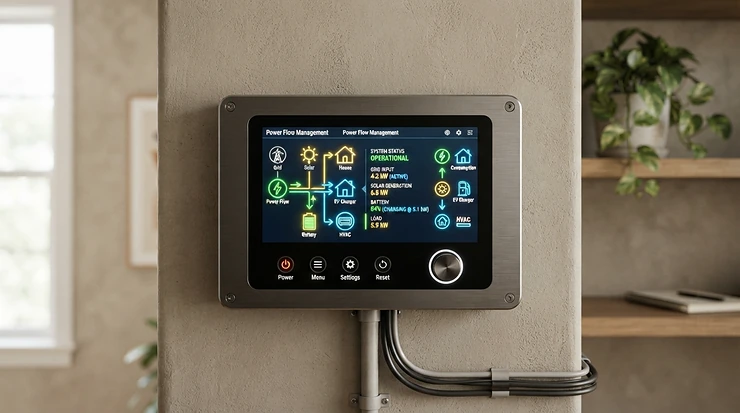
Power cuts in Britain are rare, which is exactly why they sting. One minute you’re halfway through a film. The next, the fridge hums its last note and the broadband router blinks out. A whole house power station system promises to stop that: a big lithium battery, a serious inverter and a clever bit of wiring, all keeping your essentials alive when the street goes dark.
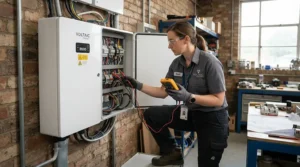
The promise is real, but “whole house” is marketing shorthand. A typical British home runs on a single-phase 230V supply, and an electric shower alone can pull somewhere around 8-10kW. That is more than any unit in this guide can deliver on its own. So the honest version is this: these systems can run your essential circuits, properly wired, for hours or days. That is still very useful.
Solar owners have an extra reason to care. Home Energy Scotland explains that a battery lets you store solar electricity for later, but it also warns that the extra savings don’t always repay the initial outlay. Keep that sentence in mind. We’ll come back to it.
Below you’ll find seven real systems, a sizing method, solar and off-grid reality checks, and the new UK wiring rules. Prices are ranges only, and availability changes, so check current price before you buy.
What Is a Whole House Power Station System?
A whole house power station system is a large lithium battery paired with a high-output inverter, usually expandable with extra battery modules. It connects to your home wiring through a transfer switch or similar arrangement, so it can power selected circuits, or most of the house, during a blackout, on solar, or off-grid.
How it differs from a camping power station
The same chemistry and the same app, but a different job. A camping unit sits in a tent. A whole house power station system sits in a garage or utility room and is wired in by a qualified electrician. It needs more output (kilowatts rather than hundreds of watts), more capacity (several kWh rather than one), and a safe way to isolate itself from the grid.
What “whole house” realistically means here
Think in tiers. A 2-3kW unit covers the fridge-freezer, lights, router, boiler controls and a kettle. A 4-6kW system adds a washing machine or a microwave alongside. A 7kW-class system with multiple batteries can ride out a day or more of normal living. None replaces a three-phase supply or a 100A cut-out, so the sensible aim is a protected essentials board rather than literally every socket.
Quick Comparison: Best Whole House Power Station System Options at a Glance
| Product | Base capacity | Continuous output | Expansion | Best For |
|---|---|---|---|---|
| EcoFlow DELTA Pro Ultra | 6,144Wh per battery | ~7kW class (listings vary) | Up to 90kWh quoted | Large homes, multi-day outages |
| Bluetti AC500 + B300S | 3,072Wh | 5,000W | Up to 18,432Wh | Modular growth, solar owners |
| Anker SOLIX F3800 | 3,840Wh | 6,000W | Expansion batteries, paired units | High-draw appliances |
| EcoFlow DELTA Pro 3 | 4,096Wh | 4,000W (6,000W X-Boost) | Up to ~12.3kWh | Balanced all-rounders |
| EcoFlow DELTA Pro | 3,600Wh | 3,600W | Up to 25kWh (retailer listing) | Mature ecosystem fans |
| Jackery Explorer 3000 Pro | 3,024Wh | 3,000W | None found in listings | Simple, portable essentials backup |
| EcoFlow DELTA 2 Max | 2,048Wh | 2,400W (3,100W X-Boost) | Up to 6,144Wh | Flats, small homes, first systems |
The table splits the field into three groups. The EcoFlow DELTA Pro Ultra and Bluetti AC500 + B300S are the genuine whole-home candidates, built to grow. The EcoFlow DELTA Pro 3, EcoFlow DELTA Pro and Anker SOLIX F3800 sit in the middle: powerful enough for most essentials, with room to expand. The Jackery Explorer 3000 Pro and EcoFlow DELTA 2 Max are better thought of as strong essentials-backup units than whole-home systems.
💬 Just one click — help others make better buying decisions too!😊
Top 7 Whole House Power Station System Picks: Expert Analysis
1. EcoFlow DELTA Pro Ultra — the scalable heavyweight
Where most units here stop at a few kilowatt-hours, the EcoFlow DELTA Pro Ultra is built like a miniature home battery, and its modular design is the whole point.
Each battery holds 6,144Wh, and the inverter is rated at roughly 7kW. US listings quote 7,200W, while at least one UK retailer lists 6,900W, so confirm the exact UK model before ordering. In practice, one battery covers a UK home’s essentials for a day or more, and the system can scale to a quoted 90kWh. Solar input of up to 5,600W lets a generous array refill it in a decent day, and the 0ms online-UPS design protects PCs and NAS drives.
This suits large households, home workers and heat-pump owners who want to shrug off multi-day outages. It is overbuilt for a two-bed flat, and the inverter and batteries ship separately, so budget for an electrician.
On reviewer sentiment, the testers at The Solar Lab judged it the quietest large power station they had tested, noticeably calmer than the Anker SOLIX F3800 Plus. I couldn’t verify a large pool of UK buyer reviews, so treat longevity claims as manufacturer specification rather than proven fact.
Pros:
- ✅ Very quiet running for its size
- ✅ Huge scalable capacity
- ✅ 0ms online UPS switchover
Cons:
- ❌ Premium price, inverter and batteries bought separately
- ❌ Heavy and bulky to position
Price: expect a four-figure outlay comfortably above £3,000 for an inverter plus one battery; check current price. Verdict: expensive up front, but the cost per kWh improves as you add modules.

2. Bluetti AC500 + B300S — the modular 5kW workhorse
The Bluetti AC500 + B300S is the system you buy when you know you’ll want more capacity later, because it snaps together like very expensive building blocks.
The AC500 is a 5,000W inverter, and each B300S adds 3,072Wh. Up to six batteries take you to 18,432Wh. UK/EU listings show five 230V sockets plus a higher-rated 32A outlet, and a 3,000W solar input. On mains, the system can recharge in roughly 1.2-2.2 hours depending on configuration. Practically, 5kW handles a kettle, microwave and fridge together, but not an electric shower. The inverter weighs about 30kg and each battery about 36kg, so this lives on the floor, not on a shelf.
It’s a strong match for solar owners who want to grow gradually and don’t mind a bulky stack.
Trusted Reviews’ write-up was struck by the sheer size of the system. It praised the constant 5,000W output and noted a full mains charge in under 90 minutes in their configuration. They also observed that its input specification exceeds what the average owner will use.
Pros:
- ✅ Genuinely modular up to 18,432Wh
- ✅ Fast mains and combined AC-solar recharging
- ✅ 3,500+ cycle LiFePO4 batteries
Cons:
- ❌ Very heavy and large
- ❌ Inverter useless without at least one battery
Price: around £3,000-£3,500 for the starter bundle on converted international pricing; check current price. Verdict: strong value once you scale beyond one battery.
3. Anker SOLIX F3800 — the 6kW simple start
The Anker SOLIX F3800 earns its place with raw output: six kilowatts from a single box, enough to run several heavy appliances at once.
It holds 3,840Wh and is listed at 6,000W on 230V. Anker offers expansion batteries of 3,840Wh each, and two F3800 units can be paired. Anker also quotes a five-year warranty and a ten-year lifespan. That output headroom means a kettle, washing machine and fridge can all run together without tripping the overload limit. Solar input on the original model is around 2,400W, so a big battery will refill slowly on a gloomy day.
It suits buyers who want maximum punch from one unit and plan to add capacity later. Anker’s branded home power panels were built around North American wiring, so UK buyers should confirm compatibility and lean on their electrician, who may well choose a standard changeover arrangement instead.
Reviewer evidence here is thin. The best comparison I found noted the newer Anker SOLIX F3800 Plus is louder than the EcoFlow DELTA Pro Ultra, and I found no verified UK review pool for the original.
Pros:
- ✅ 6,000W output from one unit
- ✅ Expandable with 3,840Wh batteries
- ✅ Five-year warranty quoted
Cons:
- ❌ Modest solar input on original model
- ❌ Fan noise noticeable under load
Price: roughly £2,000-£3,000 on converted international pricing; check current price. Verdict: excellent power per pound.
4. EcoFlow DELTA Pro 3 — the best-balanced all-rounder
The EcoFlow DELTA Pro 3 is the Goldilocks pick: big enough for real backup, small enough to sit in a utility room without needing planning permission from your partner.
It packs 4,096Wh and 4,000W continuous, rising to 6,000W with X-Boost, and expands to about 12.3kWh with two extra batteries. UK listings quote a 10ms UPS switchover, a 30dB quiet mode below 2kW and a five-year warranty. It charges 0-80% in roughly an hour from the mains. In practice, that rapid charge is gold during a rolling outage, because you can top up in short windows. The battery pack is IP65-rated and quoted at 4,000 cycles to 80%.
It fits most semi-detached homes that want essentials covered with room to grow. One caution: 10ms is fast but not the 0ms of an online UPS, so sensitive kit may still want its own small UPS.
Review coverage is limited. One UK retailer listing showed no customer reviews yet, so rely on specification and independent testing rather than crowd verdicts.
Pros:
- ✅ 4,000W output with 6,000W boost
- ✅ Very quick recharge
- ✅ Five-year warranty on UK listing
Cons:
- ❌ 10ms switchover, not zero
- ❌ Smaller expansion ceiling than rivals
Price: around £2,400-£2,900 at UK retailers; check current price. Verdict: the sweet spot for most households.
5. EcoFlow DELTA Pro — the mature ecosystem
The original EcoFlow DELTA Pro is the veteran of the range, and maturity matters in a category full of first-generation gadgets.
It offers 3,600Wh, 3,600W continuous with a 7,200W surge, 2,900W wall charging and up to 1,600W of solar. A UK retailer lists expansion to 25kWh, and EcoFlow’s ecosystem includes a Smart Generator that auto-starts when the battery runs low. The listing also describes a Smart Home Panel handling up to two units across ten circuits. That panel was designed around other markets’ wiring, so check UK compatibility. Practically, 3.6kW with a 7.2kW surge starts a fridge compressor or well pump comfortably.
It suits buyers who want a proven platform and accessories. Newer models beat it on charging speed and warranty, though.
I couldn’t verify a robust UK review sample, but the longer track record means more installers and forum posts exist to learn from.
Pros:
- ✅ 7,200W surge handles motor starts
- ✅ Wide accessory ecosystem
- ✅ Generator auto-start support
Cons:
- ❌ Slower solar input than newer models
- ❌ Heavy for its capacity
Price: roughly £1,800-£2,800 depending on promotions; check current price. Verdict: great value if found discounted.
6. Jackery Explorer 3000 Pro — the portable essentials guardian
The Jackery Explorer 3000 Pro wins on simplicity: a suitcase-style unit that rolls to wherever it’s needed.
It has 3,024Wh, 3,000W continuous and 6,000W surge, at about 29kg (the manufacturer quotes 63.93lb). Up to six solar panels can feed it, and Jackery quotes over 70% capacity after 2,000 cycles with a 3+2 year warranty. Practically, 3kW covers a kettle plus fridge and lights, but a fussy dishwasher or two heaters at once will trip it. I found no expansion battery in the listings I reviewed, so what you buy is what you get.
It’s a good fit for flats, rental properties or anyone who wants backup they can take with them. It is not a true whole-home system.
PopSci’s reviewer rated it among the best high-capacity solar generators, praising fast charging and the suitcase design, while noting that Jackery’s own panels are expensive.
Pros:
- ✅ Genuinely portable suitcase design
- ✅ Fast charging reported
- ✅ Simple, user-friendly interface
Cons:
- ❌ Not expandable
- ❌ Fewer cycles than newer rivals
Price: roughly £1,800-£2,500; check current price. Verdict: fair value for an essentials-only buyer.
7. EcoFlow DELTA 2 Max — the sensible entry point
The EcoFlow DELTA 2 Max proves you don’t need a four-figure fortune to stop food spoiling in a blackout.
It stores 2,048Wh, outputs 2,400W (3,100W with X-Boost) through four UK three-pin sockets, and expands to 6,144Wh with two extra batteries. It charges to 80% in about 43 minutes with combined AC and solar. The LFP battery is rated at 3,000 cycles, with a five-year warranty on UK listings. At roughly 23-25kg, it moves easily between rooms. Practically, 2kWh runs a fridge-freezer, router and lights overnight with plenty to spare.
It suits flats and small homes, or anyone testing the idea before committing. It plugs into appliances directly, so it needs no rewiring.
I found no verified UK review data, so lean on the specifications and the brand’s track record.
Pros:
- ✅ Plug-and-play, no electrician needed
- ✅ Expands to 6,144Wh
- ✅ Five-year warranty on UK listings
Cons:
- ❌ Too small for whole-home loads
- ❌ Four sockets limit direct use
Price: around £1,000-£1,300; check current price. Verdict: best low-risk first step.
How to Choose a Whole House Power Station System
Choosing well starts with honesty about what you want to keep running. Follow these six steps in order.
- List your must-run circuits. Fridge-freezer, boiler controls, lighting, router and one socket ring. Anything beyond that is a bonus, and each addition pushes the price up.
- Add up the watts. Note the peak draw if everything runs at once. This sets the inverter size you need.
- Estimate daily energy in kWh. Multiply watts by hours. This sets battery capacity.
- Check expandability. A unit you can grow beats one you must replace. Compare maximum capacity and whether extra batteries cost sensibly.
- Match solar input to battery size. A huge battery with a small solar input refills slowly. See the solar section below.
- Confirm UK compatibility and installation route. Check 230V models, UK sockets and a qualified electrician before you click buy.

Household Load Capacity: Sizing Your Whole House Power Station System
Household load capacity is the maximum combined power your home draws at one moment. Get it wrong and the inverter trips mid-kettle.
Here’s an illustrative essentials day, with figures that are estimates and not measurements of your home:
- Fridge-freezer: roughly 1kWh a day
- Boiler pump and controls: around 1.2kWh
- LED lighting: about 1kWh
- Router, TV and laptops: around 2.4kWh
- Kettle and microwave: roughly 0.5-1kWh
That totals about 6-7kWh, so a 4kWh unit gets you through roughly half a day of normal living, while a two-battery stack covers a day or more. Ofgem’s typical medium electricity figure is around 2,700kWh a year, or roughly 7.4kWh a day, so the maths is plausible.
Now the power side. A kettle can draw about 3kW and an electric shower 8-10kW, so a 3kW unit like the Jackery Explorer 3000 Pro can’t run both. The 6kW Anker SOLIX F3800 can manage the kettle plus other loads but still not the shower. Always leave around 20% inverter headroom, and remember usable capacity is slightly below the label because of conversion losses.
Power Station for House with Solar Panels: Making the Pairing Work
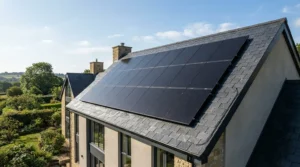
A power station for house with solar panels is only as good as the match between panel output and battery size. The EcoFlow DELTA Pro Ultra accepts up to 5,600W of solar, the Bluetti AC500 + B300S 3,000W, the EcoFlow DELTA Pro 3 2,600W, the EcoFlow DELTA Pro 1,600W and the EcoFlow DELTA 2 Max 1,000W. Those figures are why a big battery on a small input can take days to refill.
Here’s the catch most owners miss. A standard grid-tied solar inverter shuts down during a blackout as a safety measure. So your existing roof panels will not help during a power cut unless they feed the power station’s own DC input, or a hybrid inverter is installed. Solar-plus-battery systems built around a hybrid inverter solve this elegantly, though they cost more.
Practical advice: size panels to roughly one-third to one-half of your battery capacity in kW. A 6kWh battery pairs sensibly with a 2-3kW array.
✨ Don’t Miss These Exclusive Deals!
🔍 Take your home backup to the next level with these carefully selected systems. Click on any highlighted item to check current pricing and availability. These units will help you build reliable power resilience for your household!
Solar-Plus-Battery Systems: Grid-Tied, Hybrid or Standalone?
Solar-plus-battery systems come in three flavours, and picking the wrong one is the costliest mistake in this category.
Grid-tied hybrid. A fixed hybrid inverter, installed under MCS rules, manages panels, battery and grid together. It’s neat and powerful but not portable, and it needs a notification to your network operator.
Backup-only power station. Your EcoFlow DELTA Pro 3 or Bluetti AC500 + B300S sits beside the consumer unit and takes over through a transfer switch when the grid fails. It’s simpler and cheaper, and it can double as portable power.
Standalone off-grid. No grid connection at all, which is rare in the UK outside cabins and outbuildings.
For most British households, the backup-only route gives the best balance of cost and resilience. Hybrid systems win if you want daily bill savings, because they cycle every day. A power station mostly sits idle waiting for an emergency, which makes it better at insurance than at investment.
Power Station for Full Home Off-Grid Backup: What Works in Real Life
Planning a power station for full home off-grid backup means planning for December, not July. A 4kWp array might deliver only a few kWh on a decent winter day and far less under thick cloud, so winter autonomy rarely comes from solar alone.
Three tactics make it workable:
- Add a generator input. The Anker SOLIX F3800 supports 240V generator bypass, and the EcoFlow DELTA Pro works with EcoFlow’s Smart Generator that starts when the battery runs low.
- Ruthless load discipline. Run the fridge, lights and heating controls. Defer the washing machine to sunny afternoons.
- Oversize the battery, not the inverter. Days of autonomy come from kWh, so a Bluetti AC500 + B300S stack with several batteries beats a bigger inverter.
A fully off-grid home also needs a plan for heating, cooking and hot water that doesn’t rely on the battery. Gas, wood or a dedicated solar thermal system all help. Treat the battery as the nervous system, not the entire body.
Whole-House Battery Backup Power Station Review: How the Seven Compare
This whole-house battery backup power station review pulls the numbers together. Prices are indicative bands from retailer listings and converted international pricing at the time of research; check current price.
| Product | Capacity | Output | Indicative price | Best For |
|---|---|---|---|---|
| EcoFlow DELTA Pro Ultra | 6,144Wh | ~7kW class | £3,000+ | Large homes |
| Bluetti AC500 + B300S | 3,072Wh | 5,000W | £3,000-£3,500 | Modular growth |
| Anker SOLIX F3800 | 3,840Wh | 6,000W | £2,000-£3,000 | Heavy loads |
| EcoFlow DELTA Pro 3 | 4,096Wh | 4,000W | £2,400-£2,900 | Most households |
| EcoFlow DELTA Pro | 3,600Wh | 3,600W | £1,800-£2,800 | Bargain hunters |
| Jackery Explorer 3000 Pro | 3,024Wh | 3,000W | £1,800-£2,500 | Portability |
| EcoFlow DELTA 2 Max | 2,048Wh | 2,400W | £1,000-£1,300 | Small homes |
Value per kWh is best at the top and bottom. The EcoFlow DELTA 2 Max is cheapest per kWh, while the EcoFlow DELTA Pro Ultra gets cheaper per kWh as you add batteries. Middle units cost more per kWh but win on output per pound. If I had to pick for a typical three-bed semi, I’d shortlist the EcoFlow DELTA Pro 3 first and the Bluetti AC500 + B300S second.
Long-Term Energy Independence: Cost, Cycles and Reality
Long-term energy independence is a lovely phrase and a slippery target. Be honest about what a power station buys you.
Run an illustrative sum. The EcoFlow DELTA Pro 3 stores 4.096kWh and is rated at 4,000 cycles to 80%. That’s about 16,000kWh of lifetime throughput. At around £2,500, the hardware costs roughly 15p per stored kWh before charging costs and conversion losses. If you charge from cheap off-peak electricity and displace peak-rate power, the gap per kWh is small. So the battery rarely pays for itself through bill savings alone, which echoes the Home Energy Scotland caution earlier.
What you’re really buying is resilience. For households with medical equipment, home offices, freezers full of food or a rural supply prone to cuts, that’s worth real money. For everyone else, it’s insurance with a side order of solar self-consumption.
Maximise independence by combining a power station with panels, a time-of-use tariff and efficient appliances. Zero-rated VAT often applies to professionally installed battery storage, but a boxed power station you buy yourself may not qualify, so check before assuming.
Features That Actually Matter (And Those That Don’t)
Spec sheets are a carnival of big numbers. Here’s what deserves your attention.
Matters:
- LiFePO4 chemistry. Lithium iron phosphate cells are known for thermal stability and long cycle life, which is why every unit above uses them.
- UPS switchover time. 0ms (EcoFlow DELTA Pro Ultra) versus 10ms (EcoFlow DELTA Pro 3) matters for desktop computers and medical kit.
- Continuous output, not peak. Surge figures flatter a unit. Continuous wattage decides what runs all evening.
- Warranty length. Five years on the EcoFlow DELTA 2 Max beats three plus two optional on the Jackery Explorer 3000 Pro.
Doesn’t matter (much):
- Wireless charging pads and USB-C ports. Nice, but you’re buying this for the fridge.
- Peak-surge bragging. Useful for motor starts, irrelevant for steady loads.
- Charging records. Fast is helpful, but your outage rarely depends on 50 versus 60 minutes.
Ignore the sticker confetti and focus on kilowatts, kilowatt-hours, warranty and installation route.
Safety, Regulations and Compliance Guide for UK Homes
This is where cheerful gadget content turns serious. Connecting any battery to your home wiring is electrical work.
BS 7671. Industry reports say the IET and BSI published Amendment 4 to the wiring regulations on 15 April 2026. The update adds a new chapter on stationary battery storage, covering system design, protective devices suited to two-way current flow, battery location, ventilation and fire-risk mitigation. One training provider says the previous edition is withdrawn from 15 October 2026, which is days from now, so expect installers to be working to the new rules.
Grid connection. Systems that export or run in parallel with the grid typically need notification to your distribution network operator under G98 or G99, depending on size. A backup-only changeover is different, so ask your electrician which applies.
Never back-feed. Do not plug a power station into a socket with a double-ended lead. It can energise the grid and endanger line workers.
Insurance. Tell your home insurer about any permanently installed battery.
UK/EU variants only. Check 230V models with correct sockets. Several brand pages quote US 120/240V products.
Practical Setup and Maintenance Guide: Your First 30 Days
Most owners lose the benefit of a good system through poor setup. This is the stuff product listings skip.
Siting. Choose a cool, dry, well-ventilated spot in a garage, utility room or similar. Homebuilding reports that the new wiring rules rule out lofts, so plan floor space now. The Bluetti AC500 + B300S stack weighs over 60kg, so check the floor too.
Week one: commissioning.
- Have your electrician fit a labelled essentials board and a changeover switch.
- Test the switchover with the main breaker off, not on the night of the storm.
- Register the warranty and update firmware through the app.
Weeks two to four: tune it.
- Set a reserve level, such as 20-30%, so the unit never sits empty.
- Run a deliberate 30-minute “blackout drill” and note what trips.
- Charge to full, then leave it around 50-80% for storage.
Ongoing maintenance.
- Dust vents every few months.
- Cycle the battery every three months if it sits idle.
- Keep it away from frost, damp and direct heat.
Common first-month mistakes: overloading the inverter with a space heater, skipping the drill, and forgetting that solar can’t refill a battery overnight.
Real-World Scenarios: Matching a System to Your Home
Three profiles show how the numbers play out. All are illustrative.
Priya, flat in Leeds, working from home. Budget around £1,000-£1,300, no electrician access as a tenant. The EcoFlow DELTA 2 Max plugs straight into her router, laptop and fridge. It gives roughly 8-10 hours of essentials and pays for itself the first time a cut interrupts a deadline.
The Hendersons, three-bed semi with 4kWp panels. Budget £2,500-£3,500, with a gas boiler and a freezer in the garage. The EcoFlow DELTA Pro 3 behind a changeover switch covers essentials for most of a day. Pairing it with 2-3kW of dedicated panels extends that through sunny spells.
Gareth and Mel, rural four-bed with a heat pump. Budget £5,000 and up, with frequent winter cuts. A Bluetti AC500 + B300S or EcoFlow DELTA Pro Ultra stack, plus a generator input, gives multi-day autonomy. They’d still keep a plan for hot water and heating, because a heat pump and a winter outage are a hungry pairing.
The pattern: match inverter size to your peak load, match battery size to outage length, and let the budget decide the rest.
Whole House Power Station System vs Traditional Alternatives
How does a whole house power station system compare with a petrol generator or a fixed home battery?
| Feature | Whole house power station system | Petrol generator | Fixed home battery (hybrid) |
|---|---|---|---|
| Noise | Quiet to silent | Loud | Quiet |
| Fumes | None, indoor-friendly | Outdoor only | None |
| Switchover | 0-20ms typical | Manual, slow | Seamless |
| Portability | Moderate to heavy | Moderate | Fixed |
| Daily savings | Limited | None | Strong |
| Best For | Emergency backup, flexibility | Long outages, low budget | Daily solar optimisation |
A generator wins on pure runtime per pound, but it’s noisy, smelly and must live outdoors. A fixed hybrid battery wins on daily savings. A power station like the EcoFlow DELTA Pro 3 or Anker SOLIX F3800 wins on flexibility, since it can also power a campsite or a garden office.
If outages are your problem, choose a power station. If bills are your problem, look harder at an installed hybrid system, and consider using both.

FAQ
❓ How much does a whole house power station system cost in the UK?
❓ Do I need an electrician to connect one to my fuse box?
❓ Will my solar panels charge a power station during a power cut?
❓ How long will a 4kWh power station run a typical UK home?
❓ Should I tell my insurer or network operator about a power station?
Conclusion
A whole house power station system won’t turn your semi into a self-sufficient castle, and anyone promising that is selling hope by the kilowatt-hour. What it can do is keep your essentials alive through an outage, quietly, safely and without a smelly generator.
For most British households, the EcoFlow DELTA Pro 3 is the best-balanced buy, and the Bluetti AC500 + B300S is the one to choose if you expect to grow. The EcoFlow DELTA Pro Ultra suits large homes and long outages, while the Anker SOLIX F3800 delivers the punchiest single-unit output. The EcoFlow DELTA Pro is a bargain if found discounted. The Jackery Explorer 3000 Pro and EcoFlow DELTA 2 Max are the sensible choices for flats and smaller budgets.
Whatever you pick, size by household load capacity, pair it with solar thoughtfully, and have an electrician do the wiring. Treat long-term energy independence as a direction of travel, not a finish line.
✨ Ready to Keep the Lights On?
🔍 Explore the systems above, click any highlighted product to check current pricing and availability, and build a backup plan that matches your home, your budget and your peace of mind! 🔋
Recommended for You
- Power Station For Growing Power Needs: 7 Proven Picks (2026)
- Stackable Power Station: 7 Best Buys, Honestly Ranked (2026)
- Power Station For Whole House Off-Grid: 7 Best Picks (2026)
Disclaimer: This article contains affiliate links. As an Amazon Associate, I earn from qualifying purchases. If you purchase products through these links, we may earn a small commission at no additional cost to you.
✨ Found this helpful? Share it with your friends! 💬🤗
