
In This Article
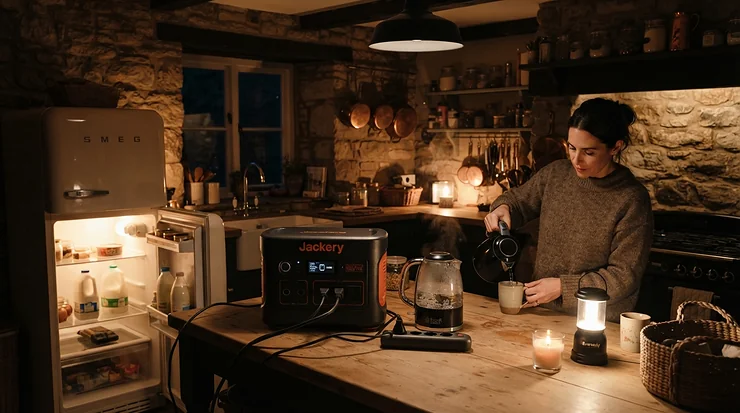
It’s 5:40 pm in January. The lights stutter, the fridge’s hum cuts out mid-note, and the router’s little green light goes dark. For most of us that’s a ten-minute inconvenience. For a few, it’s the start of a very long weekend. That’s why a power station for long power outages has stopped being a camping toy and become sensible household kit.
The UK Government’s own power cut guidance calls the grid resilient and says most cuts are short and local. It also admits that wider, longer outages can happen. Storm Arwen in November 2021 left nearly a million homes without power. Ofgem’s review found close to 4,000 homes off supply for over a week, and outages in some areas ran past ten days. Restoration was hardest in sparsely populated rural areas, which is exactly where rural power reliability is weakest.
So what changed? Batteries. LiFePO4 cells now deliver thousands of charge cycles. Pure-sine 230V inverters are common, and expansion modules stack capacity from about 1kWh to well over 25kWh. The catch is that the marketing is loud. A big number on the box doesn’t tell you whether the unit will carry a fridge, a router and a boiler pump through three days of freezing fog.
This guide cuts through that. You’ll get seven real models, honest runtime maths, and a straight answer on power station vs generator for whole house backup. You’ll also get advice on choosing a power station for self-build off-grid home projects. Every recommendation rests on published specs and genuine reviewer feedback, not invented testing.
Quick Comparison: Power Station for Long Power Outages at a Glance
Capacity (Wh) tells you how long the unit can run. Output (W) tells you what it can run at once. Weight tells you whether you’ll actually move it when the lights go out. You need all three to line up with your own situation. The table below puts the seven picks side by side before the detailed analysis.
| Product | Capacity (base) | Continuous output | Expandable to | Weight | Best for |
|---|---|---|---|---|---|
| EcoFlow DELTA 2 | 1,024Wh | 1,800W | ~3kWh | ~12kg | Flats and cuts lasting hours |
| Bluetti AC180 | 1,152Wh | 1,800W | Treat as fixed | ~16–17kg | Budget essentials backup |
| EcoFlow DELTA 2 Max | 2,048Wh | 2,400W (3,100W X-Boost) | 6,144Wh | 23kg | One-to-three-day cuts |
| Jackery Explorer 2000 Plus | 2,042Wh | 3,000W | 12kWh | 27.9kg | Scalable plug-and-play |
| Bluetti AC300 + B300 | 3,072Wh | 3,000W | 12,288Wh | 21.6kg + ~36kg battery | Modular, hot-swap setups |
| Anker SOLIX F3800 | 3,840Wh | 6,000W | 26.9kWh | ~60kg | Home-integrated systems |
| EcoFlow DELTA Pro 3 | 4,096Wh | 4,000W (6,000W X-Boost) | 12kWh | 51.5kg | Highest runtime per box |
Read across the rows and a pattern emerges. The two entry units are light and affordable but run dry within a day. The middle tier, EcoFlow DELTA 2 Max and Jackery Explorer 2000 Plus, is where multi-day maths starts working once you add battery packs. At the top, Anker SOLIX F3800 and EcoFlow DELTA Pro 3 trade portability for serious output and capacity. If your priority is carrying the unit alone, stay at or below the EcoFlow DELTA 2 Max class.
💬 Just one click — help others make better buying decisions too!😊
Top 7 Power Stations for Long Power Outages: Expert Analysis
Prices below are indicative ranges only, since they move constantly. Check current price on Amazon before buying.
1. EcoFlow DELTA 2 — lightest way to get started
At roughly 12kg, the EcoFlow DELTA 2 is the one you can carry from cupboard to kitchen without a pep talk. Portability is the whole pitch. Its 1,024Wh LiFePO4 battery and 1,800W output cover a fridge-freezer, router, lamps and chargers with room to spare. A UK press review noted that X-Boost lets some heavier appliances run towards 2,200W by throttling them rather than tripping the unit. In practice, 1kWh buys you somewhere between half a day and a day of essentials, not a long weekend.
Expansion batteries lift the system to roughly 2–3kWh. The extra cost and bulk start to push you towards the next tier up. Based on the spec comparison, this is an outage bridge for flats, terraces and anyone whose cuts last hours rather than days. The UK review described it as fast to charge, portable and intuitive, which is what you want when you’re fumbling in the dark.
Pros:
- ✅ Genuinely portable at around 12kg
- ✅ LiFePO4 chemistry with strong cycle-life claims
- ✅ App control and expandable to about 3kWh
Cons:
- ❌ 1kWh runs dry within a day
- ❌ Expansion costs climb quickly
Expect around £500–£650 at the time of research. It’s excellent value for short cuts and poor value for multi-day ones.

2. Bluetti AC180 — most watts per pound at the entry tier
The Bluetti AC180 packs 1,152Wh and a punchy 1,800W into a case of about 16–17kg. That’s slightly more capacity than the EcoFlow DELTA 2, so a kettle plus a fridge isn’t a drama. Its LiFePO4 cells are rated for 3,500+ cycles to 80%, which is close to a decade of daily cycling if you ever use it that hard. Bluetti quotes up to 1,440W charging input and roughly 45 minutes to 80%. A UPS-style switchover of around 20ms is claimed.
Here’s what the spec sheet won’t tell you. A UK review noted the Bluetti AC180 has fewer and less flexible outlets than the EcoFlow DELTA 2 (two 230V sockets on UK versions). It also cautioned that no portable power station switches as fast as a dedicated UPS, so don’t rely on it for delicate gear. The same review found Bluetti’s guidance on expansion batteries confusing, so treat this as a fixed-capacity unit. One regional Bluetti page lists the original model as phased out, so confirm UK availability and any successor before buying.
Pros:
- ✅ 1,800W handles kettles and small heaters
- ✅ 3,500+ cycle LiFePO4 battery
- ✅ Quick recharge, around 45 minutes to 80% claimed
Cons:
- ❌ Only two UK sockets, so you’ll need a power strip
- ❌ No clear expansion path for multi-day use
Expect around £500–£700. It’s good value for a one-day essentials backup.
3. EcoFlow DELTA 2 Max — the sweet spot for multi-day runtime
The EcoFlow DELTA 2 Max is where the maths begins to look like a plan rather than a hope. It has a 2,048Wh LiFePO4 battery, a 2,400W inverter (3,100W with X-Boost) and four UK sockets. Two extra batteries take it to 6,144Wh, and a 4,000-cycle-to-80% rating suggests years of standby use. At 23kg it’s heavier than the EcoFlow DELTA 2, but it only roughly doubles capacity per kilo moved.
Trusted Reviews’ test measured about 2,203Wh drawn from the wall to fill the 2,048Wh battery. That’s a charging loss of around 7–8%, a useful real-world number the brochure skips. The publication also flagged 23kg as the edge of comfortable portability. Fully expanded, you’re looking at roughly two days of “comfortable” use or three of lean use, per the runtime table below.
Pros:
- ✅ Four UK sockets and generous 2,400W output
- ✅ Expandable to 6kWh with extra batteries
- ✅ Quiet operation, around 30dB claimed
Cons:
- ❌ 23kg is awkward up stairs
- ❌ Extra batteries are a significant added cost
Expect indicatively £1,000–£1,800, with promotions swinging it. It’s the best-balanced choice for one-to-three-day rural cuts.
4. Jackery Explorer 2000 Plus — scales to 12kWh without a rewire
Jackery’s pitch is simplicity. The Jackery Explorer 2000 Plus offers 2,042Wh, 3,000W output (6,000W surge) and up to five battery packs for 12kWh total. Two units can be paralleled for up to 6kW with a separate connector. LiFePO4 cells are rated at 4,000+ cycles to at least 70% capacity. At 27.9kg it’s the heaviest of the “carry-it-yourself” group.
One detail matters for UK winters. Spec listings show charging only from 0°C and discharging from -10°C. A unit sitting in an unheated garage in a freeze can happily power your fridge but refuse to recharge. Keep it indoors or somewhere insulated. Warranty terms vary by retailer (three to five years in listings I found), so check before buying. I couldn’t verify a deep pool of independent UK reviews for this model, so weigh the specs and warranty more heavily than anecdotes.
Pros:
- ✅ 3,000W output with strong surge headroom
- ✅ Scales to 12kWh with add-on packs
- ✅ Wi-Fi and Bluetooth app monitoring
Cons:
- ❌ Charging restricted in sub-zero temperatures
- ❌ Heavy for one person at 27.9kg
Expect around £1,100–£1,700. It’s good value if you plan to expand beyond 4kWh.
5. Bluetti AC300 + B300 — modular, with batteries you can swap live
The Bluetti AC300 + B300 splits the inverter from the battery. The AC300 weighs 21.6kg and delivers 3,000W (6,000W surge) through six UK sockets. Each B300 adds 3,072Wh, and up to four stack for 12,288Wh. Bluetti says batteries can be hot-swapped while running. In theory, charge a spare battery on solar while the other powers the house, then swap, and the system never goes dark.
Each B300 weighs about 36kg, so this is a two-person job in reality. Charging is flexible: mains, solar (up to 2,400W), car, petrol generator or lead-acid input. The 5,400W combined maximum needs at least two B300s. UK retailer listings show a two-year warranty, shorter than Anker’s or EcoFlow’s. Independent long-form UK reviews were thin when I looked, so the case rests on specs and design logic.
Pros:
- ✅ Six sockets handle a whole kitchen’s essentials
- ✅ Hot-swappable battery modules
- ✅ Accepts petrol generator charging
Cons:
- ❌ Inverter is useless without a B300 purchase
- ❌ Two-year warranty on UK listings
Expect around £2,500–£3,800 for the AC300 plus one B300. It’s strong value for stackable capacity if you’ll actually use the hot-swap trick.

6. Anker SOLIX F3800 — the home-integration heavyweight
The Anker SOLIX F3800 is built to be a home backup system that happens to have wheels. It offers 3,840Wh, a 6,000W 230V output and expansion to 26.9kWh with up to six BP3800 packs. Anker also claims a five-year warranty and a ten-year lifespan. Solar input tops out around 2,400W. A 6kW inverter covers kettles, induction hobs and tools together, though it won’t run an 8–10kW electric shower. Check your high-demand loads before assuming “whole house” means everything.
GearJunkie’s review praised the massive inverter, easy rolling and strong home-integration options. Its main complaints were that the unit is top-heavy and heavy for its class, at roughly 60kg. That review covered the US version, so the UK model’s 230V details are worth confirming on the listing. Anker’s Home Power Panel and transfer switch accessories are where it shines for properly wired backup, installed by a qualified electrician.
Pros:
- ✅ 6,000W output runs genuinely demanding loads
- ✅ Scales to 26.9kWh for week-long runtime
- ✅ Five-year warranty
Cons:
- ❌ Roughly 60kg and top-heavy
- ❌ Premium price before accessories
Expect around £2,500–£3,500 for the base unit. It’s high value if you want a serious, installable system.
7. EcoFlow DELTA Pro 3 — highest runtime in a single box
The EcoFlow DELTA Pro 3 has 4,096Wh of LiFePO4 capacity, 4,000W continuous output (6,000W with X-Boost, 8,000W surge) and expansion to 12kWh using two extra batteries. It also accepts EcoFlow’s Smart Generator, which makes the generator-hybrid strategy practical. Solar input reaches 2,600W, and EcoFlow claims 4,000 cycles to 80%, a UPS switchover under 10ms and noise down to about 30dB at lower loads. The battery pack is described as IP65-rated, a useful claim for damp outbuildings.
At 51.5kg it’s lighter than the Anker SOLIX F3800 but still wheel-it-don’t-lift-it territory. It’s also a newer product, and I couldn’t verify a deep pool of long-term UK user reviews. Retailer notes at one point said UK stock was pending, so confirm availability before committing. For anyone planning the longest outages, the pairing of big base capacity with generator fallback is its trump card.
Pros:
- ✅ 4kWh base capacity, expandable to 12kWh
- ✅ Fast UPS switchover claim under 10ms
- ✅ Generator and alternator charging support
Cons:
- ❌ 51.5kg demands wheels and planning
- ❌ Limited long-term UK review history
Expect indicatively £3,000–£4,200 for the base unit. It’s premium pricing for maximum runtime and flexibility.
Top 7 Comparison: Specs, Price Ranges and Review Depth
| Product | Chemistry | Indicative price range | Warranty (as listed) | Review depth I could verify | Best for |
|---|---|---|---|---|---|
| EcoFlow DELTA 2 | LiFePO4 | £500–£650 | 5 years | Good (UK press) | Short cuts, flats |
| Bluetti AC180 | LiFePO4 | £500–£700 | Check listing | Moderate | Budget backup |
| EcoFlow DELTA 2 Max | LiFePO4 | £1,000–£1,800 | 5 years | Good (Trusted Reviews) | Rural 1–3 day cuts |
| Jackery Explorer 2000 Plus | LiFePO4 | £1,100–£1,700 | 3–5 years (varies) | Limited | Scalable plug-and-play |
| Bluetti AC300 + B300 | LiFePO4 | £2,500–£3,800 | 2 years (UK retailer) | Limited | Modular hot-swap |
| Anker SOLIX F3800 | LiFePO4 | £2,500–£3,500 | 5 years | Moderate | Home-integrated backup |
| EcoFlow DELTA Pro 3 | LiFePO4 | £3,000–£4,200 | 5 years | Limited (newer model) | Maximum runtime |
Notice how warranty length and review depth vary more than chemistry does. All seven use LiFePO4, so the real differentiators are expandability, output and how much support stands behind them. If you want the most evidence-backed mid-range choice, EcoFlow DELTA 2 Max has the best-documented track record here. If you’re building toward 10kWh-plus, the Anker SOLIX F3800 and Jackery Explorer 2000 Plus offer the most room to grow.
Extended Outage Planning: Your Day-by-Day Playbook
Hardware is half the battle. Extended outage planning is the other half, and it’s where most households come unstuck. Here’s a plan that works whichever unit you pick.
Before the storm (do this once, then monthly):
- Plug an energy monitor into your fridge-freezer, router and key chargers. Real draw beats guesswork.
- Charge the unit fully, then test it under load for an hour. Many brands recommend keeping units topped up and exercised.
- Fill freezer gaps with bottles of water, a tip the UK Government’s preparation advice endorses.
- Save 105 in your phone and check whether you qualify for the Priority Services Register, which exists for people with medical or extra support needs.
Hours 0–24: protect the essentials. Run only the fridge-freezer, router, lighting and phone charging. Keep the freezer shut. Avoid anything that makes heat. As a rough yardstick, 1,000Wh runs a space heater for about an hour, which is why heating is the battery’s worst enemy.
Days 2–3: stretch and recharge. Cycle loads. Run the fridge continuously but charge laptops during daylight. Add solar where possible, though expect modest winter yield from small panels. Connect a car charger or a petrol inverter generator (outdoors only) to top up.
Day 4 onwards: decide. If the network operator can’t give a restoration time, consider relocating vulnerable people or food rather than draining the battery to zero.
When power returns, unplug sensitive electronics first, since surges can damage them. Then recharge your power station immediately. Planning turns a power station for long power outages from a gadget into a system.
Real-World Scenarios: Three UK Households, Three Smart Setups
These are illustrative profiles to show the reasoning, not real customers.
Scenario 1: The terraced house in town. Gas combi boiler, fridge-freezer, fibre broadband, laptop workers. Cuts are usually hours. Budget: £500–£700. Frequency: once or twice a year. The EcoFlow DELTA 2 or Bluetti AC180 fits. They cover fridge, router and devices for roughly a day at lean loads, and you can carry them yourself. Expansion isn’t worth the money here.
Scenario 2: The rural cottage with private water. Oil boiler, well pump, a septic treatment plant, a full chest freezer and patchy mobile signal. Storm cuts can run two to four days. Budget: £1,500–£3,000. Frequency: a few times a year. The EcoFlow DELTA 2 Max with at least one extra battery, or the Jackery Explorer 2000 Plus with a battery pack, makes sense. Add a small petrol inverter generator, run outdoors, as a recharging backstop. Check pump start-up surge on the nameplate before you buy.
Scenario 3: The self-builder on a remote plot. No mains yet, caravan or partial build on site, tools and laptops running. Budget: £3,000–£6,000. Frequency: daily. The Bluetti AC300 + B300 (with two or more batteries), Anker SOLIX F3800 or EcoFlow DELTA Pro 3 fits, paired with a solar array and a generator fallback. Daily cycling is exactly what LiFePO4 handles well.
The pattern: match the tier to your longest realistic outage and your heaviest unavoidable load. Buy upward from there only if you expect to expand later.
What Is a Power Station for Long Power Outages?
A power station for long power outages is a large lithium battery with a built-in mains-voltage inverter, sized to run essentials like a fridge-freezer, broadband and lighting for days rather than hours. Unlike a camping unit, it pairs high capacity (typically 2kWh and up), expandable battery modules and multiple recharge routes, including solar and generator input.
How does it differ from the alternatives? A power bank charges phones and little else. A UPS keeps a PC alive for minutes. A fixed home battery is wired into your consumer unit by an installer and isn’t portable. A power station sits between them. You plug appliances straight in, you can move it, and some systems can later be wired into a home panel by an electrician.
For long outages specifically, three traits matter most. The first is usable capacity, because the nameplate figure overstates what you can draw. The second is recharge flexibility, because the grid won’t be there to help. The third is expandability, because the one outage that lasts a week is the one you’ll remember. A unit with great output but no expansion path can still strand you on day two.
How to Choose a Power Station for Long Power Outages
Follow these seven steps to avoid buying the wrong box.
- Measure your essentials. Use a plug-in energy monitor on the fridge-freezer, router, lights, phone chargers and any boiler pump. Total the daily watt-hours; that number drives everything else.
- Set your longest realistic outage. One day, three days or a week? Choose the capacity that covers it with a 20–25% margin for conversion losses.
- Check output against your heaviest load. A kettle needs around 2–3kW. Remember a UK 13A socket tops out near 3kW, so higher-output units only pay off when hard-wired by an electrician.
- Insist on LFP chemistry. Lithium iron phosphate cells trade some energy density for long cycle life and good thermal stability, which suits standby backup.
- Plan the recharge route. Solar input, 12V car charging and generator compatibility matter more than mains speed when the grid is down.
- Verify expandability and weight. Can you add batteries later, and can you physically move 50–60kg?
- Read the warranty and UK availability. Five years is better than two, and the model should actually be stocked in the UK.
Skip any of those steps and you risk buying a box that looks impressive but runs dry on day two.
Multi-Day Battery Runtime: What the Numbers Really Mean
Multi-day battery runtime is where marketing and reality part company. A 2,048Wh battery doesn’t give you 2,048Wh. Inverter losses and conservative cut-offs eat into it. Bluetti’s own published runtime formula for the Bluetti AC180 applies roughly 90% and 85% efficiency factors, which works out to about 75–80% of nameplate energy as usable. The table below uses 80%.
These figures are illustrative planning maths based on assumed loads: a “lean” day of about 1.5kWh (fridge-freezer, router, lights, chargers) and a “comfortable” day of about 2.5kWh (adding a laptop setup, a boiler pump and some extra cooking). Measure your own household before relying on them.
| Product | Usable energy (≈80%) | Lean days (1.5kWh/day) | Comfortable days (2.5kWh/day) | Max expanded, comfortable days |
|---|---|---|---|---|
| EcoFlow DELTA 2 | ~820Wh | ~0.5 | ~0.3 | ~1.0 (3kWh) |
| Bluetti AC180 | ~920Wh | ~0.6 | ~0.4 | n/a (fixed) |
| EcoFlow DELTA 2 Max | ~1,640Wh | ~1.1 | ~0.7 | ~2.0 (6kWh) |
| Jackery Explorer 2000 Plus | ~1,630Wh | ~1.1 | ~0.7 | ~3.9 (12kWh) |
| Bluetti AC300 + B300 | ~2,460Wh | ~1.6 | ~1.0 | ~3.9 (12.3kWh) |
| Anker SOLIX F3800 | ~3,070Wh | ~2.0 | ~1.2 | ~8.6 (26.9kWh) |
| EcoFlow DELTA Pro 3 | ~3,280Wh | ~2.2 | ~1.3 | ~3.9 (12kWh) |
The takeaway is sobering. A single unit, even the biggest, delivers roughly one to two days at realistic loads. Genuine multi-day battery runtime comes from expansion batteries, ruthless load discipline, or topping up from solar, a car or a generator. Winter solar in the UK is modest, so treat panels as a supplement rather than a lifeline. A 400W panel might return only a few hundred watt-hours on a dull December day.
Power Station vs Generator for Whole House: The Honest Verdict
The power station vs generator for whole house debate is rarely a clean win for either side. They solve different problems.
| Factor | Power station | Petrol generator |
|---|---|---|
| Fumes and CO risk | None at the unit | Serious; outdoor use only |
| Noise | Near-silent | Loud, neighbour-testing |
| Runtime ceiling | Fixed by battery plus recharge | Limited only by fuel supply |
| Fuel logistics | None | Petrol storage and refuelling |
| Maintenance | Minimal; periodic top-ups | Servicing, oil, stale fuel |
| Start-up effort | Press a button | Pull-start or electric start |
| Whole-house capability | Limited by 13A sockets unless hard-wired | Higher output possible, also needs proper connection |
| Best for | Silent, short-to-medium outages and sensitive indoor loads | Sustained heavy loads over many days |
A power station can’t run a “whole house” by plugging into sockets. A UK 13A socket handles about 3kW, so truly whole-house backup needs an electrician to install a changeover or interlocked connection. Without that, you’re backing up chosen circuits, which is fine and often smarter. A generator has no inherent advantage here; it faces the same wiring rules, and carbon monoxide adds a safety burden on top.
The smartest answer for long outages is often a hybrid. Use the battery for quiet overnight and low-load periods, and run a small inverter generator outdoors to recharge it during the day. That way the generator works at its efficient load, and you use far less fuel. Models such as the Bluetti AC300 + B300 and EcoFlow DELTA Pro 3 explicitly support generator charging.
Power Station for Self-Build Off-Grid Home: Bridging the Gap Until the Grid Arrives
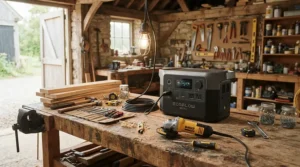
A power station for self-build off-grid home projects can be a smart phase-one power system. New grid connections can take a long time depending on your area, and a build site needs power from day one.
Choose capacity for your build phase. Early on you’re charging tools, running lights and keeping a laptop alive. That’s a 2–4kWh daily load. The Anker SOLIX F3800, Bluetti AC300 + B300 and EcoFlow DELTA Pro 3 all scale well beyond that.
Mind your tools. Many UK site tools run at 110V through a transformer. Check the transformer’s rating and the tool’s start-up surge against the inverter’s capability, not just the running wattage.
Size solar sensibly. Input ceilings are around 2,400W (Bluetti AC300 + B300, Anker SOLIX F3800) to 2,600W (EcoFlow DELTA Pro 3), but UK roof and ground yields in winter are small. Pair panels with a generator fallback.
Think of the system as modular. Daily cycling suits LiFePO4. With ratings of 3,000–4,000 cycles, a unit cycled once a day could last close to a decade on paper. As the build matures you can add batteries, then move to a permanent hybrid inverter system.
Get fixed wiring done properly. Anything beyond plug-in use should be designed and certified under BS 7671 by a qualified electrician. A portable power station is a bridge, not a replacement for a properly engineered off-grid installation. For a final home, you’ll likely graduate to a fixed battery and inverter system.
Rural Power Reliability: What Storm Arwen Taught Us
Rural power reliability is a different animal. Long overhead lines, trees, and sparse populations mean faults take longer to find and fix. Storm Arwen made that painfully concrete. It was described by government as the most severe disruption to power supplies since 2005, and during the event Ofgem lifted the compensation cap so customers could claim up to £140 a day after the first 48 hours. Compensation helps your wallet. It doesn’t keep your freezer cold.
Rural homes also have loads town homes don’t:
- Private water pumps
- Septic or sewage treatment plant blowers
- Oil-boiler controls and circulation pumps
- Electric fences or gates
- Chest freezers full of bulk-bought food
Check each nameplate for running watts and start-up surge. Pumps in particular can demand several times their running load for a second or two.
Practical steps: join the Priority Services Register if you qualify, keep 105 saved, and keep phones charged because mobile signal may be patchy. Consider a unit in the EcoFlow DELTA 2 Max or Jackery Explorer 2000 Plus class at minimum, with expansion capacity for storm season. Treat a small inverter generator as a recharging tool rather than a primary supply. And remember that the longest outages cluster in the worst weather, when solar yield is lowest.
Long-Term Cost and Maintenance
Batteries age whether you use them or not, so standby ownership has its own economics. On the indicative ranges above, entry units like the EcoFlow DELTA 2 work out at roughly £500–£650 per kWh of capacity. Larger units like the Anker SOLIX F3800 land roughly in the £650–£900 per kWh range once you include the inverter. Expansion batteries usually lower the per-kWh cost, which is why planning for expansion early saves money later.
Cycle ratings of 3,000–4,000 cycles look huge, but for occasional emergency use calendar ageing is more likely to be your limit than cycle count. That makes warranty length matter more than headline cycles. Five years on the Anker SOLIX F3800 and EcoFlow DELTA Pro 3 beats two years on the Bluetti AC300 + B300 UK listing.
Maintenance is light but not zero. Top up the charge every few months, following your manufacturer’s guidance. Store the unit somewhere cool, dry and above freezing. Test it under load periodically, and keep firmware current through the app.
Some owners also use them for daily value. Several brands’ apps let you schedule charging when electricity is cheaper, which can reduce running costs if you’re on a time-of-use tariff. Just remember every cycle uses up a little life, so don’t let ROI chasing eat into your emergency reserve.
Safety, Regulations and Compliance Guide
A power station is far safer than a petrol generator, but some rules still apply.
Never backfeed. Don’t plug a power station or generator into a wall socket to “power the house”. It can energise the network and endanger line workers and neighbours. The HSE Northern Ireland generator guidance warns that connecting a generator to your home can cause a surge that results in injury or death. It also stresses that carbon monoxide from generators is colourless and odourless and that they must never run indoors or in partly enclosed spaces. If you use a generator to recharge a battery, do it outdoors and fit battery-powered CO alarms.
Use a qualified electrician for fixed connections. Any hard-wired changeover or interlocked switch should comply with BS 7671. If a system can export power in parallel with the grid, ask your electrician about notifying your network operator (G98/G99 processes).
Check conformity marking. Look for UKCA or CE marking and a declaration of conformity from the manufacturer. Many product categories accept both in Great Britain, but verify the specifics for your unit.
Handle weight and heat sensibly. Units of 50–60kg need two people or wheels. LFP is thermally stable, but keep vents clear, avoid flammable clutter and don’t charge below the manufacturer’s stated limits.
Medical equipment needs extra care. UPS-style switchover is fast but not identical to a dedicated UPS. Don’t make a power station your only plan for life-critical devices without clinical advice, and register with the Priority Services Register.
FAQ
❓ How much should I spend on a power station for long power outages?
❓ Will a power station work in a freezing garage?
❓ How do I recharge a power station when the grid is down?
❓ Will my broadband still work during a power cut?
❓ Should I leave my power station plugged in all the time?
Conclusion
The best power station for long power outages isn’t the biggest. It’s the one matched to your longest realistic cut, your heaviest essential load and your ability to recharge when the grid is gone. If you live in a town flat or terrace, the EcoFlow DELTA 2 or Bluetti AC180 covers hours to a day affordably. For rural homes facing multi-day storm cuts, the EcoFlow DELTA 2 Max or Jackery Explorer 2000 Plus with added batteries is the sweet spot. If you’re a self-builder or want properly integrated backup, the Bluetti AC300 + B300, Anker SOLIX F3800 and EcoFlow DELTA Pro 3 earn their premium.
Whichever you pick, remember the three habits that matter more than any spec. Measure your loads, plan your recharge route, and test the unit before the weather turns. Pair that with sensible extended outage planning, and a long power cut becomes a plan you’re already running.
Recommended for You
- Whole House Power Station System: 7 Proven UK Picks (2026)
- Power Station For Growing Power Needs: 7 Proven Picks (2026)
- Stackable Power Station: 7 Best Buys, Honestly Ranked (2026)
Disclaimer: This article contains affiliate links. As an Amazon Associate, I earn from qualifying purchases. If you purchase products through these links, we may earn a small commission at no additional cost to you.
✨ Found this helpful? Share it with your friends! 💬🤗
