
In This Article
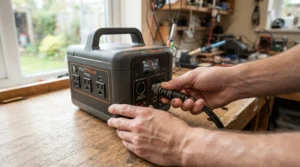
A CPAP power station vs CPAP battery pack comparison starts with definitions. A CPAP battery pack is a compact lithium battery built specifically to run sleep-therapy machines through a dedicated DC cable. A power station is a larger, general-purpose battery with mains, USB and 12V outputs that can run a CPAP alongside phones, routers and lamps.
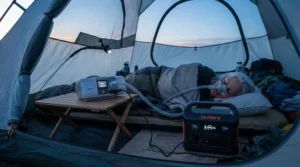
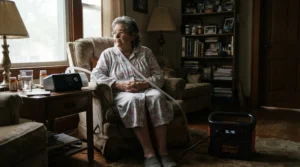
Now picture 2am, a storm, and the street going dark. The machine that has quietly kept your airway open for months stops mid-breath. Anyone who relies on therapy knows how quickly that goes from “inconvenient” to “rough night”. NICE recommends CPAP as a treatment option for adults with moderate or severe symptomatic obstructive sleep apnoea/hypopnoea syndrome, so a great many of us are plugged into the mains every night. The CPAP power station vs CPAP battery pack decision is really a decision about how much resilience you want, and how much you’ll pay and carry to get it.
I’ve built this guide from manufacturer documentation, published specifications and the themes that keep surfacing in real buyer reviews. I haven’t tested any of these products, and I won’t pretend otherwise. What I can do is read the spec sheets so you don’t have to, and translate every number into what it means at 3am. Along the way you’ll get the watt-hour maths, the DC adaptor for CPAP gotchas, and practical planning for a power station for CPAP during power cuts.
Quick Comparison: The 7 Contenders at a Glance
Here’s the lineup, covering three dedicated CPAP battery packs and four power stations from pocket-sized to proper bedside bruiser. Capacities are manufacturer figures, and runtimes always depend on your machine and settings.
| Product | Type | Capacity / Key Figure | Best For |
|---|---|---|---|
| ResMed Power Station II | CPAP battery pack | Up to 14 hours claimed (no humidifier) | AirSense 10 owners wanting official kit |
| Medistrom Pilot-24 Lite | CPAP battery pack | 95Wh, 1-2 nights claimed | Travel plus permanent backup |
| Zopec Explore Mini | CPAP battery pack | About 1 lb, 65W USB-C port | Lightest carry-on option |
| Jackery Explorer 300D | Power station (DC output) | 288Wh, 300W | Quiet, compact, DC-route users |
| Anker SOLIX C300 | Power station (AC + DC, UPS) | 288Wh, 300W, under 10ms switchover | Home power cuts, light users |
| Jackery Explorer 1000 v2 | Power station | 1,070Wh, 1,500W | Multi-night, humidifier users |
| Anker SOLIX C1000 Gen 2 | Power station (UPS) | 1,024Wh, 2,000W | Fast recharge and big headroom |
The pattern is clear. The dedicated packs win on size and plug-and-play compatibility, while the power stations win on raw energy and versatility. If you only need to get through one modest night, a pack is neater. If you want to survive a long outage and keep your phone and router alive too, the bigger Jackery Explorer 1000 v2 or Anker SOLIX C1000 Gen 2 earn their space. The middle ground, the 288Wh pair, looks tempting but needs honest watt-hour arithmetic, which we’ll do shortly.
💬 Just one click — help others make better buying decisions too!😊
Top 7 CPAP Power Station vs CPAP Battery Pack Picks: Expert Analysis
1. ResMed Power Station II — the official, purpose-built backup
The ResMed Power Station II (RPS II) is the manufacturer’s own answer, and that pedigree is its main selling point.
ResMed’s UK page claims up to 14 hours of power for the machine when the humidifier and heated tube are not connected, and two batteries can be coupled to double that. In practice, “no humidifier” is the catch: many users leave heated humidification on, and your real-world hours will drop accordingly. One compatibility wrinkle matters. ResMed warns the RPS II is not validated for recharging with the latest AirSense 10 power supply, and its documentation centres on AirSense 10 and S9 machines, with later V2 versions listing broader ResMed devices. If you own an AirSense 11, confirm compatibility with ResMed before buying.
Reviewer sentiment, from a small sample of retailer reviews, is mixed. Some buyers report it works fine, while others describe charging-adapter trouble or a dead unit and frustrating support. That’s too small a sample to condemn it, but it argues for buying from a retailer with easy returns.
Pros:
- ✅ Designed by the machine’s own manufacturer
- ✅ Up to 14 hours claimed without humidifier
- ✅ Two batteries can be coupled for double runtime
Cons:
- ❌ Compatibility depends heavily on your exact machine
- ❌ Premium pricing for the capacity
Expect to pay around £450-£500 at the time of research, which makes it the priciest per hour here. Fair value only if you want the official route and own a supported machine.
2. Medistrom Pilot-24 Lite — the dual-purpose travel and backup battery
The Medistrom Pilot-24 Lite is a small aluminium-cased pack that does double duty: permanent bedside backup and travel battery.
It stores 95Wh, and UK retailers say it can run a machine for one to two nights with the humidifier and heated tube disconnected. That 95Wh figure is also useful for flying, because many airlines apply a 100Wh cabin-battery threshold, though you should always check your airline’s current rules. Connect it to the mains and your machine, and it acts as a pass-through backup: if power fails, therapy continues. The pack is recharged using your machine’s own power supply, so there’s no extra charger to forget. Cables for AirSense 10 and AirMini are included, with other adaptors sold separately.
Buyer feedback is broadly positive about easy hook-up and service. One UK lorry driver reports using it to protect the truck battery overnight. Complaints include one unit that arrived dead and a cable-compatibility hiccup with an AirMini. Be aware that one US retailer lists the pack as discontinued while UK stockists still carry it, so check availability.
Pros:
- ✅ Pass-through backup keeps therapy going during outages
- ✅ 95Wh is airline-friendly
- ✅ Around 500 charge cycles and a 24-month UK warranty
Cons:
- ❌ Humidifier and heated tube must be disconnected
- ❌ Availability looks patchy
Indicative pricing sits around £250-£350; check the current price. For a single-night safety net, the value is solid.
3. Zopec Explore Mini — the featherweight with a USB-C party trick
The Zopec Explore Mini is the one for people who count grams before holidays.
Zopec bills it as weighing about 1 lb, and its auto-detecting multi-voltage output means one battery can serve ResMed AirSense 10 and 11 machines using the right cable, with a 65W USB-C port for laptops. What that means in practice: it’s the pack that disappears in a rucksack, and the USB-C port lets it double as a laptop top-up on the train. The 18-month warranty is shorter than some rivals’. I couldn’t verify a precise watt-hour capacity from the sources I found, so confirm it against the listing before you rely on it for a specific number of nights. Zopec also advises switching off the heated humidifier and tubing for maximum runtime.
On reviews, I couldn’t find enough verified UK buyer feedback to summarise sentiment fairly, and I’d rather say that than invent it. Look for recent customer reviews on the product page before buying.
Pros:
- ✅ Exceptionally light for carry-on luggage
- ✅ Cables for several ResMed machines included
- ✅ USB-C port also charges laptops
Cons:
- ❌ Capacity figure needs checking before purchase
- ❌ Heated humidifier shortens runtime drastically
Think around £250-£350, indicative. Good value for frequent flyers, but not my first pick for a long outage.
4. Jackery Explorer 300D — silent, tiny, and DC-only
The Jackery Explorer 300D is the whisper-quiet minimalist of the power stations.
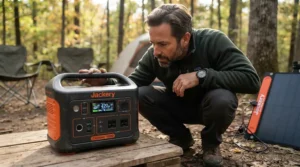
It packs 288Wh and 300W output into a 2.5 kg body with no AC socket: three USB-C ports, a USB-A port and a 12V car socket. UK retailer Currys lists a LiFePO4 battery rated up to 4,000 cycles and a five-year guarantee, and it has no fan, so it runs almost silently. The missing AC outlet is the key point. You’d power a CPAP through the 12V socket using your machine’s DC route, such as a ResMed 12/24V DC converter. That’s efficient because it skips the inverter, but it only works if the socket’s output covers the converter’s draw. Check that before you commit.
It’s a recent launch, so long-term CPAP-specific buyer feedback is thin. Its specifications look strikingly similar to Anker’s C300 DC.
Pros:
- ✅ Near-silent with no fan
- ✅ Long-life LiFePO4 cells, up to 4,000 cycles
- ✅ Very light for 288Wh
Cons:
- ❌ No AC socket, so a DC adaptor for CPAP is mandatory
- ❌ 288Wh is marginal for a full humidified night
Prices tend to sit in the low-to-mid £200s, though promotions move it; check the current price. Excellent value if you’re comfortable with the DC route.
5. Anker SOLIX C300 — the compact UPS-style home guardian
The Anker SOLIX C300 is the 288Wh model that behaves like a small uninterruptible power supply.
Anker lists 288Wh, 300W output (600W surge), a switchover time of under 10ms, LiFePO4 cells and a quiet 25dB operating noise at about a metre. The under-10ms figure is why it suits a power station for CPAP during power cuts: plug the CPAP into its AC outlet and the unit sits between wall and machine, taking over almost instantly. Anker’s own guidance pushes pure sine wave output and UPS support for CPAP use, which tallies with the sensible advice elsewhere in this guide. Note that the DC-only C300 DC variant lacks the UPS function, so buy the right version.
I couldn’t find CPAP-specific buyer reviews I’d trust, only general reviewers who praise the UPS behaviour on small electronics. Treat CPAP suitability as spec-led, and confirm your machine’s draw first.
Pros:
- ✅ Under 10ms UPS switchover for outage protection
- ✅ AC and DC outlets in one unit
- ✅ Quiet LiFePO4 design with app control
Cons:
- ❌ 288Wh won’t cover a long humidified night
- ❌ Heavier and bulkier than dedicated packs
Expect a price around the low-to-mid £200s to £300s; check the current price. A smart pick for light-draw users who want one box for the house.

6. Jackery Explorer 1000 v2 — the multi-night heavyweight
The Jackery Explorer 1000 v2 is the “just make the worry go away” option.
With 1,070Wh and 1,500W output, it’s more than three times the energy of the 288Wh units. One roundup estimates roughly 15-30 hours for a CPAP drawing 30-60W without humidifier. That’s a reviewer’s estimate rather than a lab measurement, but the arithmetic is plausible given the capacity. What that means in real life: a full week of nights at modest draw isn’t fantasy, and you’d still have energy left for the router and a phone. I couldn’t confirm a dedicated UPS function from my sources, so check the listing if automatic switchover matters to you.
The same roundup ranked it as its overall CPAP pick, but treat any single ranking cautiously. It is bulky and heavy compared with a pack, so it lives at the bedside rather than in your hand luggage.
Pros:
- ✅ Over 1,000Wh gives genuine multi-night resilience
- ✅ Handles humidifier use comfortably
- ✅ Doubles as a household emergency supply
Cons:
- ❌ Heavy and bulky for travelling
- ❌ UPS switchover not confirmed in my sources
Prices usually fall in the £500-£800 bracket, with promotions common; check the current price. Strong value if outages worry you.
7. Anker SOLIX C1000 Gen 2 — the fast-charging, UPS-ready big hitter
The Anker SOLIX C1000 Gen 2 pairs near-1kWh capacity with speed.
It offers 1,024Wh, 2,000W output (3,000W peak), a UPS switchover under 10ms, and a recharge from the wall in about 49 minutes. Fast recharging is quietly powerful: after a long outage you’re back to full far sooner, which matters if the power returns briefly and then drops again. A roundup noted the fan was noticeable against silent EcoFlow and Jackery rivals, which is worth weighing for light sleepers sharing a bedroom with the unit. Keep it in a hallway with a longer lead if so.
Reviewer sentiment I found was positive on speed and value, with noise the main grumble.
Pros:
- ✅ Roughly 49-minute wall recharge
- ✅ UPS switchover under 10ms
- ✅ Big capacity for multi-night cover
Cons:
- ❌ Fan noise noted by reviewers
- ❌ Overkill if you only need one night
Expect roughly £500-£800, depending on offers. Excellent value if recharge speed and UPS are priorities.
✨ Don’t Miss These Exclusive Deals!
🔍 Take your night-time resilience to the next level with these carefully selected products. Click on any highlighted item to check current pricing and availability. These picks will help you build a backup plan your whole household can sleep soundly on!
How to Set Up a Power Station for CPAP During Power Cuts: A Step-by-Step Guide
Buying the kit is only half the job. Here’s a setup routine that works for most people, and it’s the transformation content Amazon listings never give you.
- Do a dry run on a normal night. Unplug the mains at bedtime and run the machine from the battery. If something fails, you want it to fail while the lights are still on.
- Pick your humidifier strategy. Heated humidifiers and heated tubes burn extra watts. For short outages, ask your clinic whether dry running or lower heat is acceptable for you.
- Choose AC or DC. On a power station, the AC socket is simplest; the DC route is more efficient but needs the right cable. A pure sine wave AC output is what Anker recommends for CPAP.
- Fit it as a pass-through if you can. UPS-style units (the Anker SOLIX C300, Anker SOLIX C1000 Gen 2) or packs like the Medistrom Pilot-24 Lite sit between wall and machine, so a cut doesn’t wake you.
- Keep it charged and rotate. Medistrom advises storing its batteries fully charged and recharging at least every six months. Put a recurring phone reminder in your diary.
- Position it sensibly. Keep it off the floor where dust and spills gather, and give it airflow.
A final tip: label the cables with a strip of tape. Fumbling in the dark with a similar-looking lead is no fun.
CPAP Power Consumption in Watts: What Your Machine Really Draws
Everything in the CPAP power station vs CPAP battery pack decision flows from CPAP power consumption in watts, so let’s demystify it. Watts measure how fast energy is used, and watt-hours (Wh) measure the battery’s tank. Runtime is roughly tank size divided by draw.
ResMed’s AirSense 11 power supply is listed with a typical consumption of 56.1W and peak of 73.2W, measured at the supply. Its DC converter is described as drawing up to 90W with the humidifier and heated tube. One buyer’s review on a retailer page reports around 300Wh of DC consumption over an eight-hour sleep with the humidifier on, which works out near 38W on average. Other roundups cite 30-60W without humidifier. Real figures depend heavily on your pressure settings, and because auto-titrating machines (the type described by Royal Papworth Hospital NHS Foundation Trust) adjust pressure through the night, the draw moves around too.
Here are illustrative planning numbers, assuming roughly 85% usable efficiency through an inverter. They are rules of thumb, not lab results:
- 288Wh unit at 20W average: about 12 hours
- 288Wh unit at 40W average: about 6 hours
- 288Wh unit at 65W average: under 4 hours
- 1,070Wh unit at 65W average: about 14 hours
- 1,070Wh unit at 40W average: about 22 hours
That’s the uncomfortable truth about the 288Wh class: it can fall short of a full humidified night. Use your clinic’s data download or the power-supply label to find your own ceiling.
DC Adaptor for CPAP: What It Does and What to Check
A DC adaptor for CPAP lets your machine run from a battery instead of a wall socket. Most modern ResMed machines run on 24V DC internally, so a converter either steps 12V up or passes 24V through. ResMed’s AirSense 11 converter accepts 12V or 24V sources, such as cars, caravans and boats, and works with the humidifier and heated tube. It’s galvanically isolated for safety and certified as a medical device. Overseas listings put it at roughly £80-£110 equivalent, but check ResMed UK for current pricing.
Why does this matter? Because skipping the inverter wastes less energy. A DC adaptor for CPAP connected to a power station’s 12V socket, like the one on the Jackery Explorer 300D, avoids the AC conversion step. Dedicated packs like the Medistrom Pilot-24 Lite and Zopec Explore Mini ship with the right DC cables, which is a big part of their appeal.
Three checks before you buy any DC adaptor for CPAP:
- Does it match your exact machine and generation (AirSense 10 and 11 cables differ)?
- Can the battery’s 12V socket deliver enough current for the converter’s maximum draw?
- Is it a medical-grade or manufacturer-approved part, rather than a no-name lead?
Cheap generic cables exist, but your breathing machine is a poor place to experiment.
Power Station for CPAP During Power Cuts: Planning for the Night the Lights Go Out
A power station for CPAP during power cuts needs to answer three questions: how long might the outage last, how much do I draw, and how quickly will it switch over? Short suburban cuts often last an hour or two. Storm damage can stretch it much longer, which is where the 1,000Wh class earns its keep.
Look for UPS-style switchover, since Anker lists under 10ms for the Anker SOLIX C300 and Anker SOLIX C1000 Gen 2. Without UPS pass-through, a cut will stop your machine until you move it onto the battery.
Also register for help. The Priority Services Register is a free scheme run by your supplier and network operator, and it explicitly includes people using medical equipment that needs a power supply. Benefits include advance notice of planned cuts and priority support in an emergency. You’ll need to re-register if you switch supplier. If the power does go off unexpectedly, you can call 105 free of charge to reach your local network operator.
A power station complements this register; it doesn’t replace it. Think of the battery as your first hour, and the register as the people who work on the next ten.
NHS Sleep Apnoea Service: What to Ask Before You Buy Backup Power
If you’re treated through the NHS sleep apnoea service, your machine is typically supplied and set up by a specialist team. That’s useful, because they know exactly which model you have. Before spending money, ask them:
- Which machine and generation do I have, and what is its power supply rating?
- Is a DC cable or converter compatible with it, and does using one affect warranty or loan terms?
- Is it acceptable to turn the heated humidifier off during short outages?
- Who do I call if the machine stops during a power cut?
Policies vary between trusts, so don’t assume. In general, sleep services supply the machine, mask and consumables, while backup batteries are commonly bought privately, so confirm locally. Some retailers of medical-grade CPAP accessories mention VAT relief for eligible customers, which is worth asking about if it applies to you.
Telephone helplines and review appointments are standard parts of care, as described by the sleep centre at Royal Papworth Hospital, so use them. The NHS sleep apnoea service would rather you ask a “silly” question now than struggle through a cold, dark night later.
CPAP Power Station vs CPAP Battery Pack: Head-to-Head
So which wins? The honest answer is “it depends on your night”. Here’s how the options compare.
| Factor | CPAP battery pack | Power station | Best For |
|---|---|---|---|
| Size and weight | Pocketable (e.g. Zopec Explore Mini) | Bedside box (e.g. Anker SOLIX C300) | Packs for travel, stations for home |
| Compatibility | Cables supplied for specific machines | Universal outlets, you supply the lead | Packs for plug-and-play |
| Energy | About 95Wh (Medistrom Pilot-24 Lite) | 288Wh to over 1,000Wh | Stations for long outages |
| Pass-through backup | Common on dedicated packs | Needs UPS function | Both, check specs |
| Versatility | Mostly CPAP-only | Powers phones, routers, lamps | Stations for households |
| Typical cost per Wh | Higher | Lower | Stations for value |
In plain English, a CPAP battery pack is a specialist tool and a power station is a Swiss Army knife. Packs like the ResMed Power Station II give you certainty of fit; stations like the Jackery Explorer 1000 v2 give you far more energy per pound. If you travel often, lean towards a pack. If outages are your worry and you have a bedside spot to spare, lean towards a station. Many households sensibly own both.
How to Choose: CPAP Power Station vs CPAP Battery Pack in 6 Steps
- Find your machine’s draw. Check the power supply label and your typical pressure. It sets the baseline for everything else.
- Decide on humidifier use. Heated humidification can nearly double consumption, so plan runtimes accordingly.
- Set your target. One night, three nights, or a week? That determines whether 95Wh, 288Wh or 1,000Wh-plus makes sense.
- Check connectivity. Confirm the DC cable for your exact machine, or confirm a pure sine wave AC outlet.
- Prioritise switchover. If you sleep through everything, choose pass-through or UPS behaviour, such as under-10ms units.
- Weigh portability. Will it live by the bed, or travel in hand luggage? Check airline battery rules before flying.
Common Mistakes When Buying a CPAP Backup
Buying on capacity alone. A big number means little if the cable doesn’t fit your machine generation.
Forgetting the humidifier. Headline runtimes usually assume it’s off. If you rely on it, divide expectations accordingly.
Ignoring inverter losses. AC sockets on power stations waste some energy, so your real runtime is shorter than watt-hours divided by watts.
Letting batteries rot in a cupboard. Lithium packs need periodic top-ups. Medistrom advises recharging at least every six months in storage.
Choosing a DC-only unit without realising. The Jackery Explorer 300D is lovely, but it needs a DC adaptor for CPAP, and the DC-only Anker variant lacks UPS.
Skipping the clinic. Your NHS team knows your device. A two-minute call can save a costly mismatch.
Long-Term Cost & Value: What You’ll Really Pay
Cost per watt-hour tells a surprising story, and cycle life matters too. Power stations with LiFePO4 cells, such as the Jackery Explorer 300D (rated up to 4,000 cycles) and Anker SOLIX C300 (rated around 3,000 cycles), should last for years of occasional use. Dedicated packs like the Medistrom Pilot-24 Lite quote about 500 cycles, which is plenty for a backup that you use rarely.
| Product | Indicative price range | Value verdict | Best For |
|---|---|---|---|
| ResMed Power Station II | £450-£500 | Pricey, but official | Supported ResMed machines |
| Medistrom Pilot-24 Lite | £250-£350 | Solid for one night | Backup plus travel |
| Zopec Explore Mini | £250-£350 | Good if weight matters | Frequent flyers |
| Jackery Explorer 300D | Low-to-mid £200s | Great if DC suits | Minimalists |
| Anker SOLIX C300 | £200s-£300 | Smart UPS value | Light-draw home users |
| Jackery Explorer 1000 v2 | £500-£800 | Best energy per pound | Multi-night cover |
| Anker SOLIX C1000 Gen 2 | £500-£800 | Strong, fast recharge | Big households |
Prices are indicative and change often, so check current prices. The table shows the energy-per-pound gap clearly: the Jackery Explorer 1000 v2 and Anker SOLIX C1000 Gen 2 deliver roughly three times the capacity of the dedicated packs for a similar or modestly higher outlay. For context on why steady therapy is worth protecting, an Oxford University study modelled CPAP as cost-effective for the NHS after a couple of years of treatment, in a model of severe disease. Keeping therapy uninterrupted is the point of the whole exercise.
FAQ
❓ How long will a 288Wh power station run my CPAP machine?
❓ Can I take a CPAP battery pack on a UK flight?
❓ Does the NHS supply a backup battery for my CPAP machine?
❓ Where can I buy a DC adaptor for CPAP in the UK?
❓ Is a pure sine wave power station necessary for CPAP?
Conclusion
The CPAP power station vs CPAP battery pack verdict, boiled down: choose a dedicated pack when portability and plug-and-play compatibility matter most, and choose a power station when you want real endurance and a household safety net. For one-night resilience and travel, the Medistrom Pilot-24 Lite, Zopec Explore Mini or ResMed Power Station II make sense. For genuine power cut peace of mind, the Anker SOLIX C300 suits light users, while the Jackery Explorer 1000 v2 and Anker SOLIX C1000 Gen 2 suit anyone who wants multi-night headroom. The Jackery Explorer 300D is a neat minimalist choice if you’re happy with the DC route.
Whatever you pick, do the watt-hour arithmetic, check your cables, join the Priority Services Register, and talk to your NHS sleep apnoea service about compatibility. Then test the setup before you need it.
✨ Ready to sleep through the next outage?
🔍 Compare the picks above, click any highlighted item to check current pricing and availability, and build a backup plan that matches your machine, your humidifier habits and your nights. Your future, well-rested self will thank you!
Recommended for You
- Power Station For Campervan: 7 Best Proven Picks For UK (2026)
- Portable Power Station For Camping: 7 Best Picks For UK (2026)
- Lightweight Power Station For Camping: 7 Best Picks (2026)
Disclaimer: This article contains affiliate links. As an Amazon Associate, I earn from qualifying purchases. If you purchase products through these links, we may earn a small commission at no additional cost to you.
✨ Found this helpful? Share it with your friends! 💬🤗
