In This Article
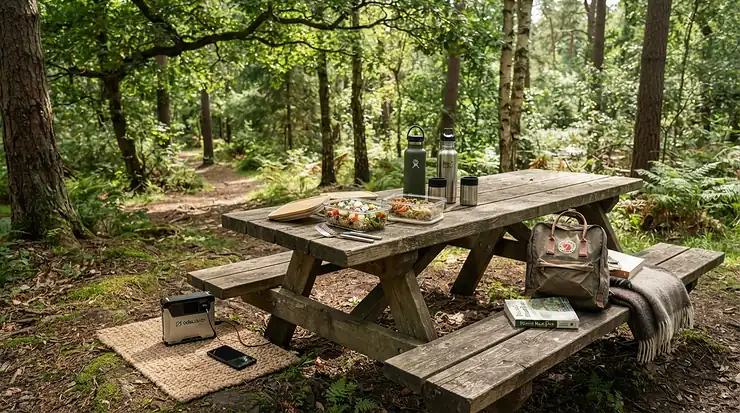
Remember when “charging your phone at camp” meant a battered power bank and a quiet prayer? A portable power station for camping is a rechargeable lithium battery with built-in mains-style sockets, USB ports and 12V outputs, so you can run lights, phones, a laptop or a small fridge away from a hook-up. You recharge it from a wall socket, your car or portable solar panels, with no engine noise and no exhaust fumes.
That silence matters in Britain. The Camping and Caravanning Club says generators may only be used on its sites at the discretion of the Holiday Site team, who set the running times. You can also be asked to stop if a generator disturbs anyone. A battery box sidesteps the whole argument.
But “portable” is a stretchy word. A 3.5kg unit and a 24kg unit are different animals, and the right choice depends on how far you carry it, what you plug in and how many nights you’re out. I’ve compared seven real models using manufacturer specs, published independent reviews and plain-English maths. They run from a festival-friendly featherweight to a week-long heavyweight.
Along the way we cover power station for festival camping, power station for carp fishing trips, a rugged waterproof power station for outdoor use, portable solar panels, and the Camping and Caravanning Club rules most people overlook. Specs and price ranges reflect research in October 2026, so always check the current listing.
Quick Comparison: The Best Portable Power Station for Camping at a Glance
| Model | Capacity | AC output | Weight | Price range* | Best for |
|---|---|---|---|---|---|
| EcoFlow RIVER 2 | 256Wh | 300W | 3.5kg | £150-£250 | Festivals, phones and lights |
| Jackery Explorer 500 v2 | 512Wh | 500W | 5.7kg | £250-£400 | Two-night tent trips |
| Bluetti AC60P | 504Wh | 600W | 9.1kg | £350-£550 | Wet weather, anglers |
| Anker SOLIX C800 Plus | 768Wh | 1,200W | 10.9kg | £400-£600 | Campsite kettle plus fridge |
| Anker SOLIX C1000 Gen 2 | 1,024Wh | 2,000W | 11.3kg | £450-£700 | Families, solar-first setups |
| Jackery Explorer 1000 v2 | 1,070Wh | 1,500W | 10.8kg | £450-£600 | Simple 1kWh all-rounder |
| Bluetti Elite 200 V2 | 2,073.6Wh | 2,600W | about 24kg | £900-£1,400 | Week-long base camps |
*Indicative ranges at the time of research. Prices vary by retailer and change often, so check the current price.
Read left to right, the table tells a simple story: weight climbs faster than capacity once you pass 1kWh. The Jackery Explorer 500 v2 and EcoFlow RIVER 2 are the only two you’d happily carry without a trolley. The Anker SOLIX C1000 Gen 2 and Jackery Explorer 1000 v2 deliver double the energy of the Anker SOLIX C800 Plus for only a little more weight. The Bluetti Elite 200 V2 is in a different league entirely, so buy it only if you genuinely need multi-day cooking power.
💬 Just one click — help others make better buying decisions too!😊
Top 7 Portable Power Station for Camping Picks: Expert Analysis
1. EcoFlow RIVER 2 — featherweight pick for phones and lights
The standout here is sheer carryability. At 3.5kg, EcoFlow RIVER 2 is the one model in this round-up you could comfortably haul across a festival field. Its 256Wh LiFePO4 battery and 300W output (600W surge) cover phones, camera batteries, LED lanterns and a laptop. That’s roughly a dozen-plus phone charges once conversion losses are counted. TechRadar’s review notes that pulling the full 300W flattens it in under an hour, so treat it as a top-up box, not a kitchen.
Solar input tops out at 110W. EcoFlow’s spec sheet quotes about 2.9 hours from empty with one 110W panel in ideal conditions, which under British skies realistically means “a full day”. On paper this is the sensible first purchase for solo campers. At 256Wh it also sits above the 160Wh limit most airlines use, so it’s strictly a car-and-boot companion.
Published reviewer sentiment, mainly TechRadar’s test, praises the weight and sturdy grab handle. I couldn’t verify a large pool of independent buyer reviews, so treat that as a limited sample.
Pros:
- ✅ Genuinely carryable at just 3.5kg
- ✅ Full mains recharge in about an hour
- ✅ LiFePO4 cells rated for 3,000+ cycles
Cons:
- ❌ Too small for a fridge across a weekend
- ❌ Solar input capped at 110W
Price: around £150-£250, which is excellent entry-level value if your needs are modest.

2. Jackery Explorer 500 v2 — lightest 500Wh-class weekender
The standout is the weight-to-capacity ratio. At 5.7kg, Jackery Explorer 500 v2 is easy to lift one-handed yet holds 512Wh. Output is 500W continuous (1,000W peak) across two AC sockets, two USB-C ports, a USB-A port and a 12V socket. Cooling-fan noise is quoted at 30dB or less, which is whisper territory.
What does that mean in a tent? A 12V camping fridge, lanterns, a fan, phones and a laptop sit comfortably inside the 500W ceiling. A 1.5kW kettle does not, so plan on a gas stove. Solar input maxes at 200W. Jackery’s UK listings quote about 2.8 to 3.5 hours with 200W of panels in optimum light, and “optimum” is doing heavy lifting in Britain. It also prioritises solar when panels and mains are both connected, which is handy for top-ups.
Independent long-term testing of this newer model is still thin. Retailer pages and round-ups lean positive on size and simplicity, but check recent buyer feedback on the live listing before you commit.
Pros:
- ✅ Lightest 500Wh-class unit here
- ✅ Wide -20°C to 45°C operating range
- ✅ Solar-priority charging saves mains top-ups
Cons:
- ❌ 500W cap rules out kettles and heaters
- ❌ Two panels need a separate connector
Price: roughly £250-£400, good value for two-night tent trips.
3. Bluetti AC60P — IP65 protection for soggy campsites
The standout is its IP65 rating, plus a 504Wh battery that expands to 2,116Wh with add-on packs. Bluetti is refreshingly honest that this does not make it “waterproof”. IP65 means dust-tight and protected against low-pressure water jets from any direction, so rain and splashes are fine but dunking is not.
Elsewhere: 600W continuous (1,200W in “Power Lifting” mode for resistive heating appliances), 9.1kg, a LiFePO4 pack rated for 3,000+ cycles, and discharge from -20°C to 40°C. Bluetti quotes about 2.5 to 3 hours from empty with its PV200 panel. The 600W inverter is the real limit, so it won’t run a kettle without Power Lifting mode.
It’s the pick for anglers and anyone pitching in unreliable weather. German outlet NextPit named it the best camping power station in its round-up, citing the IP65 rating and weight. The handful of buyer comments on Bluetti’s own store mention decent size and weight, with the 600W output as the main caveat. That’s a small sample, so don’t over-read it.
Pros:
- ✅ IP65 dust and water-jet protection
- ✅ Expandable from 504Wh to 2,116Wh
- ✅ Power Lifting mode for resistive heaters
Cons:
- ❌ 3.4kg heavier than the Jackery above
- ❌ 600W inverter limits larger appliances
Price: around £350-£550, a fair premium for weather protection.
4. Anker SOLIX C800 Plus — kettle-capable without the heft
The standout is a 1,200W inverter (1,600W surge) in a 10.9kg body. That’s unusual power for 768Wh. It also has built-in camping-light modes, and the Plus version stores its lights in a compartment on the unit. A full mains recharge takes about 58 minutes, and solar input caps at 300W via an XT60 connector.
Trusted Reviews calls it a reasonable compromise between portability and campsite power, and PopSci named it best for camping. A published test is useful here. Two 600W loads drained it in 29 minutes while delivering 580Wh, so at full tilt you get roughly three-quarters of the headline capacity. That’s normal for inverter losses, but it’s why you should size by usable watt-hours.
Trusted Reviews also flags that AC and DC input can’t be combined, because mains power disconnects solar. If your plan is “solar by day, mains in the car on the way home”, that’s fine. It’s less ideal for topping up from both at once.
Pros:
- ✅ 1,200W output handles most kettles
- ✅ 300W solar input recharges quickly
- ✅ Built-in camping-light modes
Cons:
- ❌ Can’t charge from AC and solar together
- ❌ No IP rating on the spec listings I found
Price: roughly £400-£600, strong value for a campsite all-rounder.
5. Anker SOLIX C1000 Gen 2 — fastest to refill, built for solar
The standout is charging speed. With the 1,600W UltraFast mode enabled in the app, Anker SOLIX C1000 Gen 2 refills in about 49 minutes. It also accepts up to 600W of solar. Anker quotes 1.8 hours with a full 600W array, which is a best-case lab figure. Capacity is 1,024Wh, output is 2,000W (2,400W surge), and the LiFePO4 pack is rated for 4,000 cycles to 80%.
At 11.3kg it’s barely heavier than the 768Wh Anker above, so the extra energy is nearly free in carrying terms. It has a UPS-style switchover under 10ms and can expand to 2,048Wh with a BP1000 Gen 2 pack. Bundles with the 200W Anker SOLIX PS200 panel make a tidy solar kit. Family campers get the clearest benefit here: a fridge, kettle bursts, phones and lighting for two or three nights with sensible habits.
Independent coverage of the Gen 2 is still building. T3 named its predecessor, the original C1000, its favourite, praising capacity, output and port count. Gen 2 builds on that with faster charging and a longer-life battery.
Pros:
- ✅ 49-minute mains recharge via the app
- ✅ 600W solar input suits big panel arrays
- ✅ 2,000W output runs most camp appliances
Cons:
- ❌ 11.3kg is a real carry for long walk-ins
- ❌ No IP rating listed on spec sheets
Price: around £450-£700, excellent value if you’ll use solar.
6. Jackery Explorer 1000 v2 — the no-fuss one-kilowatt-hour option
The standout is simplicity plus a weight cut. At 10.8kg, Jackery Explorer 1000 v2 is about 20% lighter than the first generation and has a fold-down handle. It offers 1,070Wh, 1,500W continuous (3,000W surge), and a LiFePO4 pack rated for up to 4,000 cycles. Mains charging takes about 1.7 hours.
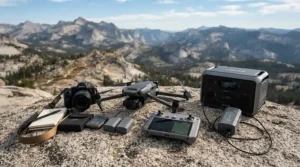
TechRadar reports that it ran three computers and charged cameras, drones and lighting for a day without fuss. It also priced the unit at roughly £499. Solar input reaches 400W through dual DC8020 ports, but those are Jackery’s proprietary 8mm barrel connectors, which narrows your choice of panels. It’s also 2.4GHz Wi-Fi only, which can annoy anyone with a modern mesh network.
The honest summary: 1,500W covers kettles and most campsite appliances, but it trails the Anker SOLIX C1000 Gen 2 on output and solar input. Choose it if you already own Jackery SolarSaga panels or just want a familiar, straightforward unit.
Pros:
- ✅ Praised for running multiple devices smoothly
- ✅ Dual 400W solar inputs
- ✅ 1.7-hour mains recharge
Cons:
- ❌ Proprietary solar connectors limit panel choice
- ❌ 1,500W cap trails some rivals
Price: around £450-£600, fair value for a dependable 1kWh unit.
7. Bluetti Elite 200 V2 — two kilowatt-hours for serious base camps
The standout is raw endurance. Bluetti Elite 200 V2 packs 2,073.6Wh, a 2,600W inverter (3,900W in Power Lifting mode) and a LiFePO4 pack rated for 6,000+ cycles. Dual AC and DC input can reach 2,400W combined. At about 24kg per Bluetti’s spec sheet, you move it by car, barrow or trolley, never by hand over distance.
An Australian 4WD review, based on nearly two months of use, positions it as a “serious” off-grid unit able to run a whole camp including a Starlink dish. It reports that 2,600W comfortably handles a small microwave, air fryer or coffee machine. CGM’s review calls the weight its main drawback. That’s the real trade: you’re buying days of autonomy, so it only makes sense for long stays, group camps or caravan-style setups without hook-up.
For a typical British weekend with a tent, it’s overkill. For a week on a remote pitch with a cooker, fridge and laptops, nothing else here comes close.
Pros:
- ✅ 2kWh+ capacity covers multi-day trips
- ✅ 6,000+ cycle LiFePO4 pack
- ✅ 2,600W output runs cooking appliances
Cons:
- ❌ Around 24kg needs wheels or two people
- ❌ Expensive for short tent trips
Price: roughly £900-£1,400, justified only if you’ll use the capacity.
How to Choose a Portable Power Station for Camping
The best portable power station for camping is the one you’ll actually carry and fully use, not the one with the biggest number on the box. Work through these six steps in order.
- Add up your watt-hours. List devices, multiply watts by hours, and add 20-25% for inverter losses. A phone charge is roughly 12Wh and a laptop charge around 50-60Wh, but check your own chargers.
- Check peak watts. Your biggest single appliance, usually a kettle, sets the minimum inverter size. Heating appliances often draw 1,000W or more.
- Respect the weight. Under about 6kg is carryable by hand, 10-11kg suits a car-to-pitch hop, and anything over 20kg needs wheels.
- Match the solar input. Look at maximum watts, voltage window and connector type, because panels beyond the cap are wasted.
- Prefer LiFePO4. It’s generally considered more thermally stable than other lithium chemistries, and these cells are rated for thousands of cycles.
- Weigh weather and noise. Look for a published IP rating if you camp in the wet, and check fan-noise claims if you pitch close to neighbours.
Rugged Waterproof Power Station for Outdoor Use: What IP65 Really Means
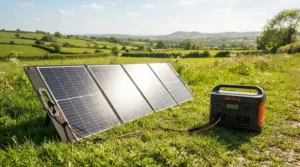
A rugged waterproof power station for outdoor use sounds like a simple category, but the marketing is slippery. The IP code, defined in the international standard IEC 60529, uses two digits. The first covers dust (6 means dust-tight) and the second covers water. In that second digit, 5 means protection against water jets from any direction and 7 means temporary immersion.
So IP65 is a splash-and-spray rating, not a swimming certificate. In this round-up, only the Bluetti AC60P carries a published IP65 rating. The others, including the Anker SOLIX C800 Plus and Jackery Explorer 1000 v2, had no IP rating on the spec listings I found, so treat them as “keep dry” units.
For any rugged waterproof power station for outdoor use, backing up the rating is just good habit. Keep the unit off wet grass on a groundsheet or crate, store it under a cover in showers, and turn ports away from the prevailing rain. Mind temperature too: the Jackery Explorer 500 v2 discharges down to -20°C, while the EcoFlow RIVER 2 is rated for charging only between 0°C and 45°C. A frosty morning is no time to discover your battery won’t accept solar.
Portable Solar Panels for Camping: Matching Panels to Your Power Station
Portable solar panels are what turn a power station from a three-night battery into an open-ended one. But manufacturers’ recharge times assume ideal light, and British skies rarely oblige. Treat their numbers as a best case and expect to double them on a grey day.
Match the panel to the input limits. The EcoFlow RIVER 2 accepts a maximum of 110W, so a second panel adds nothing. The Jackery Explorer 500 v2 takes 200W, the Anker SOLIX C800 Plus 300W, the Jackery Explorer 1000 v2 400W and the Anker SOLIX C1000 Gen 2 a generous 600W. Bluetti quotes roughly 2.5 to 3 hours with its PV200 panel on the Bluetti AC60P.
Weight matters too. The 100W Anker SOLIX PS100 weighs 2.8kg and the 200W Anker SOLIX PS200 weighs 4.8kg, so two panels can outweigh a small station. Check connectors before buying, because Jackery’s DC8020 barrel plugs and Anker’s XT60 aren’t interchangeable without adapters. For portable solar panels, angle them towards the sun, avoid even partial shade (it can cut output sharply), and keep cables clear of puddles. In summer a 100W panel will top up phones and lights daily. In autumn or winter, treat solar as a bonus and arrive with a full battery.
Power Station for Festival Camping: Light, Legal and Sensible
A power station for festival camping has one overriding requirement: you must carry it, often a long way, through crowds and mud. That makes weight the deciding spec, which favours the EcoFlow RIVER 2 at 3.5kg and the Jackery Explorer 500 v2 at 5.7kg.
Check the rules first. Glastonbury’s own packing guidance lists “no generators” among its restrictions. A lithium power station isn’t a petrol generator, but I haven’t seen any festival rule that clearly addresses them. Every event writes its own prohibited list, so email the organisers before you buy or pack, and don’t assume.
Practically, 256Wh goes a long way at a festival. Phones, a head torch, a lantern and a speaker will rarely exceed one charge cycle across a long weekend. Charge to 100% at home, keep the unit out of direct sun and pack it in a dry bag. Don’t leave it unattended in an open tent, and don’t run a heater or kettle from a small unit. The power station for festival camping you pick should be one you’re happy to carry all day.
Power Station for Carp Fishing Trips: Quiet Power for Long Sessions
Carp sessions run 24 to 72 hours, usually from one swim, so a power station for carp fishing trips is judged on silence and staying power rather than weight. Bite alarms normally run on their own batteries. A station covers the rest: head torches, phones, bivvy lighting, camera gear, a USB-charged marker setup and, if you use one, a kettle. A silent battery box is a good-neighbour courtesy on a busy bank.
If you walk in, the Jackery Explorer 500 v2 is the practical choice, offering 512Wh at 5.7kg. If you barrow gear in, the Anker SOLIX C1000 Gen 2 adds kettle capacity and enough energy for a three-night stay. Damp banks and rain make the Bluetti AC60P, with its IP65 rating, a sensible shortlist entry. For any power station for carp fishing trips, keep the unit off wet ground, away from the water’s edge and out of sleeping areas.
Mind the paperwork too. In England and Wales you need a rod licence, and fines of up to £2,500 apply if you can’t show one. Details are on the gov.uk rod fishing licence page, and you’ll also need permission from the fishery owner. Check the venue’s own rules on lights and equipment before you pitch.
Camping and Caravanning Club Sites: What Power Rules Apply?
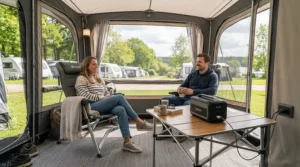
If you use Camping and Caravanning Club sites, the generator rule is the headline. The club says generators may only be used at the discretion of the Holiday Site team, who advise on running times and can ask you to stop. On Temporary Holiday Sites and at meets or rallies, where electric hook-up is often unavailable, the steward team sets permitted times. Two-stroke, diesel and open-frame generators may not be permitted at all because of noise and fumes.
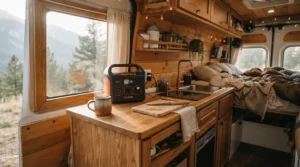
That’s exactly where a silent battery wins. A power station for camping makes no engine noise, so it can’t cause the complaint that generators attract. But I haven’t found a Camping and Caravanning Club rule that specifically covers lithium power stations, so ask the warden or site team before you pitch. On hook-up pitches, you can recharge a station between trips from the pitch supply, though the Camping and Caravanning Club’s site rules on appliance use still apply.
For off-grid Camping and Caravanning Club meets, I’d favour a mid-size unit with solar input, such as the Anker SOLIX C800 Plus or Anker SOLIX C1000 Gen 2. They can sustain a fridge, lights and devices without a hook-up and without upsetting your neighbours.
Portable Power Station for Camping vs Petrol Generator
| Factor | Portable power station | Petrol generator | Best for |
|---|---|---|---|
| Noise | Near silent; fan only | Constant engine noise | Jackery Explorer 500 v2 on quiet pitches |
| Fumes | None | Exhaust, never use near tents | Bluetti AC60P for sheltered setups |
| Running cost | Free from solar, pennies from mains | Fuel and oil | Anker SOLIX C1000 Gen 2 with panels |
| Site rules | Usually unrestricted, but ask | Often limited or banned | Anker SOLIX C800 Plus on club sites |
| Maximum output | Up to 2,600W | Higher at the top end | Bluetti Elite 200 V2 for cooking |
The table makes the trade-off clear. A generator wins on sustained high output and endless runtime if you can refuel, but it loses on noise, fumes and site acceptance. For most British campers who need lights, phones, a fridge and a laptop, a power station is simply more pleasant and more welcome. Generators only really make sense for heavy sustained loads on a private site with nobody within earshot.
Long-Term Cost and Maintenance
Cycle ratings help frame value. Divide the price by the rated cycles and a unit costing roughly £450 with 4,000 cycles works out near 11p per full charge, before electricity. At around £200 and 3,000 cycles, the EcoFlow RIVER 2 is nearer 7p. In practice you’ll never reach those cycle counts on weekend trips, so years of calendar life and warranty matter more.
Maintenance is gentle. Store units at roughly 20-30°C (EcoFlow’s spec lists this as best), avoid leaving them fully drained, and top up every few months, as the manual will advise. Keep firmware updated through the app, and don’t charge below the stated limit. The EcoFlow RIVER 2, for example, only charges between 0°C and 45°C. Check the warranty period on your specific model and retailer, because terms vary.
Practical Usage Guide: Setting Up Your Camping Power Station
A little preparation prevents most camping power headaches.
- Charge to 100% at home the night before, and update firmware via the app.
- Test everything in the garden. Plug in your fridge, lantern and laptop charger, and confirm your solar cable fits.
- Pack a dry bag or cover, plus a short extension cable so the unit can live outside the sleeping area.
- Place it in the shade, raised off the ground, with ventilation around the vents.
- Use DC and USB where possible. Most inverters waste some energy when AC is on, so switch AC off when you only need USB.
- Angle portable solar panels at the sun and re-aim them every couple of hours.
In your first 30 days, the most common mistakes are plugging in a kettle that exceeds the inverter rating, leaving the AC output on overnight with nothing connected, and forgetting to check weather and temperature limits. Build a simple habit: check the percentage each morning and evening, and recharge before the unit drops below roughly 20%.
Real-World Scenarios: Matching a Portable Power Station for Camping to Your Trip
The weekend couple. Two nights, a tent, phones, lanterns and a small fan, on a budget of around £300. A Jackery Explorer 500 v2 with a 100W panel covers it, and 5.7kg is easy to carry from the car park.
The family of four. Four nights on a pitch with no hook-up, a fridge, kettle bursts and laptops, with a budget up to about £700 and a car to carry it. The Anker SOLIX C1000 Gen 2 with a 200W panel fits well, since the 600W solar input leaves room to upgrade panels later.
The solo carp angler. Three nights, damp bank, headlamps and phone, with a budget around £400. The Bluetti AC60P brings weather protection, and you can expand it later.
The festival-goer. Three days, phone, lantern and speaker, a long walk and a budget under £250. The EcoFlow RIVER 2 is the one you’ll still be happy to carry on day three.
Problem and Solution Guide: Common Camping Power Headaches
Battery drains faster than expected. Check usable capacity (expect about 75-85% of the headline figure under heavy loads) and turn off AC when idle.
Solar charging is painfully slow. Re-angle the panels, remove shade, and arrive pre-charged. Treat cloudy-day output as a fraction of the rated watts.
Kettle or heater overloads the inverter. Match appliance wattage to output. Bluetti’s Power Lifting mode on the Bluetti AC60P helps with resistive heating, but gas stoves are safer for big loads.
Rain and dew. Use a cover, raise the unit, and rely on an IP-rated unit such as the Bluetti AC60P if you camp wet.
Cold mornings. Check charging limits before frosty trips, as the EcoFlow RIVER 2 won’t accept charge below 0°C, and keep the unit insulated in your car overnight.
FAQ
❓ Can I use a portable power station in the rain?
❓ Are power stations allowed on Camping and Caravanning Club sites?
❓ Can I take a power station to a festival?
❓ What size power station do I need for a carp fishing session?
❓ Do I need portable solar panels with a camping power station?
Conclusion
Here’s the short version. If weight is everything, buy the EcoFlow RIVER 2. For tent weekends, the Jackery Explorer 500 v2 hits a sweet spot. If you camp wet or fish from damp banks, the Bluetti AC60P is the only unit here with a published IP65 rating. For kettle-capable campsite comfort, choose the Anker SOLIX C800 Plus. If you’ll lean on portable solar panels, the Anker SOLIX C1000 Gen 2 accepts the most solar input. The Jackery Explorer 1000 v2 is a dependable alternative, and the Bluetti Elite 200 V2 is for week-long base camps.
The best portable power station for camping is rarely the biggest one. It’s the one that matches your carry distance, your appliances and your weather. Write down your watt-hours before you shop, check site and festival rules, and treat solar figures as best case.
✨ Don’t Miss These Exclusive Deals!
🔍 Take your camping trips to the next level with these carefully selected power stations. Click on any highlighted product name to check current pricing and availability. These units will help you enjoy lights, warm drinks and charged phones wherever you pitch!
Recommended for You
- Lightweight Power Station For Camping: 7 Best Picks (2026)
- Portable Power Station Vs Petrol Generator: 7 Proven Picks (2026)
- EcoFlow Vs Jackery For Home Backup: 7 Best Picks
Disclaimer: This article contains affiliate links. As an Amazon Associate, I earn from qualifying purchases. If you purchase products through these links, we may earn a small commission at no additional cost to you.
✨ Found this helpful? Share it with your friends! 💬🤗
