In This Article
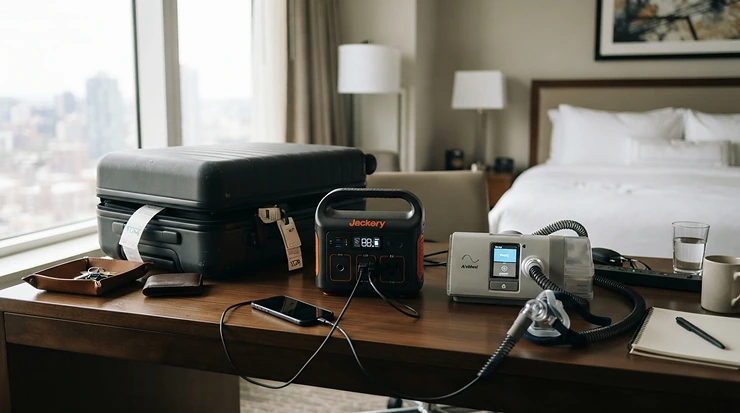
A portable power station for CPAP machine use is a rechargeable battery box with a standard mains-style socket. It keeps your sleep therapy running through a power cut, a campsite or any night away from reliable electricity. The best ones combine a pure sine wave inverter with fast UPS-style switchover. They’re sized in watt-hours (Wh), the figure that decides how many nights you actually get.
Your CPAP is a mains device, and the grid doesn’t care that it’s 3am. NICE recommends CPAP for adults with moderate or severe symptomatic obstructive sleep apnoea, so plenty of people now depend on a small pump that stops the instant the lights go out. A storm outage, a tripped fuse or a weekend in the Peaks can each turn a decent night into a ragged one.
This guide compares seven real options available to UK buyers, from a bedside-sized unit under 4kg to 1kWh-class workhorses. I’ve leaned on published specifications, independent testing where it exists, and plain arithmetic about heated humidifier power draw rather than marketing promises. You’ll also get ResMed-specific numbers, a runtime table, setup steps and the traps worth dodging.
One honest caveat: I haven’t hands-on tested any of these units, and nothing here replaces advice from your sleep clinic. Check current prices and UK-plug variants before you buy.
Best Portable Power Station for CPAP Machine: Quick Comparison
Here’s the whole field at a glance. Capacities are manufacturer-rated, and “UPS” means the unit can switch from mains to battery automatically if the supply drops.
| Product | Capacity | AC Output | UPS Switchover | Best For |
|---|---|---|---|---|
| Jackery Explorer 300 Plus | 288Wh | 300W | None listed | Lightweight, dry-therapy camping |
| EcoFlow RIVER 3 Plus | 286Wh | 600W | Under 10 ms | Compact bedside UPS |
| OUPES Exodus 600 Plus | 512Wh | 600W | Under 20 ms (UPS/EPS) | Budget capacity boost |
| BLUETTI AC70 | 768Wh | 1,000W | 20 ms | Mid-range, one to two nights |
| Anker SOLIX C1000 Gen 2 | 1,024Wh | 2,000W | Under 10 ms | Multi-night with humidifier |
| EcoFlow DELTA 3 | 1,024Wh | 1,800W | Under 10 ms | Fast recharge and expandability |
| Jackery Explorer 1000 v2 | 1,070Wh | 1,500W | 20 ms or under | Maximum runtime |
Read across the table and a pattern jumps out. Capacity, not wattage, separates these units for CPAP duty, because every one of them has far more output than a 60W machine needs. Only the sub-10 ms units promise the quickest switchover, so if you want a seamless mains-failure safety net, EcoFlow RIVER 3 Plus, Anker SOLIX C1000 Gen 2 and EcoFlow DELTA 3 are the cleanest fits. The Jackery Explorer 300 Plus is the outlier, with no UPS claim at all.
💬 Just one click — help others make better buying decisions too!😊
Top 7 Portable Power Station for CPAP Machine Picks: Expert Analysis
Every unit below uses LiFePO4 chemistry, which is generally regarded as the more stable lithium option for devices kept in a bedroom. Specs come from manufacturer and retailer listings, and prices are ranges only, so check current price before buying.
1. Jackery Explorer 300 Plus — lightest, cheapest way in
At roughly 3.75kg, the Jackery Explorer 300 Plus is the one you could carry to a tent without grumbling.
It pairs a 288Wh LiFePO4 battery with a 300W pure sine wave inverter (600W surge) and a single AC socket. A dry-therapy CPAP sips a fraction of that 300W, so headroom isn’t the issue. Cycle-life claims vary by listing, from 1,500 to over 4,000 cycles, so I’d treat the lower figure as the cautious one.
Here’s what the spec sheet won’t tell you: none of the UK listings I reviewed claim UPS switchover. That makes it a “plug in at bedtime” tool rather than a seamless safety net. With a heated humidifier at the worst-case figure, roughly 245Wh of usable energy lasts about four and a half hours, which is not a full night. Dry therapy gets you a comfortable single night with margin.
Editorial coverage praises its balance of size and usability, but I couldn’t find a reliable aggregated set of CPAP-specific customer reviews, so this verdict is spec-led.
Pros:
- ✅ Lightest unit here at about 3.75kg
- ✅ Pure sine wave output suits CPAP electronics
- ✅ App monitoring and solar-ready design
Cons:
- ❌ No UPS switchover listed
- ❌ Under half a night with humidifier on
Expect roughly £150-£250 at the time of research. It’s good value as a camping-first unit, but weak as a mains-failure safety net.
2. EcoFlow RIVER 3 Plus — tiny bedside UPS under 10 ms
The EcoFlow RIVER 3 Plus is the smallest unit here that treats automatic switchover as a headline feature.
It offers 286Wh, 600W output (1,200W with X-Boost) and a sub-10 ms transfer. There’s also a USB-B UPS communication port, and the UK model code is EFRIVER3PLUS-UK-CBOX. EcoFlow says it recharges fully in about an hour, which matters after an outage. The battery is rated for 3,000+ cycles, and extra batteries can expand it. Note that X-Boost mode isn’t UPS-protected, so keep your CPAP on the standard outlets.
My read: this suits people who run low humidity settings or dry therapy and want seamless backup in a unit small enough for a bedside shelf. About 243Wh usable gives roughly 1.2 dry nights, but only around four hours at the humidified worst case. If you use full humidification, plan on an expansion battery or choose a bigger unit.
On review evidence, StorageReview’s independent testing confirmed the sub-10 ms claim held up. That’s lab-style verification rather than customer sentiment, and I couldn’t verify a large UK customer-review pool.
Pros:
- ✅ Sub-10 ms UPS switchover
- ✅ Roughly one-hour mains recharge
- ✅ Expandable with extra batteries
Cons:
- ❌ Only four-ish hours with humidifier at worst case
- ❌ Capacity is modest for the money
Roughly £200-£300. It’s strong value if seamless switchover matters more than raw runtime.
3. OUPES Exodus 600 Plus — most capacity at entry-level money
The OUPES Exodus 600 Plus quietly punches above its price on capacity.
It packs 512Wh of LiFePO4, a 600W pure sine wave inverter (1,200W surge) and a UPS/EPS rating of under 20 ms. The brand quotes 3,500+ cycles to 80%, supports pass-through charging, and weighs around 5.6kg. That 512Wh is a meaningful threshold: roughly 435Wh usable against a worst-case humidified night of about 448Wh. You’d get nearly a full night even in the pessimistic case, and over two dry nights.
The catch is availability and polish. The spec figures come from OUPES’s own site, so confirm the UK listing and plug type before ordering. There’s also no app control, and AC recharging tops out at 300W, so refills are slower than the EcoFlow or Anker models.
For sentiment, the smaller Exodus 600 sits around the low-4s out of five on a US retailer, which is a different model and market, so indicative at best. The brand’s site also hosts a testimonial from someone powering a spouse’s CPAP, but that’s curated, so weigh it accordingly.
Pros:
- ✅ 512Wh in a bedside-friendly body
- ✅ Pure sine wave with pass-through charging
- ✅ 3,500+ rated cycles
Cons:
- ❌ No app control or monitoring
- ❌ Slow 300W AC recharging
Roughly £200-£300, subject to UK availability. It’s the budget route to a near-full humidified night.
4. BLUETTI AC70 — sweet-spot capacity for two dry nights
If you want two quiet nights rather than one margin-free one, the BLUETTI AC70 is where I’d start.
It has a 768Wh LiFePO4 battery and a 1,000W pure sine wave inverter. A Power Lifting mode lets it handle resistive loads up to 2,000W, though your CPAP will never need that. The UPS switchover is listed at 20 ms, and a UK-plug version exists. BLUETTI quotes 3,000+ cycles to 80% and claims 0-80% charging in roughly 45 minutes. Around 653Wh usable covers about three dry nights, or roughly a night and a half with the humidifier at worst case.
Twenty milliseconds is the slower tier here. Whether your specific machine rides through that blip isn’t something spec sheets can promise, so test it on a normal night before relying on it.
One store reviewer noted that in UPS use the unit sits at 100% charge, and wished for a cap near 70% to protect long-term battery health. That’s a sensible observation for anyone leaving it plugged in permanently. I couldn’t verify a broader customer aggregate.
Pros:
- ✅ Covers more than one humidified night
- ✅ UK-plug version with app control
- ✅ Expandable with BLUETTI batteries
Cons:
- ❌ UPS at 20 ms rather than under 10
- ❌ Bulkier than the compact units
Roughly £350-£450. It’s good mid-range value for people who want a buffer.
5. Anker SOLIX C1000 Gen 2 — names CPAP on its spec sheet
The Anker SOLIX C1000 Gen 2 is the only unit here whose own product pages name CPAP machines as a target load.
It has 1,024Wh of LiFePO4, 2,000W continuous output (3,000W surge) and a sub-10 ms UPS. It weighs 11.3kg and measures about 38 × 21 × 24cm. Anker quotes 4,000 cycles to 80%, a ten-year lifespan claim, and a 49-minute UltraFast recharge at 1,600W that you switch on via the app. Around 870Wh usable covers roughly 4.4 dry nights, or nearly two humidified nights at worst case.
Don’t buy the 2,000W for the CPAP; you’re paying for capacity and fast charging. It can also be expanded with a BP1000 Gen 2 battery to 2,048Wh, which suits households that want blackout cover for more than sleep therapy.
I couldn’t verify a trustworthy aggregate of UK customer reviews, so treat this verdict as spec-led.
Pros:
- ✅ Sub-10 ms UPS switchover
- ✅ 49-minute app-enabled fast recharge
- ✅ Nearly two humidified nights
Cons:
- ❌ 11.3kg is a deliberate carry, not a casual one
- ❌ Overkill 2,000W inverter for a 60W load
Roughly £450-£650. It’s the safest all-rounder if budget allows.
6. EcoFlow DELTA 3 — expandable, fast-charging, quiet
The EcoFlow DELTA 3 suits people who see CPAP backup as one job among several.
It offers 1,024Wh of LiFePO4, 1,800W output (3,600W surge), a sub-10 ms UPS and a 4,000+ cycle rating. UK retail listings quote about 12.5kg, a full mains recharge in under an hour, and quiet operation around 30 dB. It can expand to 5kWh with EcoFlow batteries. That headroom matters if you later want to run a fridge-freezer through an outage.
There’s a practical tip from EcoFlow’s guidance for the related DELTA 3 Classic: low, steady loads like CPAP can trip auto-shutoff timers, so set the AC timeout to “Never” in the app. Forget that and your therapy could stop at 4am because the unit decided nothing was plugged in.
German review aggregation for the sibling DELTA 3 Classic highlights fast charging and quiet running. I couldn’t verify enough UK reviews for this exact model.
Pros:
- ✅ Sub-10 ms UPS switchover
- ✅ Quiet operation claimed around 30 dB
- ✅ Expandable well beyond 1kWh
Cons:
- ❌ Heaviest 1kWh unit in this list
- ❌ App setting needed to avoid low-load shutoff
Roughly £450-£600. It’s strong value if you want growth room.
7. Jackery Explorer 1000 v2 — biggest battery here
The Jackery Explorer 1000 v2 has the largest capacity in this list, and Jackery bills it as the smallest and lightest 1kWh LiFePO4 station in its range.
It stores 1,070Wh and delivers 1,500W (3,000W surge) through two pure sine wave AC ports. The UPS switchover is 20 ms or under, with IEC 62040 certification claimed in listings. It weighs about 10.8kg, quotes 4,000 cycles with over 70% retained, and includes a UK 3-pin charging cable. An app-activated emergency mode refills it in under an hour. Around 910Wh usable gives roughly 4.5 dry nights or two humidified ones.
This is the one for people who dislike thinking about runtime. Its UPS is a notch slower than the sub-10 ms models, but for most machines I’d expect that to be fine. Test it anyway.
Roundups place it among the top capacity picks, but listicles aren’t customer reviews, and I couldn’t verify a reliable ratings aggregate.
Pros:
- ✅ Largest capacity in this list
- ✅ Lighter than most 1kWh rivals
- ✅ One-hour emergency recharge via app
Cons:
- ❌ UPS at 20 ms, not under 10
- ❌ Street price swings widely
Roughly £500-£800. It’s best value when you catch it towards the lower end.
| Product | Rated Cycles | Recharge Speed (Claimed) | Price Range | Best For |
|---|---|---|---|---|
| Jackery Explorer 300 Plus | 1,500-4,000+ (listings vary) | About 2 hours | £150-£250 | Camping, dry therapy |
| EcoFlow RIVER 3 Plus | 3,000+ | About 1 hour | £200-£300 | Bedside UPS |
| OUPES Exodus 600 Plus | 3,500+ | 300W AC input | £200-£300 | Budget capacity |
| BLUETTI AC70 | 3,000+ | 0-80% in about 45 min | £350-£450 | Two-night buffer |
| Anker SOLIX C1000 Gen 2 | 4,000 | 49 min via app | £450-£650 | Multi-night security |
| EcoFlow DELTA 3 | 4,000+ | Under an hour | £450-£600 | Expandable backup |
| Jackery Explorer 1000 v2 | 4,000 | Under an hour (app mode) | £500-£800 | Maximum runtime |
Cycle ratings are all long enough that wear-out won’t be your problem, since occasional backup use burns through cycles slowly. The real separators are recharge speed after an outage and UPS tier. If you can only spend around £300, the EcoFlow RIVER 3 Plus buys switchover and the OUPES Exodus 600 Plus buys runtime, so decide which failure you fear more.
How to Set Up a Portable Power Station for CPAP Machine Backup
Treat this as part of your therapy routine, not a gadget in a cupboard.
- Measure your real draw. A plug-in energy monitor between the wall and your CPAP shows your actual watts at your pressure and humidifier settings. Do this once your clinic has settled your pressure. Royal Papworth Hospital explains that auto-titrating units work out your levels over one to two weeks, and draw can shift afterwards.
- Use the original power supply. Plug your CPAP’s own power brick into the station’s AC socket. Retailers warn that non-genuine ResMed supplies can risk damage and void warranties.
- Keep it on the mains. Leave the station plugged in so it works as a pass-through or UPS.
- Run a blackout test. Switch off the wall socket on a normal night and confirm therapy continues.
- Place it sensibly. Stand it on a stable, dry surface with airflow, away from damp, condensation and your humidifier chamber.
- Check the AC auto-off setting. Low loads can trigger shutoffs on some units.
- Recharge after any outage. A half-empty backup is a false comfort.
The classic first-30-days mistake is trusting the setup without ever testing it.
✨ Ready to Sleep Easier During the Next Power Cut?
🔍 Take your night-time backup plan to the next level with these researched options. Click any highlighted product name to check current pricing and availability, and match capacity to your humidifier habits.
Real-World Scenarios: Matching a Portable Power Station for CPAP Machine to Your Life
Specs only mean something against a real routine. These profiles are illustrative rather than real customers.
The rural household with winter outages
Imagine a retired couple in a rural village with a heated humidifier running every night and outages that can last a day. They need around two humidified nights without recharging, plus fast refills. The Anker SOLIX C1000 Gen 2 or EcoFlow DELTA 3 fit, with sub-10 ms switchover and nearly two humidified nights of buffer. The Jackery Explorer 1000 v2 is the alternative if capacity beats switchover speed.
The weekend camper on a budget
A camper using dry therapy for two nights doesn’t need UPS at all. The OUPES Exodus 600 Plus gives around 2.2 dry nights, while the Jackery Explorer 300 Plus covers one night comfortably but not two. Solar helps in summer, but UK output varies with season, cloud and shade, so don’t rely on it in October.
The flat-dweller wanting seamless backup under £300
If you live in a flat where outages are rare but you want automatic cover, compactness and switchover speed matter more than days of runtime. The EcoFlow RIVER 3 Plus is the match, ideally with dry or low-humidity therapy. If you use full humidification, the BLUETTI AC70 is the sturdier answer.
Common Problems and How to Fix Them
The station switches off at low load. Some units shut AC output when they sense a tiny draw. Set the AC timeout to never in the app, as EcoFlow advises for CPAP-type loads.
Your CPAP resets during switchover. Try a unit with sub-10 ms transfer such as the EcoFlow RIVER 3 Plus or Anker SOLIX C1000 Gen 2. If it still resets, ask your provider whether the machine tolerates interruptions.
The humidifier drains the battery. Dial back humidity or switch off the heated tube during outages. Shrewsbury and Telford Hospital NHS Trust works with ResMed to set patients up, so your clinic can advise on safe settings.
The plug doesn’t fit or the unit is cold. Buy the UK-plug variant, since some listings are EU Schuko. LiFePO4 units generally charge only above 0°C, so don’t leave a unit charging in a freezing garage.
How to Choose a Portable Power Station for CPAP Machine
Follow these steps in order:
- Measure your draw in watts. Everything else follows from that number.
- Convert to watt-hours per night. Multiply watts by hours slept, then divide by 0.85 to allow for inverter losses.
- Pick your outage length. One night, two nights or “until the engineer arrives” decides the capacity tier.
- Insist on pure sine wave output. It matches what your machine’s electronics were designed for.
- Decide whether you need UPS. If a 3am blackout must not wake you, choose sub-10 ms or at least 20 ms and test it.
- Check UK practicalities. Look for UK plugs, UKCA/CE conformity and a sensible warranty.
Buyers often chase high wattage and ignore watt-hours, which is the wrong way round for a low, steady load like this.
Pure Sine Wave Power Station for CPAP: Why Waveform Matters
A pure sine wave power station for CPAP use delivers smooth, mains-like electricity. Cheaper inverters use a modified waveform, which Anker warns can make some medical devices run hot, hum or behave unpredictably. That’s a poor gamble overnight.
All seven units here list pure sine wave output, but check it on the exact variant you buy, because marketing pages sometimes blur the details.
Safety and Regulations
Look for conformity marking. Listings reference CE certification and, for OUPES, UN38.3 transport testing, and UK buyers should expect UKCA or CE documentation on the product page. LiFePO4 chemistry is considered more thermally stable than many other lithium types, but keep any station ventilated. And speak to your clinician or provider first, because CPAP is a medical therapy and a third-party power source is your responsibility.
Heated Humidifier Power Draw: What a ResMed CPAP Really Uses
The heated humidifier is the biggest swing factor. Published power-supply specifications for the ResMed AirSense 11 list a typical consumption of about 56W and a peak of about 73W, from a 65W adapter, down from the 90W adapter on the AirSense 10. One analysis suggests dry operation around 20-30W at 10 cmH2O, while forum users report single-digit figures with the humidifier and heated tube off. Treat the wide range as a reason to measure.
Retailer pages even disagree on whether the 65W supply suits heated features, so verify against your manual. For a power station for CPAP with heated humidifier use, I’d plan with the 56W worst-case, then enjoy the surplus. Humidification and heated tubing both add draw, and switching them off during an outage can stretch runtime dramatically.
CPAP Power Station for Overnight Use: Runtime Maths
For a CPAP power station for overnight use, assume an 8-hour night, 85% usable capacity, 25W dry and 56W humidified worst case. That needs about 200Wh or 448Wh respectively.
| Product | Usable Energy (about 85%) | Dry Nights (about 25W) | Humidified Nights (about 56W) | Best For |
|---|---|---|---|---|
| Jackery Explorer 300 Plus | 245Wh | 1.2 | 0.5 (about 4.4h) | One dry night |
| EcoFlow RIVER 3 Plus | 243Wh | 1.2 | 0.5 (about 4.3h) | Dry or low humidity |
| OUPES Exodus 600 Plus | 435Wh | 2.2 | 1.0 (about 7.8h) | Budget full night |
| BLUETTI AC70 | 653Wh | 3.3 | 1.5 (about 11.7h) | Two-night cover |
| Anker SOLIX C1000 Gen 2 | 870Wh | 4.4 | 1.9 (about 15.5h) | Multi-night security |
| EcoFlow DELTA 3 | 870Wh | 4.4 | 1.9 (about 15.5h) | Expandable backup |
| Jackery Explorer 1000 v2 | 910Wh | 4.5 | 2.0 (about 16.2h) | Longest outages |
These are my own calculations, not manufacturer claims. Small units clear a dry night but not a humidified one, and the real-world gap is usually kinder than the worst case. The 512Wh class is the first to approach a full humidified night. If you need more than one, jump straight to the 768Wh-and-up tier.
Obstructive Sleep Apnoea and Power Cuts: Why Backup Planning Matters
Obstructive sleep apnoea means the airway repeatedly narrows or closes during sleep, breaking up breathing and rest. CPAP counters that with pressurised air through a mask, and it works only while it runs.
NHS-linked documentation notes that untreated sleep apnoea is associated with high blood pressure and is a risk factor for heart attack and stroke. A single night without therapy isn’t a catastrophe for most people, but it can leave you groggy and is worth planning around. Your sleep team can tell you what’s reasonable for your situation, including what to do during an extended outage.
Portable Power Station vs Dedicated CPAP Battery and Alternatives
A dedicated CPAP battery isn’t automatically worse. Anker notes that these packs are often smaller, while a power station earns its keep when several devices share one battery.
| Option | Strengths | Weaknesses | Best For |
|---|---|---|---|
| Portable power station | Multi-purpose, UPS options, big capacity | Heavier, pricier | Home backup and camping |
| Dedicated CPAP battery (e.g. EASYLONGER ES960 PRO, a 297.6Wh LiFePO4 pack) | Compact, CPAP-specific DC cables | Fewer other uses | Travel and tents |
| Petrol generator | Long runtime | Noise and exhaust fumes | Not recommended indoors |
For most households a power station wins on flexibility, while frequent travellers may prefer a purpose-built pack. Generators are a poor bedroom companion.
Can You Fly With One?
The UK CAA’s rules, as summarised by Expert Reviews, allow up to 100Wh without approval, 100-160Wh with airline approval, and nothing above 160Wh in ordinary passenger baggage. Every station in this guide exceeds 160Wh, so none can fly with you. For air travel you’d need a smaller pack, cleared with your airline and clinician.
Frequently Asked Questions
❓ How much does a portable power station for CPAP machine use cost in the UK?
❓ Will a portable power station work with ResMed AirSense 10 and AirSense 11 machines?
❓ How long will a 500Wh power station run a CPAP machine?
❓ Can I charge a power station while it powers my CPAP?
❓ Can I use a power station for CPAP camping in the UK?
Conclusion: Which Portable Power Station for CPAP Machine Should You Buy?
The right portable power station for CPAP machine backup comes down to three honest questions. How many hours of humidified therapy do you need? How seamless must the switchover be? And how heavy a box are you willing to lift?
If you want clean switchover on a modest budget, the EcoFlow RIVER 3 Plus is the neat bedside answer. If runtime per pound is your priority, the OUPES Exodus 600 Plus stretches furthest. The BLUETTI AC70 is the sensible middle, and the Anker SOLIX C1000 Gen 2 and EcoFlow DELTA 3 are the confident choices for longer outages. The Jackery Explorer 1000 v2 gives you the biggest battery here, and the Jackery Explorer 300 Plus is for campers who value weight above automatic switchover.
Whichever you pick, measure your draw, buy the UK-plug version, set the auto-off timer sensibly, and test the blackout switchover on an ordinary night. Then tell your clinic what you’ve done. A power cut should be an irritation, not an interruption to your therapy.
Recommended for You
- CPAP Power Station Vs CPAP Battery Pack: 7 Top Picks (2026)
- Power Station For Campervan: 7 Best Proven Picks For UK (2026)
- Portable Power Station For Camping: 7 Best Picks For UK (2026)
Disclaimer: This article contains affiliate links. As an Amazon Associate, I earn from qualifying purchases. If you purchase products through these links, we may earn a small commission at no additional cost to you.
✨ Found this helpful? Share it with your friends! 💬🤗
