
In This Article
A power station for whole house off-grid living is a large, battery-based unit that stores electricity from solar panels, a generator or the mains and delivers it as household 230V power. The catch, and it is a big one, is that most models power the circuits you choose rather than every socket at once. Get that distinction wrong and you’ll spend a lot of money to discover your electric shower has opinions.

Here’s the reality check. Ofgem’s latest benchmark puts a medium UK household at roughly 2,500 kWh of electricity a year, as the House of Commons Library explains, which works out at about 6.8 kWh a day. That number is smaller than most people fear, and it’s the reason a well-chosen power station for off-grid living is genuinely viable for a lean household, a cabin or a workshop-plus-caravan setup. It’s also why guessing is the expensive way to shop.
This guide does the sums for you. You’ll find seven real units from Amazon UK’s catalogue, honest analysis of what each one can and can’t do, and step-by-step help with daily energy consumption planning, solar array sizing and battery depth of discharge. Every spec below is interpreted, not just listed, and where I couldn’t verify something, I say so.
Quick Comparison: The Best Power Station for Whole House Off-Grid Use at a Glance
| Product | Capacity | Continuous AC output | Best For |
|---|---|---|---|
| EcoFlow DELTA Pro 3 | 4,096Wh (expandable to 12kWh) | 4,000W | Biggest single-unit output and fast charging |
| Anker SOLIX F3800 | 3,840Wh (expandable to 26.9kWh) | 6,000W | Heavy loads and long-term expansion |
| BLUETTI Apex 300 | 2,764.8Wh (modular) | 3,840W | Best value modular starter |
| Anker SOLIX F3000 | 3,072Wh (expandable to 12kWh) | 3,600W | Quiet, low-idle essential circuits |
| AFERIY P310 | 3,840Wh (expandable to 11,520Wh) | 3,600W | Most capacity per pound |
| EcoFlow DELTA 3 Max | 2,048Wh | 2,400W | Budget entry for a small cabin |
| Jackery Explorer 2000 Plus | 2,042.8Wh (expandable to 12kWh) | 3,000W | Simple, expandable mid-range |
Look at the pattern in that table. Only the Anker SOLIX F3800 breaks the 4kW barrier on continuous output, but the AFERIY P310 and BLUETTI Apex 300 undercut both flagships on cost per kilowatt-hour of storage. If your budget is tight, the EcoFlow DELTA 3 Max is the sensible way in, though you’ll outgrow it faster than the rest.
💬 Just one click — help others make better buying decisions too!😊
Top 7 Power Station for Whole House Off-Grid Options: Expert Analysis
Prices below are ranges from my research window and move constantly, so always check the live listing.
1. EcoFlow DELTA Pro 3 — highest single-unit output and fastest charging
The EcoFlow DELTA Pro 3 is the one to look at first if you want a genuine power station for whole house off-grid use without stacking multiple boxes. It pairs a 4,096Wh LFP battery with 4,000W of continuous output and takes up to 2,600W of solar input.
What does that mean in practice? Four kilowatts covers a fridge-freezer, induction hob ring, router and lighting simultaneously, with headroom left for a washing machine. Add the optional extra batteries and capacity climbs to 12kWh, enough for a couple of cloudy UK days. EcoFlow quotes 4,000 cycles to 80% capacity, roughly eleven years of daily use.
On paper this is the most complete unit here. Based on the spec comparison, it suits anyone who values fast recharging from a generator or the grid over sheer capacity per pound. Independent reviewers such as TechRadar describe the charging speed and smart-home integration as standout strengths, while others note the unit is heavy and the price is far from impulse-buy territory.
Pros:
- ✅ 4,000W output runs several heavy loads together
- ✅ Very fast AC charging for a 4kWh unit
- ✅ Expandable to 12kWh with two extra batteries
Cons:
- ❌ Heavy enough to need two people to move
- ❌ Premium price for the capacity
Price range: broadly the high-£2,000s at list price. Verdict: worth it if output and charging speed matter more than pounds per kilowatt-hour.

2. Anker SOLIX F3800 — 6,000W output and serious expandability
The Anker SOLIX F3800 is the brute of the group. Its 3,840Wh battery feeds a 6,000W AC output, and Anker’s UK page confirms 230V operation, so this isn’t a US import you’ll need adapters for.
Six kilowatts is what separates it from the rest. It can run an electric oven and a kettle at once, provided your wiring allows it. Solar input tops out at 2,400W, and AC recharging peaks at around 2,990W per Anker’s UK user guide, which is respectable rather than class-leading. Expansion batteries take the system up to 26.9kWh, the largest ceiling in this guide.
Here’s what the spec sheet won’t tell you, but reviewers note: it weighs about 60kg, so plan a permanent home for it on wheels rather than treating it as portable. Anker also states the unit isn’t waterproof, so keep it dry indoors. Reviewers consistently praise the output and modular growth, while the main reservations are weight and cost.
Pros:
- ✅ 6,000W output handles almost any single household appliance
- ✅ Scales to 26.9kWh with expansion batteries
- ✅ Five-year warranty and LFP battery rated 3,000+ cycles
Cons:
- ❌ About 60kg makes repositioning a chore
- ❌ AC recharge is slower than the EcoFlow rival
Price range: from the high-£1,000s to the mid-£2,000s for the unit alone, with bundles costing more. Verdict: superb if you truly need high output, expensive if you don’t.
3. BLUETTI Apex 300 — best value modular starter with native UK sockets
The BLUETTI Apex 300 is the pragmatist’s pick. A 2,764.8Wh LiFePO4 battery, 3,840W continuous output and four native UK three-pin sockets mean you can plug in a kettle without hunting for adapters.
The key trick is modularity. Add B300K battery modules and one unit grows to roughly 19kWh, with Bluetti quoting far higher figures for multi-unit systems. Its dual solar input accepts 2,400W, and one UK review reports a flat-to-full mains charge in around 70 minutes. A very low idle draw of about 20W matters more than it sounds: that’s a router and a couple of LEDs running overnight without drinking the battery.
Honest analysis suggests this suits a household building capacity in stages. The trade-offs come from UK reviewers: it weighs roughly 38kg, the fan is audible under fast charging, and DC outputs need the optional Hub D1 accessory, which adds cost. Sentiment across reviews is positive, with build and value repeatedly highlighted.
Pros:
- ✅ Four UK sockets, no adapters needed
- ✅ Very low idle drain suits always-on loads
- ✅ Modular growth with B300K batteries
Cons:
- ❌ DC ports need a separate hub
- ❌ Fan noise while charging fast
Price range: roughly £1,300-£1,900 depending on retailer and promotions. Verdict: probably the best all-round value here.
4. Anker SOLIX F3000 — quiet, low-idle essential circuits
The Anker SOLIX F3000 is the calm one. Its 3,072Wh battery delivers 3,600W at 230V, and Anker rates it at 35dB under 1,800W load, roughly library territory.
Practical meaning: it’s the unit you can park in a bedroom cupboard or utility room without noticing the fan. Standby is up to five days per Anker, thanks to ultra-low idle consumption, which suits fridge-and-router duty. Solar input reaches 2,400W across two ports, and expansion takes the system from 3kWh to 12kWh. One catch worth knowing: it charges only between 0°C and 40°C, so outbuildings in a UK winter need warmth for recharging.
My read: this is a sensible choice for essential circuits rather than a full-blown home. On buyer feedback, the US Amazon listing showed roughly 4.7 stars from a few dozen ratings when a late-2025 deal post captured it. That’s a small, non-UK sample, so treat it as directional only.
Pros:
- ✅ Whisper-quiet at everyday loads
- ✅ Long standby thanks to ultra-low idle draw
- ✅ Expandable from 3kWh to 12kWh
Cons:
- ❌ Charging locked out below 0°C
- ❌ Less output headroom than the F3800
Price range: around £2,000 at one UK retailer during research, with Amazon pricing varying. Verdict: fair value if quiet operation is a priority.
5. AFERIY P310 — most capacity per pound
The AFERIY P310 is the lesser-known challenger with an eye-catching price-to-capacity ratio. You get 3,840Wh of LiFePO4 storage, 3,600W pure sine wave output and a seven-year warranty.
A 7,200W surge rating helps with motor start-up loads such as well pumps or compressors, while 2,000W of solar input keeps charging times sensible. Two P310B expansion batteries take the total to 11,520Wh, though the batteries can’t work alone. It weighs around 40kg, so wheels and a handle are a necessity, not a luxury.
Based on spec comparison, this offers roughly the F3800’s capacity for far less outlay, though without Anker’s 6kW ceiling. The caution is brand maturity: AFERIY is newer to the UK than EcoFlow or Anker, so I’d check UK support arrangements before buying. On the brand’s own UK store, 29 reviews average around 4.9 stars, but that’s a brand-hosted sample, so weigh it accordingly.
Pros:
- ✅ Best capacity-for-money ratio in this list
- ✅ Seven-year warranty is unusually generous
- ✅ 7,200W surge copes with motor loads
Cons:
- ❌ Newer brand with a shorter UK track record
- ❌ Expansion batteries can’t run independently
Price range: roughly £1,200-£1,400. Verdict: excellent value if you’re comfortable with a less familiar name.
6. EcoFlow DELTA 3 Max — budget entry for a small cabin
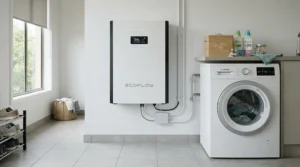
The EcoFlow DELTA 3 Max is the friendly starting point. A 2,048Wh LFP battery, 2,400W output and a weight of about 20kg make it the most manageable unit here.
X-Boost stretches output to around 3,200W by reducing voltage, which is why one UK guide notes it will drive a 3kW kettle, only more slowly. That’s clever, though it isn’t a substitute for real capacity. Two limitations matter for off-grid use: solar input is capped at 500W, and independent reviewers report it can’t take extra batteries. Battery life is rated at 4,000 cycles, and EcoFlow offers up to five years’ warranty.
So who is it for? A garden office, shepherd’s hut or holiday cabin drawing 2-3kWh a day. For a family home it’s a stopgap. Reviewers generally call it well built, reliable and affordable, while flagging the solar cap as the main frustration.
Pros:
- ✅ Light enough to carry with two hands
- ✅ 4,000-cycle LFP battery
- ✅ Lowest entry cost in this guide
Cons:
- ❌ Solar input capped at 500W
- ❌ No expansion batteries
Price range: around £1,000. Verdict: good value for small loads, poor for a full house.
7. Jackery Explorer 2000 Plus — simple, expandable mid-range
The Jackery Explorer 2000 Plus is the straightforward one. It has a 2,042.8Wh LiFePO4 battery, 3,000W output and expansion up to 12kWh, and Amazon UK lists it as sent and sold by Jackery UK.
Jackery quotes a wall charge in around 1.7 hours and a two-hour solar charge using six 200W SolarSaga panels, which tells you the solar input is generous, though you’d need panel space for it. The 3+2 year warranty gives five years of cover in total. That combination of moderate capacity and a large expansion ceiling suits people who want to start modestly and grow.
I couldn’t verify a large body of independent UK reviews specific to this listing, so I won’t summarise sentiment I can’t source. On specs alone, it sits between the EcoFlow DELTA 3 Max and the 3kWh-plus units, with the advantage of simple operation and Jackery’s established support network.
Pros:
- ✅ Expandable to 12kWh
- ✅ Fast 1.7-hour wall charge
- ✅ Five years of warranty cover
Cons:
- ❌ Base capacity is modest for a house
- ❌ Independent UK review evidence is thin
Price range: check the current listing, as promotions swing widely. Verdict: a safe mid-range pick for staged growth.
How the Seven Compare on Solar Input and Growth Potential
| Product | Max solar input | Expansion ceiling | Battery chemistry |
|---|---|---|---|
| EcoFlow DELTA Pro 3 | 2,600W | 12kWh | LFP |
| Anker SOLIX F3800 | 2,400W | 26.9kWh | LFP |
| BLUETTI Apex 300 | 2,400W | About 19kWh per unit | LiFePO4 |
| Anker SOLIX F3000 | 2,400W | 12kWh | LFP |
| AFERIY P310 | 2,000W | 11.52kWh | LiFePO4 |
| EcoFlow DELTA 3 Max | 500W | None | LFP |
| Jackery Explorer 2000 Plus | Not verified | 12kWh | LiFePO4 |
Solar input decides how quickly you refill after a grey week, and this table shows the EcoFlow DELTA Pro 3 and Anker SOLIX F3800 pulling clear of the pack. The EcoFlow DELTA 3 Max is the outlier, and its 500W cap makes a lean cabin possible but a solar-only house frustrating. If growth matters most, the Anker SOLIX F3800‘s 26.9kWh ceiling is unmatched here.
Daily Energy Consumption Planning: The Step-by-Step Method
Every good decision starts with daily energy consumption planning, and it’s less scary than it sounds. You’re simply adding up watt-hours.
Step 1: list every appliance. Note its wattage and how many hours a day it runs. Multiply to get watt-hours. A router at 12W running all day is about 0.3 kWh.
Step 2: use a plug-in energy meter for a week. Nameplate ratings lie; meters don’t.
Step 3: add a loss allowance. Inverters waste roughly 10% of what they convert, so scale your total by 1.1.
Here’s an illustrative example for an efficient off-grid cottage: fridge-freezer about 1.0 kWh, lighting 0.5, router and devices 0.9, washing machine 0.7, kettle 0.4, induction hob 0.8, water pump 0.2. That totals roughly 4.5 kWh. Add the 10% allowance and you’re planning for about 5 kWh a day.
Compare that with the 6.8 kWh benchmark for an average UK home, and you see why lifestyle changes matter as much as hardware. Move your washing to sunny afternoons and you’ll shave the peak load, not just the total.
Solar Array Sizing for UK Skies
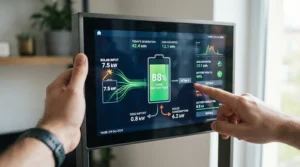
Solar array sizing is where optimism meets the Met Office. Sources such as Simple Green Energy suggest each installed kWp yields roughly 850-1,050 kWh a year in suitable UK conditions, or about 2.3-2.9 kWh a day averaged across the year. Winter, though, is a far lower story.
The Energy Saving Trust says the typical home system is around 4.5kWp, with output rising and falling with the sunshine. Use that as your reality anchor.
Our 5 kWh-a-day cottage needs about 5 ÷ 2.6, or roughly 2kWp, to break even on the annual average. But in December you’ll need several times that, which is why I’d size the array for the shoulder months and add a generator for deep winter. Also check your power station’s input ceiling: the Anker SOLIX F3800 accepts up to 2,400W, so beyond around 3kWp of panels you’re wasting potential. The AFERIY P310 caps at 2,000W and the EcoFlow DELTA 3 Max at just 500W.
Orientation matters too. Energy Saving Trust guidance suggests an unshaded south-facing roof is ideal. Ground-mount arrays let you tilt for winter sun.
Real-World Scenarios: Which Power Station Fits Which Household?
Scenario 1: the weekend cabin (about 2 kWh a day). Fridge, lights, laptop and a kettle. The EcoFlow DELTA 3 Max with a 400W panel is plenty, and it’s the cheapest way in.
Scenario 2: the frugal off-grid cottage (about 5 kWh a day). Here you want 8-12kWh of storage. A BLUETTI Apex 300 with two or three battery modules, or an Anker SOLIX F3800 plus two expansion batteries, fits. Budget for roughly 2-3kWp of panels and a small petrol generator as insurance.
Scenario 3: the family home (8-10 kWh a day plus electric cooking). Be honest: this is beyond a single portable unit. You need multiple battery blocks, a 6kW-plus inverter, and probably professional installation. The EcoFlow DELTA Pro 3 or Anker SOLIX F3800, expanded and properly wired to a consumer unit by a qualified electrician, gets you closest. Otherwise, consider a fixed hybrid inverter system instead.
Note the pattern. As daily use rises, expandability and output jump in importance while portability becomes irrelevant.
Battery Depth of Discharge: How Much Can You Really Use?
Battery depth of discharge (DoD) is the share of a battery’s capacity you draw out before recharging. As Wikipedia’s explanation notes, for almost all rechargeable chemistries there’s a link between depth of discharge and cycle life, and LiFePO4 cells are often limited to a mid-range state of charge to greatly extend their life.
Why should you care? Because manufacturers’ cycle ratings, such as 4,000 cycles to 80% capacity, assume particular use patterns. A battery cycled shallowly every day generally outlives one hammered to empty.
For sizing, the working rule is simple: plan on around 90% usable for LiFePO4 units with sensible built-in limits, and knock it to 80% if you want longevity headroom. So a 3.84kWh unit gives you about 3.1-3.5kWh a day in practice. Multiply by days of autonomy and you have your capacity target.
Using our cottage: 5 kWh × 2 days = 10 kWh, divided by 0.9 usable, is about 11-12 kWh nominal, meaning three to four 3.84kWh blocks. Battery depth of discharge isn’t a footnote; it changes how many boxes you buy.
How to Choose a Power Station for Off-Grid Living
Choosing a power station for off-grid living comes down to seven checks:
- Calculate daily use in kWh. Follow the method above; don’t guess.
- Check peak wattage. Add the loads that run together, then compare with continuous output, not surge.
- Decide on days of autonomy. Two days is a sensible minimum for the UK.
- Confirm battery chemistry. LiFePO4 or LFP typically offers thousands of cycles and better safety.
- Verify solar input limits. Match the array to the input ceiling.
- Look at expansion. A no-expansion unit caps your future.
- Read the warranty. Five to seven years signals confidence, but check UK support.
If you only remember one, remember step two. Capacity is easy to fix later; an under-rated inverter isn’t.
Power Station vs Traditional Alternatives
| Feature | Power station | Fixed battery and inverter | Petrol generator |
|---|---|---|---|
| Installation | Plug-in, minimal | Professional install | Plug-in |
| Noise | Very quiet | Silent | Loud |
| Running cost | Free if solar-charged | Free if solar-charged | Fuel needed |
| Scalability | Modular, limited | Excellent | Fixed |
| Best For | Cabins, staged growth | Full family homes | Occasional top-ups |
Read this table as a spectrum. A power station wins on simplicity and silence, fixed systems win on scale, and generators win on raw winter reliability. For genuine whole-house living, I’d treat the power station as the friendly starting point and the fixed system as the eventual destination, with a generator as winter insurance either way.

Power Station for Solar Panel Setup: Wiring and Compatibility
A power station for solar panel setup lives or dies on voltage matching. Anker’s F3800 user guide gives an input window of 11-60V, for instance, and limits current at lower voltages. Get it wrong and the unit either throttles or refuses to charge.
Practical rules: check the open-circuit voltage of your panels in cold weather, because voltage rises as temperature falls. Wire panels in series to raise voltage and in parallel to raise current, staying inside both limits. Use MC4 connectors and appropriate cabling, and keep runs short to limit losses.
Most units here include built-in MPPT controllers, so you don’t need a separate charge controller. Mixing panel types on one input is a common mistake and worth avoiding. If you’re building a power station for solar panel setup on a roof or ground mount, get an electrician to check the DC side, especially at higher array voltages.
Safety, Regulations and UK Compliance
Large lithium batteries deserve respect. Keep units ventilated, dry and away from flammable materials. Check for UKCA or CE marking on products and chargers.
Connecting to your home’s wiring is the serious bit. Fixed connection to a consumer unit falls under the IET Wiring Regulations, BS 7671, and should be done by a competent electrician using a proper changeover arrangement so power can’t back-feed the grid. Never improvise a plug-to-plug link.
If your property stays connected to the mains, network operator rules such as G98 or G99 may apply to generation, so ask your electrician. Tell your home insurer about a large battery too; policies vary.
Long-Term Cost and Maintenance
| Product | Approx. price range | Approx. cost per kWh of capacity |
|---|---|---|
| AFERIY P310 | £1,200-£1,400 | Roughly £320-£370 |
| EcoFlow DELTA 3 Max | Around £1,000 | Roughly £490 |
| BLUETTI Apex 300 | £1,300-£1,900 | Roughly £470-£690 |
| Anker SOLIX F3000 | Around £2,000 | Roughly £650 |
| EcoFlow DELTA Pro 3 | High-£2,000s | Roughly £650-£700 |
Price per kWh of storage is the cleanest way to compare, and the AFERIY P310 wins clearly, with the BLUETTI Apex 300 close behind at its lower price range. The EcoFlow DELTA Pro 3 costs more per kWh, but you’re paying for output and charging speed. These figures use approximate ranges from my research and will shift.
Maintenance is light: recharge to around 50% if storing for months, keep units between about 0°C and 40°C where charging is concerned, update firmware, and test your backup monthly. Cycle ratings of 3,000-6,000 imply a decade or more of daily use, though warranty cover of five to seven years is the real contractual guarantee.
Common Mistakes When Buying a Power Station for Off-Grid Living
- Buying on capacity alone. A huge battery behind a small inverter can’t start your pump.
- Ignoring winter. Solar output in December can fall dramatically.
- Forgetting the standby drain. A 20W idle load is nearly 0.5 kWh a day.
- Assuming every socket works at once. Total output is shared.
- Skipping the electrician. DIY wiring to a consumer unit is dangerous and may void insurance.
- Believing “whole house” marketing. Ask what circuits, at what wattage, for how many hours.
FAQ
❓ Can a power station really run a whole UK house off-grid?
❓ Do power stations charge in cold UK winters?
❓ How many solar panels do I need for a power station?
❓ Should I add a generator as a winter backup?
❓ How long does a 4kWh power station last in a house?
Conclusion
The honest answer to “what’s the best power station for whole house off-grid living?” is that it depends on the house, and on how much you’re willing to change your habits. For a lean cottage, the BLUETTI Apex 300 offers the best blend of value and growth. If you need brute output and long-term expansion, the Anker SOLIX F3800 or EcoFlow DELTA Pro 3 make sense, and the AFERIY P310 is the value wildcard.
Start with your daily numbers, respect winter, and treat battery depth of discharge as a design input, not an afterthought. Then get a qualified electrician to connect anything permanent. Size for reality, not for the brochure.
Recommended for You
- Expandable Power Station: 7 Best Picks For UK Homes (2026)
- Power Station For Camping Cooking: 7 Best Picks For UK Trips (2026)
- Power Station For Family Camping: 7 Best Picks (2026)
Disclaimer: This article contains affiliate links. As an Amazon Associate, I earn from qualifying purchases. If you purchase products through these links, we may earn a small commission at no additional cost to you.
✨ Found this helpful? Share it with your friends! 💬🤗
