In This Article
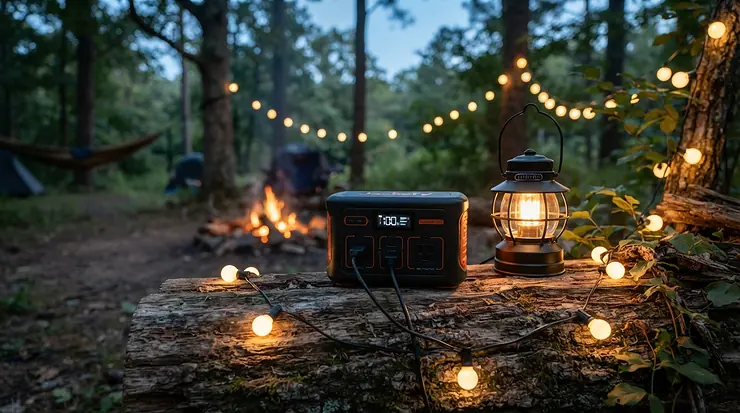
A lightweight power station for camping is a rechargeable battery pack, usually built around lithium iron phosphate cells, that weighs roughly 2.5 to 6 kg yet offers mains sockets, USB-C ports and a 12V car socket. In plain English, it keeps phones, lanterns, a laptop and sometimes a small kettle running when your pitch has no hook-up and the fire has gone out.

It’s mid-October, which means first frosts, early darkness and a sudden craving for warmth. That is exactly when a lightweight power station for camping earns its keep. A summer weekend can limp along on a power bank. A November night under canvas, with a blanket to heat and a brew to boil, cannot.
The catch is that “lightweight” and “capable” pull in opposite directions. Every extra watt-hour means more cells, and more cells mean more kilos to haul from the car park. So this guide weighs up seven genuinely portable models. They range from a 2.8 kg DC-only featherweight to a 10.8 kg kettle-capable heavyweight, and each is judged against real UK jobs: glamping with an electric kettle, running an electric blanket, surviving freezing nights, and topping up from a car socket.
A quick note on method. Everything here comes from manufacturer spec sheets, retailer listings and published reviews, not from me lugging batteries round a field. Where reviews are thin, I say so rather than pretend. Most of these units use lithium iron phosphate (LFP) cells, a chemistry prized for long cycle life and thermal stability. All prices below are ranges only, so check current price before you buy.
Quick Comparison: Lightweight Power Station for Camping at a Glance
Before the deep dive, here is the short version. These five picks cover most UK camping styles, from ultralight tenting to proper glamping.
| Pick | Weight | Capacity / Output | Best For |
|---|---|---|---|
| Anker SOLIX C300 DC | 2.8 kg | 288Wh / 300W (DC only) | Ultralight USB-C and 12V kit |
| EcoFlow RIVER 3 | 3.5 kg | 245Wh / 300W | Budget one-hand carry |
| BLUETTI Elite 30 V2 | 4.3 kg | 288Wh / 600W | Small kettle and blanket top-ups |
| Jackery Explorer 500 v2 | 5.7 kg | 512Wh / 500W | Weekend tenting with a blanket |
| Jackery Explorer 1000 v2 | 10.8 kg | 1,070Wh / 1,500W | Glamping with an electric kettle |
Looking at the comparison above, the EcoFlow RIVER 3 and Anker SOLIX C300 DC suit anyone counting grams. The Jackery Explorer 1000 v2 is the only one here that can comfortably host a proper kettle. The BLUETTI Elite 30 V2 is the neat middle path, with 600W from a body barely heavier than a bag of sugar times four. Remember that output decides what you can run, while capacity decides how long you can run it.
💬 Just one click — help others make better buying decisions too!😊
Top 7 Lightweight Power Station for Camping Picks: Expert Analysis
1. Anker SOLIX C300 DC — lightest here, with no mains socket
The standout feature is weight. At roughly 2.8 kg, this is the featherweight of the list, and Anker offers a carry strap as a separate accessory.
The 288Wh battery feeds two 140W two-way USB-C ports, a 100W USB-C, USB-A and a 12V/10A car socket rated to 120W. Crucially, there is no AC outlet. That means laptops, phones, camera batteries, LED lanterns and a 12V cool box are fine, but kettles and mains blankets are out. Anker lists discharge from -20°C to 40°C and charging from 0°C to 40°C, so it will keep working on a frosty night but won’t recharge below freezing.
Here is my take. If your kit all speaks USB-C or 12V, skipping the inverter is a bonus, because there is no AC conversion to waste energy. It suits solo walkers, bikepackers and festival minimalists far better than glampers.
Review sentiment: I couldn’t verify a large, reliable pool of UK customer reviews for this specific variant. Rather than guess, I’d read recent buyer feedback before ordering.
Pros:
- ✅ Roughly 2.8 kg, the lightest pick here
- ✅ Two 140W two-way USB-C ports
- ✅ 12V socket suits cool boxes and inflators
Cons:
- ❌ No mains socket for kettles or blankets
- ❌ Won’t charge below 0°C
Price: typically in the £150–£220 range at the time of research, and decent value if you genuinely never need AC.
2. EcoFlow RIVER 3 — smallest way into proper AC power
Its headline is an AC socket in a package of around 3.5 kg, which is rare at this weight.
The 245Wh LFP battery delivers 300W continuous, with X-Boost advertised for loads up to 600W. In practice that covers phone and laptop charging, lighting and a low-wattage fan, and it should handle a small blanket for a few hours. EcoFlow quotes a one-hour mains recharge, a car input of up to 100W (around 2.8 hours) and 3,000 cycles to 80% capacity. Charging is spec’d at 0°C to 45°C, with discharge down to -10°C.
What most buyers overlook is the 245Wh ceiling. It is lovely to carry, but one evening of blanket and brews will drain it.
Review sentiment: TechRadar’s coverage of the model highlights how genuinely portable it is, slotting into a rucksack or car boot without fuss. I couldn’t verify a large UK customer-review pool, so treat sentiment as limited.
Pros:
- ✅ Around 3.5 kg with real AC output
- ✅ Quick one-hour mains recharge
- ✅ 12V input and 12V output built in
Cons:
- ❌ 300W cap rules out most kettles
- ❌ 245Wh drains quickly on blankets
Price: roughly £150–£200 at the time of research, which is strong value for a first station.
3. BLUETTI Elite 30 V2 — 600W from just 4.3 kg
The hook here is output per kilo. BLUETTI claims 600W continuous, and up to 1,500W for purely resistive loads using its Power Lifting mode.
The 288Wh LFP battery offers eight output ports, a 12V/10A car outlet and a 140W USB-C. Standby draw is quoted as low as 4.5W, which matters because inverters quietly nibble capacity overnight. It accepts up to 200W of solar and doesn’t support expansion batteries. For campers, that means a small kettle, a blanket, a laptop and lights, all from something you can carry in one hand.
My take: this is the best “small but flexible” option here. I couldn’t confirm its charge-temperature range from the sources I found, so check the manual if you camp in frost.
Review sentiment: the model is recent and I found little independent review data, so I won’t summarise sentiment.
Pros:
- ✅ 600W continuous from 4.3 kg
- ✅ Low 4.5W standby draw
- ✅ 140W USB-C and 12V car outlet
Cons:
- ❌ No battery expansion possible
- ❌ 288Wh limits kettle-heavy weekends
Price: around the £180–£250 range at the time of research, which looks good for the output.
4. EcoFlow RIVER 3 Plus — expandable to 858Wh
Its standout trick is modularity. You can stack extra battery units onto the base station to reach 858Wh.
The base unit holds 286Wh, outputs 600W (1,200W with X-Boost) and weighs about 4.7 kg. Solar input reaches 220W for a roughly 1.5-hour charge, and EcoFlow quotes about 3.3 hours via its car input. The 12V output tops out at 126W. Charging runs from 0°C to 45°C, with discharge from -10°C to 45°C. For campers, that means you can start light and add capacity if your trips grow.
Honestly, the catch is that extra batteries add cost and weight, so check the combined total against a single larger unit.
Review sentiment: I couldn’t verify a meaningful pool of independent UK reviews for this model, so I’m not summarising any.
Pros:
- ✅ Expandable to 858Wh with extra batteries
- ✅ 600W continuous, 1,200W X-Boost
- ✅ Fast solar and car input options
Cons:
- ❌ Extra batteries add cost and weight
- ❌ Charging stops below 0°C
Price: typically in the mid-£200s to low-£300s at the time of research, so check current price.
5. Jackery Explorer 500 v2 — 512Wh at just 5.7 kg
The standout is balance: it carries double the capacity of the 288Wh crowd for only a kilo or two more.
Jackery lists 512Wh, 500W (1,000W peak) and a 6,000-cycle LFP battery. You get two AC outlets, two 100W USB-C ports and a 12V/10A car socket. Recharge times are about 1.3 hours from the wall, 2.8 hours on 200W solar and around 6 hours via a car. Jackery’s own listing quotes charging and discharging from -20°C to 45°C. Some EU retailers list charging from 0°C, so check the manual.
That 512Wh buys roughly seven hours of a 60W blanket in my estimates (see the runtime table below), or a few small boils.
Review sentiment: TechRadar’s review calls it compact, quiet and practical, with simple operation.
Pros:
- ✅ 512Wh at only 5.7 kg
- ✅ Claimed 6,000-cycle LFP battery
- ✅ Quiet operation and simple display
Cons:
- ❌ 500W cap rules out 1kW kettles
- ❌ Solar and car charging can’t run together
Price: around the £300–£400 range at the time of research, which is fair for a weekend workhorse.

6. BLUETTI Elite 100 V2 — 1,800W from an 11.5 kg body
This one’s hook is brute output in a compact shell. It is rated for 1,800W continuous from roughly 11.5 kg and 17 litres.
The 1,024Wh battery supports 1,200W AC input (80% in about 45 minutes) and quotes a 30dB noise level under 600W. BLUETTI also claims Power Lifting up to 2,700W for resistive loads. A separate alternator charger is sold separately, and the unit isn’t waterproof. In camping terms, that means a 1.5kW glamping kettle is fine. I couldn’t confirm its temperature ranges from my sources, so check the manual before a frosty trip.
The honest wrinkle: one TechRadar review noted that 1,024Wh can disappear quickly under high-draw devices. Capacity, not wattage, is your limiter.
Pros:
- ✅ 1,800W comfortably runs a camping kettle
- ✅ Very fast mains recharge claims
- ✅ Quiet at moderate loads
Cons:
- ❌ Not waterproof, so keep it dry
- ❌ Capacity drains fast under heavy loads
Price: roughly £400–£500 at the time of research, good value for the output.
7. Jackery Explorer 1000 v2 — the glamping kettle specialist
Its trump card is a clean 1,500W for a roughly 10.8 kg 1kWh class unit.
Jackery lists 1,070Wh, 1,500W (3,000W surge), a 4,000-cycle LFP battery and a 3-year guarantee at UK retailers. Charging is 0–45°C, discharge -10–45°C. Mains recharge takes under two hours, or around an hour in the app’s emergency mode. A car adapter is listed as taking about 12 hours, so don’t count on it as your main charging route. For campers, that means a 1.5kW kettle, a blanket all night, and spare for phones.
My take: this is the “stop worrying about the battery” option for family and glamping trips.
Review sentiment: editorial reviewers call it refined and reliable, with the caveat being the 1,500W ceiling.
Pros:
- ✅ 1,500W runs real camping kettles
- ✅ 1,070Wh covers blanket plus brews
- ✅ Claimed 4,000-cycle LFP battery
Cons:
- ❌ At 10.8 kg it’s a carry, not a stroll
- ❌ Car charging takes around 12 hours
Price: mid-£400s to around £500 at the time of research, so check current price.
Side-by-Side Comparison
| Product | Capacity | AC Output | Weight | Charges At | Price Range | Best For |
|---|---|---|---|---|---|---|
| Anker SOLIX C300 DC | 288Wh | None | 2.8 kg | 0–40°C | £150–£220 | Ultralight USB-C kit |
| EcoFlow RIVER 3 | 245Wh | 300W | 3.5 kg | 0–45°C | £150–£200 | Budget first station |
| BLUETTI Elite 30 V2 | 288Wh | 600W | 4.3 kg | Check manual | £180–£250 | Small flexible setups |
| EcoFlow RIVER 3 Plus | 286Wh | 600W | 4.7 kg | 0–45°C | Mid-£200s to low-£300s | Growing capacity |
| Jackery Explorer 500 v2 | 512Wh | 500W | 5.7 kg | Check manual | £300–£400 | Weekend tenting |
| BLUETTI Elite 100 V2 | 1,024Wh | 1,800W | 11.5 kg | Check manual | £400–£500 | Kettle plus blanket |
| Jackery Explorer 1000 v2 | 1,070Wh | 1,500W | 10.8 kg | 0–45°C | Mid-£400s to £500 | Glamping all-rounder |
Looking at the table, the jump from 5.7 kg to roughly 11 kg is where kettle capability appears, so weight and capability are closely tied. The BLUETTI Elite 100 V2 delivers the most output, while the Jackery Explorer 1000 v2 counters with a longer guarantee. Budget buyers should note the EcoFlow RIVER 3 and Anker SOLIX C300 DC sacrifice AC capability for lightness.
✨ Ready to Pack Light?
🔍 Take your lightweight power station for camping search to the next level with these carefully selected products. Click on any highlighted item to check current pricing and availability. Your next frosty weekend will feel a lot cosier!
Power Station for Glamping with Electric Kettle: The Maths Nobody Prints on the Box
Glamping is basically camping with opinions about tea. If your bell tent, pod or yurt has no bollard nearby, a power station for glamping with electric kettle duty must clear two hurdles: output and appetite.
Output first. A typical UK household kettle has a 2–3kW element, and campsite guidance warns that even 10A hook-ups struggle with kettles above 2kW. Every unit here tops out below 2kW, so none will run a full-fat domestic kettle. Camping kettles are commonly around 750–1,000W, and that is the realistic target.
Appetite next. Warming one litre of water from around 15°C to boiling takes roughly 100Wh in theory. Allow for inverter losses and call it 115–125Wh. That’s my back-of-envelope maths, not a lab figure. Tea for two, five times a day, is about 2.5 litres, or roughly 290Wh daily.
So what does that mean for buying? The Jackery Explorer 1000 v2 (1,500W) and BLUETTI Elite 100 V2 (1,800W) handle a proper 1–1.5kW kettle. The Jackery Explorer 500 v2 can manage a kettle of 500W or less, slowly. The 600W BLUETTI Elite 30 V2 and EcoFlow RIVER 3 Plus suit small travel kettles. Meanwhile the EcoFlow RIVER 3 only copes via X-Boost with a small kettle, and the Anker SOLIX C300 DC can’t run one at all.
Check the wattage printed on your kettle’s base, boil only what you need, and pre-fill a flask to stretch every watt-hour.
Power Station for Tent Heater or Electric Blanket: One Is Sensible, One Is Wishful Thinking
A power station for tent heater or electric blanket use sounds like one question, but it’s really two. Blankets sip power. Heaters guzzle it.
Single underblankets typically draw around 40–60W, while throws and larger blankets often run 100–150W. A small fan or radiant heater draws 1kW or more. That’s a 20-fold difference, and the table below shows what it means in practice.
| Station | Max AC Output | 60W Blanket | 1 Litre Kettle Boils | 1kW Heater |
|---|---|---|---|---|
| Anker SOLIX C300 DC | No AC outlet | n/a | n/a | n/a |
| EcoFlow RIVER 3 | 300W (600W X-Boost) | ~3.5 h | ~2 (small kettle) | No |
| BLUETTI Elite 30 V2 | 600W | ~4 h | ~2 | ~15 min* |
| EcoFlow RIVER 3 Plus | 600W | ~4 h | ~2 | ~15 min* |
| Jackery Explorer 500 v2 | 500W | ~7 h | ~4 | No |
| BLUETTI Elite 100 V2 | 1,800W | ~14 h | ~7.5 | ~50 min |
| Jackery Explorer 1000 v2 | 1,500W | ~15 h | ~8 | ~55 min |
*Via the boost modes the makers advertise for resistive loads.
These are my own estimates, assuming about 85% usable energy after inverter losses. Thermostat-controlled blankets cycle on and off, so real runtimes may be longer. The pattern is clear. Blankets are easy, with even the mid-size Jackery Explorer 500 v2 covering a night. Heaters are a different story, because a 1kW heater empties even the biggest unit in under an hour.
The smart play is to warm yourself, not the tent. Preheat the bed for half an hour, then switch off. Add a four-season sleeping bag, an insulated mat and a kettle-filled hot water bottle. Use a heater only when you have a real hook-up.
Cold-Weather Battery Performance: Why Your Power Station Sulks Below 0°C
Cold-weather battery performance is the unglamorous truth behind every spec sheet. LFP batteries can generally discharge in the cold but shouldn’t be charged below freezing. Charging below 0°C risks lithium plating, a reaction that permanently reduces capacity, so power stations block charging when the cells are too cold.
Here is how the published ranges compare. The EcoFlow RIVER 3, EcoFlow RIVER 3 Plus and Jackery Explorer 1000 v2 all list charging from 0°C to 45°C and discharge from -10°C. The Anker SOLIX C300 DC lists discharge to -20°C but charging only from 0°C. The Jackery Explorer 500 v2 is advertised at -20°C to 45°C for both, though some retailer listings show 0°C for charging, so check the manual. For the two BLUETTI models I couldn’t confirm ranges from my sources.
Capacity also drops in the cold, so a station may deliver less than its label on a frosty night. UK tents hover near ambient temperature, so don’t assume warmth.
Practical fixes:
- Charge fully at home before you leave.
- Keep the unit in the car or inside the tent, never on frozen ground.
- Store it near your sleeping bag overnight so it stays above freezing.
- Warm it indoors before any recharge.
- Don’t count on winter solar to refill it.
12V Car Socket Charging: Free Top-Ups on the Drive
12V car socket charging is the cheapest top-up on the road, if you set realistic expectations. A standard socket is typically fused around 10A, so the headline “fast” figures often need a dedicated cable.
Here is what the makers claim. The Jackery Explorer 500 v2 lists roughly 6 hours via car, and the EcoFlow RIVER 3 about 2.8 hours at up to 100W. The EcoFlow RIVER 3 Plus quotes 3.3 hours, but that’s a 220W input, so expect a standard lighter socket to be slower. The Jackery Explorer 1000 v2 quotes around 12 hours, and the BLUETTI Elite 100 V2 needs a separately sold alternator charger for its 1.8-hour claim.
Output is a separate story. All seven models can feed 12V kit. The Anker SOLIX C300 DC offers up to 120W, and the EcoFlow RIVER 3 and EcoFlow RIVER 3 Plus offer 126W, enough for a 12V cool box or tyre inflator.
Charge with the engine running, because many sockets switch off with the ignition and idling drains your starter battery. Treat car charging as a safety net, not a plan.
Camping Electric Hook-Up Alternatives: Life Beyond the Bollard
Camping electric hook-up alternatives matter because hook-ups are limited, expensive or absent. The Camping and Caravanning Club notes that campsite sockets overload easily, and that running a heater and kettle together can trip the pitch supply. That’s an unpopular thing to do.
| Alternative | Noise | Typical Output | Best For |
|---|---|---|---|
| Lightweight power station | Very quiet | 300–1,800W | Tents, pods and glamping, e.g. Jackery Explorer 500 v2 |
| Leisure battery (12V) | Silent | 12V only | Caravans and motorhomes |
| Solar panel + station | Silent | 100–220W input | Sunny trips with EcoFlow RIVER 3 Plus |
| Petrol generator | Loud | High | Remote use, but many sites restrict them |
| Power bank | Silent | USB only | Phone-only weekends |
This comparison favours the power station for flexibility. A leisure battery needs a vehicle, a generator annoys neighbours, and a power bank can’t run a kettle. Solar helps in summer, but autumn sun is feeble, so I’d treat it as a bonus rather than a lifeline. The honest answer is a station sized to your trip, with a back-up gas kettle.
How to Choose a Lightweight Power Station for Camping
- Add up your watts and hours. List devices, note their wattage, and multiply by hours of use. That total is your minimum capacity.
- Check continuous output against your biggest appliance. A 750W kettle needs a unit rated well above 750W.
- Weigh the carry. If your pitch is a 500-metre walk, 11 kg gets heavy quickly.
- Prefer LFP chemistry. It delivers long life, and CHOICE’s testing of five portable power stations found claimed cycle lives anywhere from about 500 to 3,500, so claims vary widely.
- Check the charge temperature. If you camp in frost, you need a unit that tolerates it, or a plan to keep it warm.
- Look at input options. 12V car socket charging and solar input add flexibility when there is no mains.
- Confirm ports and warranty. UK three-pin sockets, USB-C PD and a decent guarantee matter more than app gimmicks.

Features That Actually Matter (And Those That Don’t)
Marketing loves big numbers, but only a few specs change your trip. Continuous output decides what you can run. Capacity decides how long. Weight decides whether you’ll still smile after the walk from the car park. Charge-temperature range decides whether it works in November.
Surge ratings, X-Boost and Power Lifting modes are real, but they are tricks for resistive loads like kettles and heaters, and they can slow things down. Treat them as bonus, not baseline. Likewise, UPS switchover times are handy at home but irrelevant on a field. App control is pleasant, yet you’ll rarely open it while holding a brew.
What does matter is quiet running, since campsite quiet hours are real. The BLUETTI Elite 100 V2 quotes 30dB under 600W, and the Jackery Explorer 500 v2 lists 36dB while charging. Sensible ports matter too. A 12V socket, a couple of USB-C ports and a UK three-pin outlet cover most campers. Chasing six extra USB-A ports rarely helps.
Common Mistakes When Buying a Lightweight Power Station for Camping
Mistake one is buying on watt-hours alone. A big battery with a 300W output still can’t run a kettle. Mistake two is assuming the label equals reality, since inverter losses and cold weather both trim usable energy.
Mistake three is expecting to charge in freezing conditions. Leave your station in a frosty car overnight and it may simply refuse to recharge. Mistake four is skipping a back-up. Even the best unit runs out eventually, so keep a gas stove or flask as insurance.
Mistake five is the dangerous one: bringing fuel-burning heaters or barbecues into a tent to keep warm. Northern Ireland’s government has published carbon monoxide guidance for campers noting deaths linked to barbecues and gas equipment used in tents. That’s exactly why people look to electric options in the first place, and why a blanket beats a flame.
Real-World Scenarios: Matching the Right Station to Your Trip
The solo festival-goer. Two nights, phone, power bank, a lantern and perhaps a small fan. A long walk from the car park means weight is everything. The Anker SOLIX C300 DC or EcoFlow RIVER 3 fits the budget, and you’ll recharge on the drive home.
The couple in a bell tent. Three nights in late October, an electric underblanket, a laptop for a film, and four brews a day. Capacity around 500Wh is the sweet spot, so the Jackery Explorer 500 v2 is a strong match. The BLUETTI Elite 30 V2 works if you run the blanket only briefly. Budget around £300–£400, and bring a gas kettle for backup.
The family glamping weekend. Four people, a cool box, a 1.5kW kettle, phones and tablets. The Jackery Explorer 1000 v2 or BLUETTI Elite 100 V2 is the realistic choice. Pitch near the car, keep the unit warm overnight, and recharge from home before and after. Spend roughly £400–£500.
In every case, size for your heaviest day, not your average one.
Long-Term Cost & Maintenance
The cost per trip drops fast. A mid-priced station used for thirty nights a year barely touches its claimed cycle life, whether that’s 3,000, 4,000 or 6,000. Cycles aren’t the limit. Calendar ageing and warranty are, so the guarantee length matters. EcoFlow’s spec sheet for the EcoFlow RIVER 3 lists a two-year warranty, while a UK retailer lists three years for the Jackery Explorer 1000 v2.
Compare that with campsite hook-up fees, a petrol generator and its fuel, or disposable batteries. A station that serves for years can undercut all of them, particularly if you also use it for power cuts.
Maintenance is mercifully light:
- Store it cool and dry, never in a freezing shed or hot car.
- Top it up every few months, and check the manual for storage charge levels.
- Keep vents clear and avoid water, especially with the BLUETTI Elite 100 V2, which isn’t waterproof.
- Use the manufacturer’s cables and chargers.
FAQ
❓ Can a lightweight power station for camping boil a kettle?
❓ How long does 12V car socket charging take?
❓ Will a power station run an electric blanket all night?
❓ Do power stations work in freezing weather?
❓ How many watt-hours do I need for a weekend under canvas?
Conclusion: Pick Light, Plan Warm
A lightweight power station for camping is less about the biggest number on the box and more about matching a few honest specs to your trip. Count your watts, respect the carry, and plan for the cold.
If you travel light and live on USB-C, the Anker SOLIX C300 DC or EcoFlow RIVER 3 will do the job. If you want mains in a small body, the BLUETTI Elite 30 V2 and EcoFlow RIVER 3 Plus hit a lovely sweet spot. The Jackery Explorer 500 v2 is my pick for weekend blanket-and-brew trips, and the BLUETTI Elite 100 V2 and Jackery Explorer 1000 v2 are the ones to choose for proper glamping with a kettle.
Whatever you choose, charge it fully at home, keep it warm overnight and pack a gas kettle as insurance. Choose well and your next frosty weekend becomes a cosy one.
✨ Ready to Choose?
🔍 Compare your shortlist, check current pricing and availability, and pick the lightweight power station for camping that fits your pitch, your kettle and your back. Happy camping!
Recommended for You
- Portable Power Station Vs Petrol Generator: 7 Proven Picks (2026)
- EcoFlow Vs Jackery For Home Backup: 7 Best Picks
- Portable Power Station For Power Cuts: 7 Reliable UK Picks (2026)
Disclaimer: This article contains affiliate links. As an Amazon Associate, I earn from qualifying purchases. If you purchase products through these links, we may earn a small commission at no additional cost to you.
✨ Found this helpful? Share it with your friends! 💬🤗
