In This Article
A power station for campervan use is a self-contained battery pack with a built-in inverter, solar controller and a cluster of sockets. It runs laptops, lights and a 12V fridge without a hook-up. You recharge it from the mains, solar panels or the 12V socket, and you can lift it out of the van whenever you like.
Every British campervan owner eventually has the same 2am revelation. The fridge has gone quiet, the lights are dimming and the leisure battery is sulking. For years the fix meant drilling, crimping and a long weekend of swearing at thick cable. Now there’s a lazier, smarter route. The best units use cells based on lithium iron phosphate chemistry, which is widely rated for thousands of charge cycles and for being calmer under stress than older lithium types.
That’s why a power station for campervan builds has gone from curiosity to mainstream. The choice is still genuinely confusing, though. Do you need 1kWh or 2kWh? Will your split charge relay play nicely with it? Is portable power station vs leisure battery even a fair fight? Does MPPT solar charging matter if the box already says “solar input”? And where does a solar generator for camping end and proper van conversion electrics begin?
This guide pulls together real manufacturer specs, UK retailer listings and published editorial tests to answer those questions honestly. Prices are indicative ranges only, so check current pricing before you buy.
Quick Comparison: 7 Best Power Station for Campervan Options at a Glance
| Product | Capacity | AC Output | Max Solar Input | Weight | Price Range (indicative) | Best For |
|---|---|---|---|---|---|---|
| Jackery Explorer 1000 v2 | 1,070Wh | 1,500W | 400W | 10.8kg | £550–£800 | Light 1kWh all-rounder |
| Anker SOLIX C1000 Gen 2 | 1,024Wh | 2,000W | 600W | 11.3kg | £550–£800 | Fast top-ups on short stops |
| EcoFlow DELTA 2 | 1,024Wh | 1,800W | 500W | 12kg | £500–£750 | Expandable mid-range |
| Anker SOLIX F2000 | 2,048Wh | 2,400W | 1,000W | 30.5kg | £900–£1,300 | Full-time van living |
| Bluetti Elite 200 V2 | 2,073.6Wh | 2,600W | 1,000W | 24.2kg | £900–£1,300 | Big inverter, long cycle life |
| EcoFlow DELTA Pro 3 | 4,096Wh | 4,000W | 2,600W | 51.5kg | £2,300–£3,000 | Power-hungry fixed builds |
| Jackery Explorer 600 Plus | 632Wh | 800W | 200W | 7.3kg | £350–£500 | Budget weekenders |
The 1kWh trio sits in a tight price band, so the decision comes down to weight, solar headroom and recharge speed. Anker SOLIX C1000 Gen 2 offers the most inverter headroom, while Jackery Explorer 1000 v2 is the easiest to lift. If you live in the van rather than visit it, Anker SOLIX F2000 and Bluetti Elite 200 V2 double your daily budget for roughly twice the money. I’ve left star ratings out on purpose, because they shift weekly and vary by retailer.
💬 Just one click — help others make better buying decisions too!😊
Top 7 Power Station for Campervan Picks: Expert Analysis
Each pick below is judged on what the specs mean inside a steel box that bakes in summer and freezes in winter. Where I mention reviewer sentiment, it comes from editorial roundups and retailer listings I could find. I couldn’t verify a large pool of UK customer reviews for every model, so please treat it as directional rather than a rating.
1. Jackery Explorer 1000 v2 — lightest 1kWh option for easy lifting
Weight is the sneaky headline here. At roughly 10.8kg, Jackery Explorer 1000 v2 is among the lightest 1kWh-class stations, which matters when you’re passing it through a sliding door.
It stores 1,070Wh and has a 1,500W inverter with a 3,000W surge peak. Two DC inputs accept up to 400W of solar combined. In practice, a camping kettle, laptop and fridge all run comfortably, but a big induction hob plus anything else will hit the 1,500W ceiling.
Based on the spec comparison, this suits couples who want a power station for campervan weekends that can also leave the van for the garden. The 12V car input is modest, so treat driving as a top-up rather than a refill.
Editorial roundups I found rank it near the top for van use. One recurring niggle is that solar input is said to work best with Jackery-branded panels.
Pros:
- ✅ Light enough for one-person lifting
- ✅ 1,500W output with 3,000W surge peak
- ✅ Flexible 100–400W solar input
Cons:
- ❌ Solar pairing favours the same brand’s panels
- ❌ 1,500W cap limits heavy cooking combinations
Price: roughly £550–£800 depending on bundles (check current price). Verdict: a strong all-rounder for the money.
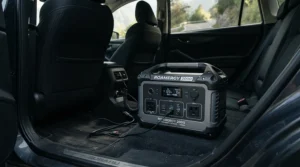
2. Anker SOLIX C1000 Gen 2 — fastest recharging in its class
Anker SOLIX C1000 Gen 2 is built for people who hate waiting. Anker says it recharges from empty to full in 49 minutes using 1,600W AC input, and cites a Guinness World Records certification for that claim.
The 1,024Wh LiFePO4 pack feeds a 2,000W inverter with a 3,000W surge peak. Solar input goes up to 600W through its XT60i port, and it weighs 11.3kg. It’s rated for 4,000 cycles to 80% and can expand to 2,048Wh with a BP1000 Gen 2 battery.
On paper, the quick mains top-up is gold for campsite hopping, where you plug in for an hour and carry on. The 600W solar ceiling is mostly theoretical, because few vans have roof space for that much panel.
Anker’s page also mentions an alternator charger described as “upcoming”, so check UK availability before counting on it.
Several 2026 roundups tag it as the best-value 1kWh unit, though I can’t verify a UK customer-review sample.
Pros:
- ✅ 2,000W inverter beats most 1kWh rivals
- ✅ 1,600W fast AC recharge
- ✅ Up to 600W solar input
Cons:
- ❌ Fast charging must be enabled in the app
- ❌ Alternator accessory availability needs checking
Price: roughly £550–£800 (check current price). Verdict: the best pick for short-stop recharging.
3. EcoFlow DELTA 2 — expandable and well supported
The standout trait of EcoFlow DELTA 2 is room to grow. You can add an extra battery to reach 2,048Wh, or a DELTA Max extra battery to reach 3,040Wh.
The base unit has 1,024Wh of LFP cells and a 1,800W inverter with a 2,700W surge. X-Boost lets it run some resistive loads rated up to around 2,200W. Solar input reaches 500W across an 11–60V window, and EcoFlow quotes 0–80% AC charging in about 50 minutes. It weighs about 12kg, and cell life is rated at 3,000 cycles to 80%.
Here’s what to weigh. Expandability suits a van that starts small and grows. The 12V car input is only 8A, so alternator-style charging is gentle at best.
One 2026 US outdoor-gear test named it best overall. Warranty terms differ between UK retailers (one lists two years, EcoFlow’s own listing cites five), so read the small print.
Pros:
- ✅ Expandable to 2kWh or 3kWh
- ✅ 500W solar input with wide voltage window
- ✅ Fast 50-minute 0–80% AC charging
Cons:
- ❌ Car-socket charging is slow at 8A
- ❌ Warranty terms vary by UK seller
Price: roughly £500–£750 (check current price). Verdict: the best long-term flexibility for the cash.
4. Anker SOLIX F2000 — wheels and 2kWh for full-timers
Anker SOLIX F2000 is the only station here that comes with wheels and a tow handle. That detail matters more than it sounds once a unit passes 30kg.
It stores 2,048Wh and delivers 2,400W continuous, with Anker quoting up to 3,600W for heavier loads. Solar input is up to 1,000W through an 11–60V MPPT input, and AC input is 1,440W. The 12–24V car input runs at 10A. It can expand to 4,096Wh.
Judging by the specs, this is a power station for campervan living that suits people who cook, work and stay put for days. Anker’s own spec lists charging between roughly 0°C and 40°C. In a freezing or baking van, that matters.
GearJunkie’s 2026 guide names it best for van life and overlanding. Its writers describe using it for around two years, praise the wheels, and use it to top up house batteries.
Pros:
- ✅ Wheels and handle ease 30.5kg moves
- ✅ 1,000W solar input for fast refills
- ✅ Expandable to 4,096Wh
Cons:
- ❌ 30.5kg still needs two hands into the van
- ❌ Charging limited to roughly 0–40°C
Price: roughly £900–£1,300 (check current price). Verdict: the best fit for serious off-grid living.
5. Bluetti Elite 200 V2 — big inverter and long cycle life
Bluetti Elite 200 V2 leads on endurance. Its LiFePO4 pack is rated for 6,000+ cycles to 80%, roughly double the figure on several rivals.
You get 2,073.6Wh and a 2,600W inverter, with a 3,900W power-lifting mode for resistive loads. Solar input reaches 1,000W (12–60V, 20A), AC charging reaches 1,800W, and the unit weighs 24.2kg. The 12V car input is weak at 96W (192W at 24V), and UPS switchover is rated at 15ms or less.
So the sums look like this. It’s a good power station for campervan duty if you’ll recharge from solar or mains. It’s a poor choice if you rely on driving to top up.
Bob Vila’s testing ranked it the best overall of 23 stations. It’s often sold through marketplace sellers on UK sites, so check who provides the warranty.
Pros:
- ✅ 6,000+ cycle rating
- ✅ 2,600W inverter with power-lifting mode
- ✅ 1,000W solar input
Cons:
- ❌ Car input only around 96W at 12V
- ❌ UK warranty depends on the seller
Price: roughly £900–£1,300 (check current price). Verdict: great value if you charge from mains or solar.

6. EcoFlow DELTA Pro 3 — premium 4kWh for power-hungry builds
EcoFlow DELTA Pro 3 is the only unit here that behaves like a small home battery. It holds 4,096Wh and expands to 12kWh.
The inverter delivers 4,000W (6,000W with X-Boost). Solar input accepts up to 2,600W across two ports: a 1,600W high-voltage port (30–150V) and a 1,000W low-voltage port (11–60V). EcoFlow’s 800W Alternator Charger is a separate accessory, so driving can genuinely recharge it. It’s rated for 4,000 cycles, runs as quietly as 30dB under moderate load, and weighs 51.5kg.
Here’s the reality check. Few vans have roof space for 2,600W of panels. At 51.5kg this behaves like a fixed install rather than a portable one. It’s overkill for a fridge and a laptop, but sensible for induction hobs, air conditioning or power tools.
Retailer copy calls it well suited to vanlifers. Independent UK long-term data was thin when I looked.
Pros:
- ✅ 4,000W output runs almost anything
- ✅ Alternator charging option via accessory
- ✅ Expandable up to 12kWh
Cons:
- ❌ 51.5kg makes it effectively fixed
- ❌ Premium price, with accessories extra
Price: roughly £2,300–£3,000 (check current price). Verdict: only worth it if your loads really demand it.
7. Jackery Explorer 600 Plus — budget weekender with real portability
At 7.3kg, Jackery Explorer 600 Plus is the easiest unit here to carry, and the cheapest way into LiFePO4 power.
It stores 632Wh and delivers 800W with a 1,600W surge. Solar input is capped at 200W, and Jackery’s emergency mode can recharge it in about an hour via the app. That suits weekend fridge-plus-gadgets use but not heavy cooking.
The sums are simple. A weekend in a small campervan is easy. A week without hook-up needs solar or mains stops. Also check your kettle, because full-size UK kettles often draw 2–3kW, far above this unit’s rating.
Retailer listings highlight its low weight and quick charging. I couldn’t verify enough independent UK review data to quote a consensus.
Pros:
- ✅ Very light at 7.3kg
- ✅ Quick app-enabled recharge
- ✅ Lowest entry price here
Cons:
- ❌ 632Wh runs out fast with a fridge
- ❌ 800W ceiling rules out most kettles
Price: roughly £350–£500 (check current price). Verdict: a sensible starter, not a full-time solution.
✨ Ready to Power Your Build?
🔍 Take your power station for campervan setup to the next level with these carefully researched products. Click on any highlighted item to check current pricing and availability. These units will help you create a comfortable, reliable off-grid base your whole
crew will love!
Portable Power Station vs Leisure Battery: Which Wins?
The portable power station vs leisure battery debate usually gets framed as old versus new. It’s really integrated versus assembled.
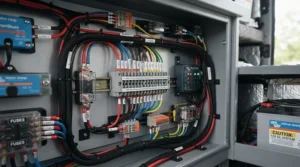
A traditional leisure battery is just a battery. To make it useful you add a charger, a split charge relay or DC-DC charger, a solar controller, fuses and usually an inverter. A power station bundles all of that in one case. You lose the ability to swap parts, and you gain a system that works the moment you unbox it.
| Factor | Portable Power Station | Leisure Battery System | Best For |
|---|---|---|---|
| Setup | Plug in and go | Needs wiring and components | Power station: beginners; Leisure battery: builders |
| Driving charge | Slow via 12V socket unless using an alternator accessory | Strong via DC-DC charger | Leisure battery: frequent drivers |
| Mains outlets | Built in | Needs a separate inverter | Power station: AC-heavy use |
| Portability | Can leave the van | Fixed | Power station: multi-use |
| Upgrade path | Brand-specific extra batteries | Flexible components | Leisure battery: custom builds |
Looking at the table, the portable power station vs leisure battery question hinges on how you recharge. If you drive hundreds of miles between pitches, a DC-DC-fed battery wins on refill speed. If you stop for days and rely on solar or mains, EcoFlow DELTA 2 or Jackery Explorer 1000 v2 deliver the same energy with far less fuss. Many owners end up with a hybrid: a small leisure battery for 12V lights and a power station for AC loads.
How to Choose a Power Station for Campervan Use
- Add up your daily watt-hours. List every device, multiply watts by hours, and total them. A fridge, laptop, lights and phones often land somewhere between 600Wh and 1,000Wh a day, but check your own specs.
- Check the inverter against your biggest load. Rated watts must exceed your kettle, hob or hairdryer, and surge ratings only cover brief starts.
- Match recharge routes to your travel style. Weekend campsite users need mains speed. Long-stay wild campers need solar headroom. Heavy drivers need alternator charging.
- Check temperature limits. Some spec sheets limit charging to roughly 0–40°C, which matters in UK winters and sun-baked vans.
- Respect the weight. Anything above about 25kg is a two-person lift. Plan where it lives and how it’s secured.
- Verify warranty and UK support. Look for UKCA or CE marking and a UK-based warranty route.
The rule of thumb across several buying guides is that 700–1,200Wh suits the simple campervan sweet spot. The catch is that sizing only makes sense alongside your recharging plan. A 2kWh station you can’t refill in a cloudy week is less useful than a 1kWh station with decent solar.
Split Charge Relay: Where It Fits (and Where It Doesn’t)
A split charge relay is a voltage-sensitive switch that connects the starter battery and the leisure battery when the alternator is producing charge. It’s simple and cheap. It’s also a poor match for modern vehicles.
Here’s the problem. Many newer vans use smart alternators that vary their output to save fuel. A split charge relay simply passes that varying voltage along, which can leave a leisure battery undercharged. Several UK forums and installers also note that a relay can’t provide the proper multi-stage charge profile that LiFePO4 batteries need. A DC-DC charger fixes this by regulating voltage and current itself.
So how does a power station for campervan setups interact with all this? In most cases, it doesn’t need the relay at all. You recharge it from mains, solar or its own 12V or alternator input. That’s why people with smart-alternator vans often find a power station simpler than a full leisure-battery rebuild.
| Charging Method | Typical Speed | Notes | Best For |
|---|---|---|---|
| Mains hook-up | Fastest (1.4–1.8kW on some units) | Great for campsite stops | Anker SOLIX C1000 Gen 2 |
| Solar | 100–1,000W in good sun | Needs clear panel space | Anker SOLIX F2000 |
| 12V socket | Around 100–120W | Slow top-up only | Jackery Explorer 1000 v2 |
| DC-DC or alternator charger | Up to 800W on some systems | Needs installation | EcoFlow DELTA Pro 3 |
| Split charge relay | Depends on vehicle | Not ideal for smart alternators or LiFePO4 | Older vans with lead-acid |
The table shows that a split charge relay is the cheapest route but the least flexible. If you keep a legacy lead-acid leisure battery, a relay can stay. If you go lithium or have a smart alternator, a DC-DC charger is the safer upgrade. Any 12V wiring should be fused and installed by a competent person, because alternator circuits carry serious current.
MPPT Solar Charging Explained for Campervan Owners
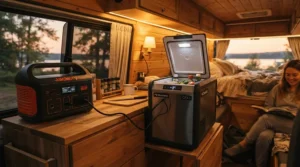
MPPT solar charging is a technique that continually adjusts the electrical load on your panels so they operate at their most productive point. The principle is explained well in this overview of maximum power point tracking. It’s why modern solar controllers harvest more energy than older PWM designs, especially in poor light.
Every unit in this guide has MPPT solar charging built into its solar input, so you don’t need a separate controller. That’s a big simplification compared with van conversion electrics built from scratch. EcoFlow states its MPPT efficiency exceeds 98%.
Three practical rules matter more than the controller itself:
- Mind the voltage window. Anker and EcoFlow low-voltage ports accept 11–60V. Panels wired in series add voltage, so check the open-circuit voltage on the label.
- Leave cold-weather headroom. Panel voltage rises in cold mornings, which is a classic UK trap.
- Avoid shade. Even partial shade can crush output, so park for sun, not just for the view.
As a rough planning guide, a 200W panel might return several hundred watt-hours on a bright UK summer day and far less in winter. Treat these as estimates, not promises. The takeaway is that MPPT solar charging gets the most from your panels, but panel area and sky still decide your daily budget.
Solar Generator for Camping vs Campervan Setups
A solar generator for camping is really just marketing shorthand for a power station sold with panels. The hardware overlaps heavily with a campervan power station, but the use case differs.
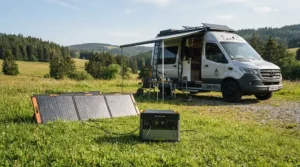
When camping outside the van, folding panels are brilliant. You can chase the sun, tilt them, and park the van in shade. The Anker SOLIX C1000 Gen 2 bundles, for instance, pair it with panels weighing roughly 2.8–4.8kg. Roof-mounted panels, by contrast, travel with you but can’t move.
Many owners combine both: a small fixed panel to trickle-charge during the week, and a folding panel for longer stays. If you’re comparing a solar generator for camping bundle against a standalone unit, check three things. Does the panel’s voltage and connector match the station? Is the panel included or sold separately? How much does the bundle cost versus buying the pieces?
A solar generator for camping built around Jackery Explorer 600 Plus keeps weight down for festivals and weekends. A bigger setup around EcoFlow DELTA 2 gives you a longer runtime for family trips.
Van Conversion Electrics: A Sensible Blueprint
Done properly, van conversion electrics with a power station are far simpler than a full 12V build. They’re not zero-effort, though.
Step 1: Build a load list. Write down fridge, lights, fans, laptop, phone charging and anything with a heater. This tells you the daily watt-hours you need.
Step 2: Choose a home for the unit. It should be strapped down, ventilated, away from direct sun and easy to reach. Never leave it loose in a crash scenario.
Step 3: Plan recharge routes. Decide how you’ll feed it: mains inlet, solar, alternator accessory or just the 12V socket.
Step 4: Protect every 12V feed. Use appropriately rated fuses and cable per the manufacturer’s guidance. Wiring regulations for motor caravans exist (BS 7671 has a section dedicated to them), so confirm requirements with a qualified electrician.
Step 5: Add safety basics. Fit smoke and carbon monoxide alarms, especially if you run a diesel heater or gas.
Common mistakes in the first 30 days include leaving a unit in a baking van, ignoring cold-charging limits, assuming a kettle will run, and forgetting how many watt-hours a fridge really uses. For smart-alternator vans, remember that van conversion electrics built around a relay may underperform compared with a DC-DC solution.
Real-World Scenarios: Three Van Profiles
The weekend warrior. A couple with a small panel van, four nights away every other weekend, a 12V fridge and two laptops. Jackery Explorer 1000 v2 or EcoFlow DELTA 2 fits, with a 200W folding panel. Budget: around £700–£1,100 for station plus panel.
The full-time remote worker. A single owner living in a long-wheelbase van, working eight hours a day, wild camping most weeks. Anker SOLIX F2000 or Bluetti Elite 200 V2 gives two days of buffer, ideally with 400–800W of roof solar. Budget: £1,200–£2,000 including panels.
The budget minimalist. A student with a small campervan, a few nights at a time, no heater and a cool-box. Jackery Explorer 600 Plus is enough, charged by a 100–200W panel. Budget: around £450–£700.
If your needs include induction cooking plus air conditioning, EcoFlow DELTA Pro 3 is the one model here with headroom, though it needs a fixed mounting plan.
Features That Actually Matter (And Those That Don’t)
What matters: real usable capacity, inverter headroom for your biggest load, a 12V DC output (it avoids inverter losses for your fridge), pass-through charging, temperature limits and warranty terms.
What doesn’t: headline surge numbers, “ultra-fast” charging if you rarely see a socket, and port counts beyond what you’ll ever plug in.
One UK-specific point is that standard kettles often draw 2–3kW, so even a 2,400W station may balk at one. A 600–1,000W camping kettle is the sensible workaround.
Long-Term Cost and Maintenance
| Product | Mid-Range Cost per Wh (indicative) | Cycle Rating | Best For |
|---|---|---|---|
| EcoFlow DELTA 2 | ~59p | 3,000 | Best all-round value |
| Bluetti Elite 200 V2 | ~53p | 6,000+ | Lowest cost per cycle |
| Jackery Explorer 1000 v2 | ~61p | Check spec | Light weight |
| Anker SOLIX C1000 Gen 2 | ~63p | 4,000 | Fast recharging |
| Anker SOLIX F2000 | ~54p | 3,000 | Wheels and capacity |
| EcoFlow DELTA Pro 3 | ~65p | 4,000 | Expandable power |
| Jackery Explorer 600 Plus | ~67p | Check spec | Low entry cost |
These are indicative figures using the middle of each price range above. The table suggests larger units can be slightly cheaper per watt-hour, but only if you use the capacity. A battery glossary I found suggests lead-acid typically manages 500–700 cycles against 3,000–5,000 for LFP, which tilts lifetime cost firmly toward lithium. To protect any unit, follow the manufacturer’s storage guidance and avoid long periods at extreme temperatures.
Safety, Regulations and Insurance
Lithium batteries are safe when used sensibly, and the guidance is mostly common sense. Fire Scotland’s lithium-ion battery safety page advises buying from reputable retailers, not covering chargers, avoiding charging near flammable materials and recycling batteries properly.
In a van, that translates to ventilation, secure mounting and sensible temperature management. Check for UKCA or CE marking and keep documentation for insurance. If you’ve modified your vehicle, tell your insurer, because policies differ.
FAQ
❓ How long will a 1,000Wh power station for campervan run a fridge?
❓ Can a power station for campervan charge while I drive?
❓ Do I need separate MPPT solar charging if my power station has solar input?
❓ Can I keep my split charge relay and add a power station?
❓ Is a hot campervan bad for a power station?
Conclusion
Choosing a power station for campervan use comes down to three questions: how much energy you burn, how you refill it, and how much weight you can handle.
For most weekend travellers, Jackery Explorer 1000 v2, Anker SOLIX C1000 Gen 2 and EcoFlow DELTA 2 are all strong choices, differing mainly on weight, recharge speed and expandability. For full-time living, Anker SOLIX F2000 and Bluetti Elite 200 V2 bring a proper two-day buffer. EcoFlow DELTA Pro 3 is for big loads and fixed installs, and Jackery Explorer 600 Plus is a low-cost way in.
If you remember one thing, make it this: size the unit to your recharge plan, not just your daily load. Whether you pick a split charge relay, a DC-DC charger or simply lean on solar, the power station for campervan setup that fits your habits is the right one.
✨ Ready to build your off-grid setup?
🔋 Click any highlighted product to check current pricing and availability, then power your next trip with confidence!
Recommended for You
- Portable Power Station For Camping: 7 Best Picks For UK (2026)
- Lightweight Power Station For Camping: 7 Best Picks (2026)
- Portable Power Station Vs Petrol Generator: 7 Proven Picks (2026)
Disclaimer: This article contains affiliate links. As an Amazon Associate, I earn from qualifying purchases. If you purchase products through these links, we may earn a small commission at no additional cost to you.
✨ Found this helpful? Share it with your friends! 💬🤗
