In This Article
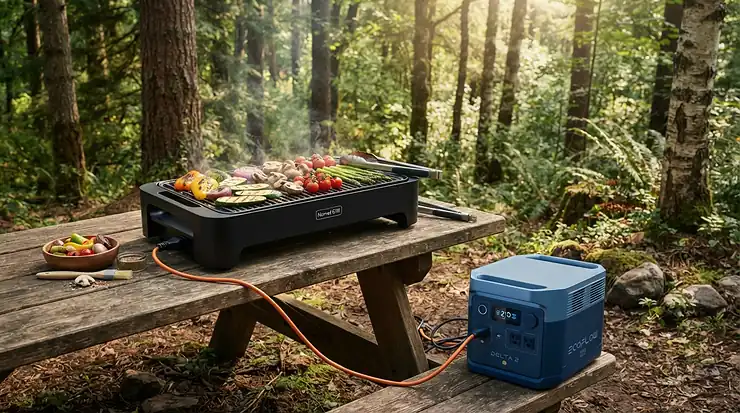
There’s a particular kind of despair that sets in when you’ve hauled a shiny new induction hob to a campsite, plugged it into what you thought was a perfectly capable battery, and watched the display flash an angry error code instead of boiling your morning coffee. It’s happened to more campers than the marketing photos would ever admit. A power station for camping cooking appliances isn’t just another gadget on the packing list — it’s the difference between a proper fry-up on day three and a sad bag of cold crisps because the “portable power bank” you bought turned out to be built for phones, not frying pans.
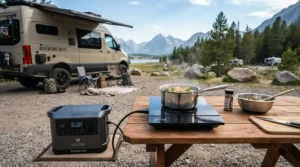
This guide cuts through the spec-sheet noise. We’ve dug into seven real, currently available units — from a genuinely budget-friendly option through to expandable, hookup-replacing setups built for a full family kitchen under canvas — and we’re going to talk honestly about what each one can and can’t cook. That matters more than it sounds: induction hobs typically draw 1,800-2,200W, and a huge number of “camping power stations” on Amazon simply cannot deliver that continuously, whatever the box implies. We’ll cover induction hob power draw specifically, high-wattage appliance compatibility more broadly, and how a power station stacks up as a campsite hookup alternative — whether you’re pitching a small dome tent or running a full family setup that would normally need a 16A hookup. By the end, you’ll know exactly which of these seven units matches your actual cooking habits, not just your budget.
Quick Comparison Table
| Power Station | Capacity | Continuous Output | Best For |
|---|---|---|---|
| EcoFlow Delta 2 | 1,024Wh (expandable to 3kWh) | 1,800W (2,200W X-Boost) | All-round induction cooking |
| Jackery Explorer 2000 v2 | 2,042Wh | 2,200W | Group camping trips |
| Bluetti AC200L | 2,048Wh (expandable to 8,192Wh) | 2,400W | Large tent hookup alternative |
| Anker SOLIX C1000 Gen 2 | 1,024Wh | 1,800-2,000W | Fastest recharge between meals |
| Bluetti AC180 | 1,152Wh | 1,800W (2,700W Power Lifting) | Mid-range value cooking |
| Jackery Explorer 1000 v2 | 1,070Wh | 1,500W | Lightest solo/couple pick |
| EcoFlow River 3 Plus | 286Wh | 600W (1,200W X-Boost) | Entry-level basics |
Looking at the spread here, the split between the top four and the bottom three is really a split between “can genuinely run an induction hob” and “can run a kettle and not much else.” The EcoFlow Delta 2, Jackery Explorer 2000 v2, Bluetti AC200L and Anker SOLIX C1000 Gen 2 all clear the 1,800W threshold that most single-ring induction hobs need, while the Jackery Explorer 1000 v2 and EcoFlow River 3 Plus are honestly better suited to kettles, toasties and slow cookers. If cooking is genuinely the whole point of your purchase, don’t let a lower price tag on the smaller units tempt you into a mismatch.
Found a favourite already? One tap on any highlighted model above takes you straight to current pricing and stock.
Top 7 Power Stations for Camping Cooking Appliances: Expert Analysis
1. EcoFlow Delta 2 — best all-rounder for induction hob cooking
The standout here is X-Boost, EcoFlow’s software trick that lets the inverter briefly exceed its own rated ceiling to start higher-draw appliances it wouldn’t otherwise touch. On paper the EcoFlow Delta 2 is rated at 1,800W continuous, but with X-Boost engaged it can coax a 2,000-2,200W induction cooktop into simmering (not searing) for a genuinely useful stretch. The 1,024Wh LiFePO4 battery pack recharges from empty to full in under an hour on mains power, which matters enormously when you’re trying to cook breakfast and lunch off one overnight charge.
What most buyers overlook is the expansion system: bolt on an EcoFlow extra battery and you can scale from 1,024Wh right up to 3kWh without buying a second unit, so a weekend trip and a week-long off-grid stay can use the exact same base station. This is the pick for a couple or small family who wants one box that handles a two-ring breakfast, a kettle, and a laptop charge without constantly doing mental arithmetic about wattage.
Aggregated reviewer sentiment across major outlets is consistently positive on the app’s charge-speed control and the X-Boost mode specifically for cooktops, though several reviewers note the cooling fan is audible under heavy induction load — worth knowing if you’re pitched close to a neighbouring tent.
Pros:
- ✅ X-Boost mode stretches compatibility to 2,000W+ induction hobs
- ✅ Expandable from 1,024Wh to 3kWh with extra batteries
- ✅ Full recharge from mains in under an hour
Cons:
- ❌ Fan noise becomes noticeable under sustained induction load
- ❌ X-Boost sacrifices full cooking power for compatibility
Prices for the EcoFlow Delta 2 typically sit in the £600-£750 range depending on bundle and current promotions — check current price before buying, as EcoFlow runs frequent seasonal offers. For the flexibility of near-full induction compatibility plus genuine expandability, it represents strong value for anyone who cooks properly rather than just boiling water.
2. Jackery Explorer 2000 v2 — best for group camping trips and hearty cooking
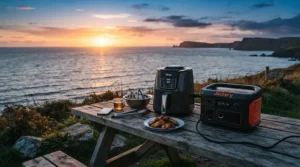
If you’re feeding more than two people, the standout feature is simply headroom: a 2,200W continuous output with a 4,400W peak surge, delivered from a 2,042Wh LiFePO4 pack that Jackery has managed to squeeze into a 17.5kg unit — noticeably lighter than most of its 2kWh-class rivals. In practice this means the Jackery Explorer 2000 v2 can run an induction stovetop and a griddle in the same session, which is exactly the kind of double-appliance cooking a group of four or five ends up wanting for a proper camp breakfast.
Field testers report powering string lights, a laptop, a Starlink dish and an induction stovetop across full weekends without anxiety about running dry, and real-world usable output tends to land around 1,740Wh once inverter losses are accounted for — still comfortably enough for two full days of hearty cooking.
The honest trade-off is that high-wattage cooking appliances drain this battery noticeably faster than lights or phone charging, so if your group genuinely plans to run the induction hob for hours rather than minutes, plan your recharge window (mains, car, or a pair of solar panels) accordingly rather than assuming the big number on the box means unlimited cooking.
Pros:
- ✅ 2,200W continuous output runs a griddle and induction hob together
- ✅ 17.5kg is genuinely lighter than most 2kWh-class rivals
- ✅ Emergency Super Charge mode refills from empty in under 2 hours
Cons:
- ❌ Not expandable — 2,042Wh is a hard ceiling
- ❌ Heavy cooking sessions drain the battery faster than the spec sheet implies
Expect to pay in the £900-£1,150 range depending on solar bundle and seasonal promotions, with prices moving around frequently — always check current pricing before ordering. For a group that wants one unit capable of a proper cooked breakfast for the whole tent, this is one of the strongest options currently available on amazon.co.uk.
3. Bluetti AC200L — best campsite hookup alternative for large tents
What sets the Bluetti AC200L apart from the rest of this list is sheer scalability: 2,048Wh as standard, but expandable up to a genuinely enormous 8,192Wh when you start stacking compatible extra batteries, alongside a 2,400W continuous output that’s the highest on this list. That combination is precisely what makes it a realistic campsite hookup alternative for a large bell tent or frame tent setup that would otherwise be relying on a 16A electric hookup (EHU) — the kind of pitch where you’re running an induction hob, a fridge, lighting and charging several devices simultaneously.
Comparative testing between the AC180 and AC200L found the larger unit successfully powered 43 out of 53 tested household-style appliances versus 39 for the smaller AC180, which is a meaningful real-world gap when your “campsite kitchen” starts looking like an actual kitchen.
The trade-off, unsurprisingly, is weight and bulk: this is not a unit you casually carry from car boot to pitch in one hand, and it’s overkill if you’re camping solo or as a couple. Reviewers consistently flag the higher solar input ceiling (up to 1,200W) as a genuine advantage for anyone planning extended off-grid stays without a mains recharge option nearby.
Pros:
- ✅ Expandable to 8,192Wh — genuinely rivals a 16A hookup
- ✅ 2,400W continuous output, the highest on this list
- ✅ Accepts up to 1,200W of solar input for extended off-grid stays
Cons:
- ❌ Bulky and heavy — not built for solo or lightweight trips
- ❌ Overkill (and overpriced) for anyone not running multiple appliances at once
Pricing typically sits in the £950-£1,300 range depending on configuration, with the base unit often available at the lower end and battery expansions pushing it higher — prices vary, so always check current listings. For large groups or family camping where a hookup pitch isn’t guaranteed, this is the closest thing to bringing your own EHU.
4. Anker SOLIX C1000 Gen 2 — fastest recharge for back-to-back cooking sessions
The headline feature is HyperFlash charging: a full recharge from empty in roughly 58 minutes on mains power, which is faster than almost anything else in this capacity class. With 1,024Wh of LiFePO4 capacity and up to 2,000W continuous output on the Gen 2 revision (2,400-3,000W surge, depending on source), the Anker SOLIX C1000 Gen 2 comfortably handles a 1,400-1,800W induction cooktop, a 1,200W electric kettle, or both in sequence without drama.
What that fast recharge actually buys you in practice is the ability to run the hob at breakfast, plug into a campsite mains point for under an hour while you’re out for a walk, and have a full battery again by lunch — genuinely useful if you’re at a site with hookup access but don’t want a permanent cable running to your tent.
At 11.3kg it’s noticeably more portable than the larger units on this list, and testers particularly rate the pure sine wave output for avoiding the buzzing or flickering that cheaper modified-sine-wave inverters can cause with sensitive electronics. The one recurring complaint across owner reviews is fan noise under heavier loads, echoed by multiple independent testers rather than a single outlier.
Pros:
- ✅ Full recharge in around 58 minutes via HyperFlash
- ✅ Pure sine wave output, clean enough for sensitive electronics
- ✅ Compact 11.3kg build for its output class
Cons:
- ❌ Fan noise is a recurring complaint under sustained heavy load
- ❌ No official capacity expansion on the Gen 2 revision
You’ll generally find the Anker SOLIX C1000 Gen 2 somewhere in the £400-£550 range, though it’s frequently discounted from a higher RRP — prices move around often enough that checking the current listing before buying is genuinely worthwhile. For campers who prioritise quick turnaround between charges over raw capacity, it’s one of the smartest buys on this list.
5. Bluetti AC180 — best mid-range value for two-ring cooking
The Bluetti AC180 earns its spot through Power Lifting Mode, a feature that temporarily boosts the standard 1,800W continuous output to 2,700W to cover the startup surge of higher-draw appliances like kettles and small induction hobs. With 1,152Wh of LiFePO4 capacity, it sits squarely between the entry-level units and the premium expandable models, and reviewers consistently note that the 0-80% charge in around 45 minutes via Turbo Charge is genuinely fast for the money.
In practical terms, this means the AC180 handles a single induction ring plus an electric kettle run back-to-back, provided you’re not trying to do both at the exact same moment — which, for most solo cooks or couples, is a perfectly realistic way to prepare a camp meal.
The honest catch is that unlike the larger AC200L, the AC180 has no expansion port, so if your capacity needs grow later (say, you upgrade from weekend trips to week-long stays), you’re looking at buying a second unit entirely rather than simply adding a battery. At 16-17kg it’s carryable but not light, and aggregated review sentiment across independent testers is broadly positive on build quality, with the main criticism centred on the app being Bluetooth-only rather than offering full WiFi remote control.
Pros:
- ✅ Power Lifting Mode boosts output to 2,700W for surge appliances
- ✅ Turbo Charge reaches 0-80% in around 45 minutes
- ✅ Strong mid-range value against similarly specced rivals
Cons:
- ❌ No battery expansion port if you outgrow 1,152Wh
- ❌ Bluetooth-only app, no full remote WiFi control
Expect a price range around £500-£650, though this model is regularly discounted from a higher original list price — check current pricing, as promotions shift frequently. For anyone who wants genuine two-appliance cooking without paying premium-tier money, this is a sensible middle ground.

6. Jackery Explorer 1000 v2 — lightest and quietest pick for solo or couple trips
Let’s be upfront about this one: the standout feature — under 22dB “Quiet Charging Mode” and an 11kg build — is genuinely the lightest and quietest 1kWh-class LiFePO4 unit widely available in the UK, but it is honestly not the pick if a full induction hob is your priority. The 1,070Wh battery pairs with a 1,500W continuous output (3,000W surge), which comfortably handles a travel kettle, a microwave, a single-ring hob rated below 1,500W, or a slow cooker, but a standard 1,800-2,200W induction hob will exceed its sustained output and won’t run properly, whatever the surge rating suggests — surge capacity helps with brief motor startups, not continuous high-wattage cooking.
What most buyers get right about this unit is recognising it for what it is: a superb lightweight companion for phones, laptops, lighting and lower-wattage cooking gear, rated for over 4,000 charge cycles thanks to its LiFePO4 chemistry, which works out to a genuine 10-year-plus lifespan under regular use.
Independent testers consistently rate it as the quietest and lightest unit in its class, which matters more than people expect when you’re trying to sleep twenty feet from your power station.
Pros:
- ✅ Genuinely the lightest 1kWh-class LiFePO4 unit at 11kg
- ✅ Under 22dB Quiet Charging Mode, ideal for close-quarters camping
- ✅ Rated for 4,000+ charge cycles, a decade-plus lifespan
Cons:
- ❌ Cannot run a standard 1,800-2,200W induction hob continuously
- ❌ Non-expandable capacity ceiling of 1,070Wh
Pricing typically lands around £400-£500, occasionally dipping lower during promotional periods — always verify current pricing before purchase. If your cooking needs are kettles and microwaves rather than a full induction setup, and portability genuinely matters, this remains one of the better lightweight options around.
7. EcoFlow River 3 Plus — most affordable entry point for basic camp cooking
At the budget end of this list, the EcoFlow River 3 Plus delivers 286Wh of LiFePO4 capacity and a 600W continuous output (1,200W with X-Boost engaged), squeezed into a 4.7kg unit that’s genuinely pocketable compared to everything else here. Being transparent about limitations rather than overselling them: this is not an induction hob power station, full stop — at 600W continuous, even with X-Boost pushing briefly to 1,200W, it will not sustain a genuine cooking appliance rated above roughly 1,000-1,200W, so a proper induction ring is off the table.
What it does very well is basic camp cooking adjacent tasks: a travel kettle under 1,000W, a rice cooker, phone and laptop charging, LED lighting, and topping up a 12V cool box, all while charging fully from empty in around an hour. Reviewers across multiple outlets consistently praise the sub-30dB noise level and the compact, unobtrusive design, describing it as one of the better-looking units in its price bracket rather than the usual utilitarian box.
For weekend campers whose “cooking appliances” mean a kettle and maybe a single-slice toastie maker rather than a full induction setup, it’s a genuinely sensible starting point rather than a compromise.
Pros:
- ✅ Recharges from empty to full in around an hour
- ✅ Sub-30dB operation, among the quietest units tested
- ✅ Compact 4.7kg build, easy to fit in a rucksack or car boot
Cons:
- ❌ Cannot run an induction hob — 600W continuous is the hard limit
- ❌ 286Wh capacity drains quickly under any higher-wattage load
Prices generally sit in the £200-£280 range, making it comfortably the most accessible unit here — as always, prices fluctuate, so check the current listing. Buy this if your camp cooking is genuinely light-duty; look elsewhere on this list if an induction hob is non-negotiable.
What Is a Power Station for Camping Cooking Appliances?
A power station for camping cooking appliances is a portable, rechargeable battery pack with a built-in inverter that converts stored DC power into standard 230V AC mains power, letting you run kettles, induction hobs, air fryers and similar appliances away from a fixed electricity supply. Unlike a basic power bank, it’s rated in both watt-hours (total energy stored) and watts (how much it can deliver at once) — and it’s that second figure that decides whether it can actually cook, rather than just charge a phone.
The Camping and Caravanning Club puts it plainly: you need the total wattage of everything switched on at once to stay under what your supply can provide, whether that supply is a campsite hookup bollard or a battery in the boot of your car. That single principle — total draw versus available output — is the entire game when shopping for a cooking-capable power station, and it’s why two units with near-identical battery capacity (measured in Wh) can behave completely differently in the kitchen department depending on their continuous wattage rating.

Induction Hob Power Draw Explained
This is worth its own section because it’s the single most common cause of buyer disappointment. Most portable single-ring induction hobs sold for camping and caravanning draw somewhere between 1,800W and 2,200W at their highest heat setting, though many offer adjustable power levels that step down to 500-1,000W for simmering. That top-end figure is what actually matters when you’re comparing it against a power station’s continuous output rating — not the peak or surge figure, which only covers brief startup spikes rather than sustained cooking.
Here’s the practical rule: if a power station’s continuous AC output is below roughly 1,500W, treat a full-power induction hob as off-limits, and check the hob’s lower power settings instead. Above 1,800W continuous, most single-ring induction cooking becomes realistic, and double-ring hobs or simultaneous kettle-plus-hob use generally need 2,000W or more of headroom. Reviewers on outdoor and camping forums consistently flag peak wattage as the most misleading spec on the box — always check the continuous rating first, and treat the peak figure as a bonus rather than a promise.
High-Wattage Appliance Compatibility
Beyond induction hobs, several other common camp kitchen appliances sit in the same demanding wattage bracket, and it’s worth knowing the numbers before you pack them. A standard travel kettle typically draws 800-1,000W, while a full-size domestic kettle can pull 2,000-3,000W — well beyond what any of the units on this list can sustain, which is exactly why a dedicated low-wattage travel kettle is worth packing regardless of which power station you choose. Electric griddles and mini ovens generally sit around 1,000-1,500W, air fryers around 1,200-1,800W, and a coffee machine’s startup surge can briefly spike well above its running wattage.
The practical takeaway is that running two mid-to-high wattage appliances at once — say, an induction ring and an air fryer — will comfortably exceed the continuous rating of every unit on this list except the Bluetti AC200L and, briefly via X-Boost, the EcoFlow Delta 2. Stagger your cooking sequence rather than assuming you can run everything simultaneously, and always add roughly 20% headroom to your calculations to account for conversion losses in the inverter itself.
Power Station for Group Camping Trips: Sizing Up for the Whole Site
Cooking for a group changes the maths considerably. A solo camper or couple boiling a kettle and running a single induction ring for twenty minutes at a time can get by comfortably on 1,000-1,200Wh of capacity across a weekend. A group of four to six people cooking two proper meals a day — breakfast and dinner, each involving 45-60 minutes of induction cooking plus a kettle — will realistically draw through 1,500-2,500Wh per day once you factor in lighting, phone charging and the inevitable coffee machine somebody insists on bringing.
This is exactly why the Jackery Explorer 2000 v2 and Bluetti AC200L earn their place on this list specifically for group trips: their higher continuous output supports running an induction hob and a second appliance simultaneously, while their larger capacity means you’re not recharging mid-holiday just to get dinner cooked. If your group trip runs longer than a weekend without reliable mains access, pairing either unit with a portable solar panel is genuinely worth the extra outlay — both accept solar input high enough to make a meaningful dent in daily consumption during a sunny British summer (rare as those days can be).
Power Station for Large Tent Electric Hookup Alternative
Large bell tents, frame tents and multi-room family tents increasingly come with the option of running mains power through a hookup point, but not every pitch offers one, and not every campsite has hookup pitches available when you book late. This is where a genuinely capable power station starts to function as a real electric hookup alternative rather than a compromise.
The comparison isn’t perfect — a UK campsite’s 16A hookup delivers 3,680W continuously for as long as you’re plugged in, which no portable power station can match indefinitely without a generator or an enormous solar array. But for the realistic pattern of large-tent camping (cooking in bursts, lighting in the evening, charging devices overnight), the Bluetti AC200L‘s expandable capacity and 2,400W output get remarkably close, particularly across a long weekend rather than an open-ended stay. The genuine advantage over a hookup pitch is flexibility: you’re not tied to hookup-only pitches, which are often pricier, smaller, and booked up first at popular UK sites during peak season.
Campsite Hookup Alternatives Compared
| Option | Continuous Power Available | Best For |
|---|---|---|
| 10A campsite hookup | ~2,300W | Budget pitches, basic appliances |
| 16A campsite hookup | ~3,680W | Full family cooking setups |
| Bluetti AC200L (power station) | 2,400W (expandable) | Non-hookup pitches, flexibility |
| EcoFlow Delta 2 (power station) | 1,800-2,200W | Smaller groups, non-hookup pitches |
As Practical Caravan explains, the standard formula for working out what a hookup can handle is volts multiplied by amps — 230V x 16A gives you 3,680W on a full UK hookup, dropping to 2,300W on the more common 10A supply found at many smaller sites. Looking at the numbers side by side, a genuinely capable power station like the Bluetti AC200L actually beats a 10A campsite hookup on raw continuous wattage, which is a slightly startling realisation the first time you do the sums. The trade-off, of course, is that a hookup recharges nothing and simply supplies indefinitely, whereas a power station is a finite tank you need to top up — so the real decision isn’t “which is more powerful” but “which better matches how long you’re staying and whether mains access is guaranteed.”
How to Choose a Power Station for Camping Cooking Appliances
- Check the appliance’s continuous wattage, not just its name. A “1800W induction hob” needs a power station rated at 1,800W continuous or higher, plus a safety margin — don’t rely on peak or surge figures.
- Multiply your group size by realistic cooking time. Estimate total daily Wh consumption by adding up appliance wattage times hours of use, then add 20% for inverter losses, as recommended by multiple independent testers.
- Decide whether expandability matters. If you might camp longer or in bigger groups later, an expandable platform like the EcoFlow Delta 2 or Bluetti AC200L avoids buying twice.
- Weigh portability against capacity honestly. A 2kWh unit that never leaves the car boot because it’s too heavy to carry to the pitch isn’t actually solving your problem.
- Check the recharge method and speed. Fast mains recharge (like the Anker SOLIX C1000 Gen 2’s 58-minute HyperFlash) matters more than most buyers initially assume, especially on multi-day trips.
- Confirm LiFePO4 battery chemistry. It handles far more charge cycles than older lithium-ion technology and degrades far more gracefully over years of camping use.
- Read aggregated review sentiment on fan noise. Several strong performers on this list draw genuine criticism here, and it’s rarely mentioned on the product listing itself.
Practical Usage Guide: Setup, First Cook and Avoiding Trips
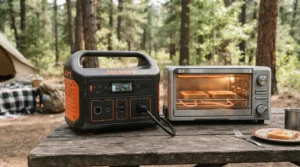
Getting the most from a new power station starts before you even switch on the hob. On your first trip, run a single low-wattage appliance first — a phone charger or a light — to confirm the unit is charging and discharging correctly before committing dinner to it. When you do move to cooking, start the induction hob on its lowest power setting and step up gradually, watching the power station’s display for its live wattage draw; most units show this in real time, and it’s the fastest way to learn your actual margin before you trip an internal overload protection.
A common mistake in the first 30 days of ownership is running the induction hob and a phone charger, a light and a coffee machine simultaneously, then being surprised when the unit cuts out — remember that every port draws from the same shared wattage ceiling. Get into the habit of fully recharging the power station the night before a cooking-heavy day rather than topping it up piecemeal, since partial charges on LiFePO4 batteries are perfectly safe but leave less usable headroom for that morning’s breakfast rush. Finally, store the unit somewhere dry and moderate in temperature between trips; extreme heat inside a stationary car boot is one of the more common (and avoidable) causes of premature battery degradation.
Real-World Scenarios: Matching Stations to Camping Styles
Consider a couple doing weekend wild camping trips, cooking a simple one-pot dinner and porridge each morning on a single induction ring: the Bluetti AC180 or Jackery Explorer 1000 v2 (if the hob’s lower power setting is used) covers this comfortably without unnecessary weight or expense. Now picture a family of five on a week-long staycation in a large frame tent, running an induction hob, a kettle, phone chargers and evening lighting daily: the Jackery Explorer 2000 v2 matches this pattern well, with enough headroom that cooking two things at once doesn’t become a negotiation.
Finally, imagine a group of eight friends sharing a large pitch for a week without guaranteed hookup access, cooking substantial meals nightly and running a cool box continuously: here the Bluetti AC200L‘s expandable capacity genuinely earns its higher price, because the time saved not rationing power compounds across a week-long stay in a way a smaller unit simply can’t match. The common thread across all three scenarios is matching realistic daily wattage consumption to the unit’s continuous output rather than simply buying whichever has the biggest number on the box.
Common Mistakes When Buying a Power Station for Camping Cooking
The single most frequent mistake is buying based on the surge or peak wattage figure rather than the continuous rating — a station advertising “3,000W peak” might only sustain 1,500W, which won’t run a proper induction hob no matter how impressive the headline number looks. A close second is underestimating total capacity needs: buyers frequently size for a single meal rather than a full trip, then find themselves rationing power by day two.
Another recurring error is ignoring noise levels entirely until arriving at the campsite, only to discover the chosen unit’s cooling fan is louder than expected at close range — something aggregated reviewer feedback flags repeatedly for several models on this list. Finally, many buyers skip checking whether the power station’s ports can run simultaneously at full combined load, assuming each socket operates independently, when in reality every output shares the same inverter ceiling.
Long-Term Cost and Maintenance
LiFePO4 (lithium iron phosphate) batteries, used in every unit on this list, are rated for 3,000-4,000+ charge cycles before capacity noticeably declines, which works out to well over a decade of regular weekend camping use. According to Wikipedia’s overview of the chemistry, LiFePO4 cells offer notably better thermal stability than older lithium-ion (NMC) chemistry, which typically manages only 500-800 cycles before degrading — the practical upshot being that every station reviewed here should genuinely outlast several years of regular seasonal use rather than needing replacement after a couple of summers.
In terms of total cost of ownership, the higher upfront price of an expandable platform like the EcoFlow Delta 2 or Bluetti AC200L is worth weighing against buying a second, separate unit later if your capacity needs grow — expansion batteries are almost always cheaper per Wh than a whole new base unit. Maintenance itself is minimal: keep the unit charged to roughly 50-80% during long storage periods between trips rather than leaving it fully depleted or fully charged for months, and give it a full charge cycle every few months if it’s sitting unused over winter.
Safety, Regulations and Campsite Compliance
Portable power stations use sealed lithium battery packs, and while the UK has no dedicated consumer legislation specifically for camping power stations, the Health and Safety Executive’s guidance on battery energy storage sets out the broader principles that responsible manufacturers build into their battery management systems — protection against overcharge, overheating and short circuit being the baseline you should expect from any reputable brand on this list. Always use the manufacturer’s own charging cable and avoid third-party adapters of unknown quality, since inconsistent charging rates are one of the more common causes of premature battery wear.
If you’re using a power station alongside a genuine campsite hookup rather than instead of one, never connect the two simultaneously through a shared extension lead, and always run outdoor-rated, CE-marked cabling if you’re bridging any distance between the unit and your appliances. Most campsites are relaxed about power stations since they carry none of the fire risk associated with petrol generators, but it’s worth checking individual site rules if you’re planning to charge via solar panels staked into shared ground, as pitch boundaries can be a genuine point of contention during busy weekends.

Frequently Asked Questions
❓ Can a power station run an induction hob while camping?
❓ What size power station do I need for camping cooking?
❓ Is a power station cheaper than a campsite electric hookup?
❓ How long does a power station last for camping cooking appliances?
❓ Do power stations work as a campsite hookup alternative for large tents?
Conclusion
Choosing a power station for camping cooking appliances really comes down to being honest about your actual cooking habits rather than chasing the biggest battery on the shelf. If induction cooking is the whole point of the exercise, the EcoFlow Delta 2, Jackery Explorer 2000 v2, Bluetti AC200L and Anker SOLIX C1000 Gen 2 are your realistic shortlist — each handles genuine high-wattage cooking, just at different capacities and price points depending on group size. If your idea of camp cooking is a kettle, a slow cooker and the occasional single-ring simmer, the Bluetti AC180, Jackery Explorer 1000 v2 or EcoFlow River 3 Plus will save you weight, money and unnecessary capacity you’d never actually use.
Whichever direction you go, the single most valuable thing you can do before buying is check the continuous wattage rating against your specific appliance’s actual power draw — not its name, not its surge figure, and not what the box implies. Get that one number right, and every camp breakfast from here on genuinely gets easier.
Recommended for You
- Power Station For Family Camping: 7 Best Picks (2026)
- Power Station For Medical Equipment Home Backup: 7 Best Picks (2026)
- Power Station For Whole House Backup: 7 Best UK Picks (2026)
Disclaimer: This article contains affiliate links. As an Amazon Associate, I earn from qualifying purchases. If you purchase products through these links, we may earn a small commission at no additional cost to you.
✨ Found this helpful? Share it with your friends! 💬🤗
